
Chris Gaffney

By Chris Gaffney, Georgia Tech Supply Chain and Logistics Institute and Zaid Duwayri, supply chain advisor.
During Chris’s years at Coca-Cola, one recurring question was how long it took for new information to make its way into a supply chain decision. At one point, the answer was measured in weeks. A lot could happen between learning that conditions had changed and doing something about it.
That delay is one reason we are interested in what AI might do for supply chains. Digital tools can shorten the time between sensing a change and deciding how to respond. Robotics and other physical technologies can shorten the time between a decision and its execution. But a faster decision is only valuable if the organization has decided what a good decision looks like.
In the first conversation of our new SCL webinar series, we asked a deliberately provocative question: If AI runs more of the supply chain, what is left to manage? Our answer begins with a familiar idea. The purpose of the supply chain has not changed. The way we organize people, processes, and decisions around that purpose may change considerably.
As AI takes on more sensing, analysis, and routine decision-making, management does not disappear. It moves up a level, from making individual decisions to designing the objectives, boundaries, and decision systems within which those decisions are made.
The destination is familiar
Set AI aside for a moment. What would we want from an excellent supply chain? It would sense demand and changes in the environment early, anticipate what might happen next, coordinate supply with demand, make decisions across functions, execute reliably, adapt when conditions change, and learn from the results. We have been working toward that kind of system for decades.
The measures are familiar too: service, cost, cash, growth, resilience, and responsibility. Better technology may help us improve several of these at once, but it will not make every tradeoff disappear. A machine still has finite capacity. Inventory still uses cash. A product moving from Atlanta to Dallas still takes time. Suppliers and customers remain people and organizations with their own constraints.
This is the point of starting with the supply chain rather than with an AI tool. We need to know what we are trying to improve before we choose which decisions to automate. A better forecast has limited value if a supplier cannot respond, a plant cannot add capacity, or a customer allocation rule has never been agreed upon.
The time between knowing and acting is shrinking
Supply chain technology has advanced in waves. Enterprise systems connected information. Sensors improved our ability to see what was happening. Forecasting, simulation, and optimization improved our ability to anticipate and evaluate choices. Generative AI has made some of that information and analysis easier to access. Agents are beginning to coordinate steps in a workflow, while robotics and computer vision extend automation into physical operations.
Each wave removes some friction, but adoption is uneven. I remember when RFID was going to change everything quickly. It took much longer to reach useful applications than many expected. Even today, some companies have not fully realized the value of earlier investments in data, planning, and integration. That matters when we talk about what is possible with AI and what a company can operate reliably at scale. Those are different questions.
Integrated business planning offers a practical example. For years, companies organized decisions around a monthly calendar: collect forecasts, reconcile supply and demand, meet, approve a plan, then act. Some can now pull in a new promotion or supply disruption, recalculate options, and circulate an updated plan much faster. The opportunity is to respond while the information is still useful. Whether the resulting action can happen immediately depends on capacity, partners, and clearly assigned decision rights.
If an allocation decision is needed today, who decides which customer receives the limited product? Who tells the other customer? What happens to margins, future demand, and the supplier’s schedule? Faster analysis makes those questions more urgent. It does not answer them on its own.
Three systems have to move together
The framework we used in the webinar separates the physical system, the management system, and the intelligence system. The physical system includes suppliers, plants, inventory, warehouses, transportation, and customers. The management system includes policies, planning routines, metrics, roles, and decision rights. The intelligence system includes people, data, models, and increasingly AI agents that help sense, interpret, recommend, and act.
AI is moving fastest into the intelligence system. That puts pressure on the management system. A company cannot take a much faster, more capable intelligence layer and assume that a meeting calendar, escalation path, and organizational structure designed years ago will still be the best way to use it. It may also discover that some physical design choices, such as the amount or location of inventory, deserve a fresh look.
The physical system can change, but it does not vanish. A decision that looks sound in a model still has to work in a plant, on a truck, and with partners whose systems may be less mature. This is why management design and technology adoption have to advance together.
Three decisions show where management moves
Consider a replenishment decision. Today, a planner often reviews a forecast, judges the inventory position, and approves an order. With better demand sensing and connected systems, routine decisions within defined limits may happen much faster. The planner’s work then shifts toward setting policy with colleagues, checking assumptions, deciding when to intervene, and learning from results. “Exception management” alone is too narrow a description; AI will also get better at handling some exceptions.
Now consider a supplier disruption. A system might identify the problem earlier, compare alternative sources, revise production and transportation plans, and show the effect on customers. The cheapest alternative might carry a labor practice concern, or a preferred supplier may be unable to move as quickly as the model assumes. We must decide which outcomes and obligations matter before delegating the choice. The system needs those values expressed clearly, and someone must remain accountable for the outcome.
A fulfillment center creates a different test. Sensors, computer vision, and mobile robots could help a team detect congestion, adjust work releases, and route equipment around a problem. Here, a digital decision can put a person in the path of a physical machine or push a shift past a safe workload. Autonomy should be bounded by operational and safety rules, with people able to intervene. These are scenarios to design and test, not claims that most facilities already run this way.
Managing the decision system is real management
The center of management work moves from touching every routine choice toward designing and governing how choices get made. Leaders have to establish objectives, define which decisions a system may take on its own, decide where approval is required, and monitor whether the results match the intent. They also have to look beyond the first result. A quick allocation might protect this week’s service level while weakening a customer relationship or creating a bottleneck somewhere else.
This work still requires deep supply chain knowledge. As AI takes on more of the analysis, and eventually more of the decisions, leaders may touch fewer individual decisions, but they will carry greater responsibility for the system making them. They need to understand why a recommendation was made, when its assumptions no longer hold, and whether the system is producing the outcomes the organization intended. You cannot govern a decision you do not understand.
It also raises a development question. Many experienced supply chain leaders built judgment by making thousands of everyday decisions and living with the results. If software takes over more of those decisions, how will the next generation develop that judgment? Companies will need to make learning part of the operating model: give people access to the reasoning behind recommendations, let them test scenarios, and review outcomes with those who know the operation.
The workforce deserves a straight answer
The anxiety around AI is reasonable. At industry conferences, professionals hear what technology may do but often hear little about how their work will change. Leaders may not have a complete answer, and some jobs will change more than others. Silence leaves employees to draw their own conclusions.
A leadership team can say what it knows now. Is the current goal to help people do their jobs better, to automate particular tasks, or both? What work is under review? What training and opportunities will be available? Those answers can evolve. An honest account of the work underway is more useful than a confident promise no one can support.
Practitioners have a role as well. Use the tools available within your organization’s rules, ask for training, and bring your knowledge of the process into the design conversation. The people who understand why a decision works in the real world will be essential to building systems that work there too.
Where the series goes next
This first episode focused on the system. AI may help us make better decisions sooner and act on them faster, while the supply chain’s purpose and physical limits remain. Managing that future means setting the objectives and boundaries, developing the people, and learning from what the system actually does.
Our next conversation turns to strategy. If competitors can buy access to similar AI tools, where will supply chain advantage come from? We think the answer will have much to do with design, judgment, and the ability to make these technologies work in a specific business. We would welcome the examples and questions you want us to examine.
Related Webinar
This is a companion article to Part 1 of The AI-Managed Supply Chain: What Changes, What Doesn't, and What Leaders Must Do. View the related webinar on our YouTube channel.
Chris Gaffney
By Chris Gaffney, Managing Director of the Georgia Tech Supply Chain and Logistics Institute and a former Vice President of Global Strategic Supply Chain at The Coca-Cola Company and Bill Eidenire, former operations and transformation leader at The Coca-Cola Company and UPS.
A few weeks ago I sat down with a friend who works in the defense industry. His role gives him current visibility into the contractors now being asked to rapidly scale production of munitions and interceptors after a season of heavy use. I knew from his hands-on background he would have a point of view that would validate or challenge my perceptions. What I got instead was a conversation any plant manager would recognize and was quite familiar with my food and beverage experience. In sophisticated and automated operations, it still comes down to having qualified people who are engaged in a process-disciplined culture.
He described operations that depend on specific people more than solely on documented processes. Sequencing steps marked with tape on the tooling. Machine settings carried on a folded sheet of paper in an operator's back pocket. Tools modified by hand over the years, with the changes never finding their way back into the work instructions. He walked through the standard surge playbook familiar to me, adding a third or fourth shift and moving the most experienced operators to nights to anchor it. Then he smiled and said that third shift is where the magic happens. He meant it with affection and a wince at the same time.
None of this was foreign to me. I spent my early career in plant and distribution operations at Frito-Lay and then 25 years in the Coca-Cola system, and I have seen every one of these patterns. So I tested the conversation with several people in my network, most of them Coca-Cola alumni, plant managers and continuous improvement leaders, and one with a deep project management background. They all landed in the same place. The complexity is real. The people dealing with it deserve empathy rather than criticism, because they are being asked to do something genuinely hard: rebuild years of inventory in months, with supply chains built for a different era, often without the contracts that would let them invest.
How We Got Here, Honestly
The defense industrial base did not get fragile through negligence. It got fragile through rational decisions, made year after year, that optimized for a demand pattern that had been reduced across a long timeframe.
Consider the Tomahawk cruise missile. CSIS reports that orders averaged 86 missiles a year over the past decade, so recent production ran under 200 a year even though the manufacturer's capacity goal exceeds 1,000. Nobody sized that production schedule and capacity plan incorrectly. It was sized to the order book. The same logic explains the single sourcing that is common in the defense industry. Peacetime volumes could not sustain two qualified suppliers of anything specialized, so awarding the work to one kept one alive. Lean and just-in-time practices, imported from those of us in commercial industry, minimized carrying costs exactly as designed.
CSIS estimates it will take three or more years to restore inventories of the interceptors and missiles most heavily used in recent operations. When the National Defense Industrial Association surveyed its members about barriers to surging capacity, the top answer was not machines or floor space. Fifty-six percent said they had no contract vehicle to justify expansion, and 41 percent pointed to the technical workforce. Suppliers have been burned before, and the deeper tiers reach into global sources, including China, for materials and components most of us would assume were made here.
Some of the gaps are genuinely surprising. The United States has not produced its own TNT since 1986. The primary explosive fill for artillery shells has come entirely from overseas for nearly four decades. A new plant is finally under construction in Kentucky, fully funded and politically championed, and its estimated completion is early 2029, roughly four and a half years after the contract was signed. Meanwhile, seven of the most heavily consumed missiles trace back to two prime contractors and essentially one solid rocket motor industrial base, with several programs drawing on the same small labor markets in places like Camden, Arkansas.
Reasons for Optimism, and Lessons from Other Ramps
This is a challenging situation, but there is light at the end of the tunnel. Since January the Pentagon has signed multiyear framework agreements intended to lift Patriot PAC-3 production from roughly 600 to 2,000 interceptors a year over seven years, THAAD from 96 to 400, and Tomahawk toward more than 1,000. Congress carved out dedicated funding for the solid rocket motor base. And the Army's 155mm artillery ramp, while short of its goal, has proven something useful: spreading production across several smaller facilities has delivered, with new propellant plants opening ahead of schedule, while the single large facility built on untested equipment has struggled. Spreading the wealth to additional producers has started to build resilience.
My friends pushed the conversation toward a question I think holds the real value: where have other industries ramped capacity under pressure, and what did they learn? Three cases stand out to me, and together they carry one message.
You can't build sustainable capacity without committed demand.
The largest domestic surgical mask maker offered in January 2020 to reactivate four mothballed N95 lines, and the federal government showed little interest. They were able to ramp up production a few months later when the Texas National Guard helped staff them to 24-hour operation. Rational suppliers do not build capacity against urgency alone. Operation Warp Speed proved the other side of the same coin: advance purchase agreements signed before vaccine trials even finished, priority ratings on materials, government staff embedded at manufacturing sites, and regulatory steps run in parallel rather than in sequence.
Then there is UPS, a story from our own industry. After the 2013 peak season failure left an estimated two million packages undelivered on Christmas Eve, UPS spent half a billion dollars on trucks, sorting capacity, and people. Delivery performance recovered, and earnings cratered when forecast volumes failed to appear. The lasting fix took years: disciplined demand shaping with retailers, collaborative forecasting, and automated capacity that was still coming online in 2018.
Efficiency won't get you there.
Surge capacity is a different investment from efficient operations, and even a company with money, urgency, and full control of its own network bought it in years, not quarters.
That is the common denominator across every case, and it was the project manager in the group who put a fine point on it. The schedule is set by the slowest constraint, whether that is a chemical plant, a qualification test, a hiring funnel, or a training curve. The solutions that actually work are the ones that buy time back: demand certainty that starts the clock sooner, doing in parallel what tradition does in sequence, and managing demand honestly while capacity catches up.
What We Would Do: It Still Comes Down to People
Underneath the contracts and the chemistry, the constraint I keep coming back to is the one my friend led with that matched our experience at Coca-Cola. These are person-centric operations, and the surge playbook puts them at risk at the worst possible moment. We learned at Coca-Cola that around-the-clock operations do not add capacity in a straight line, especially in less automated environments. The research agrees, showing night shifts running measurably behind days in manual work while highly automated lines show little difference. Moving your best operators to third shift while handing first shift to trainees stretches your thinnest asset, which is experienced judgment, exactly when quality margins are tightest.
So before adding a shift, I would count the operations that only one person can run to spec. Most plants I worked with never thought to do this math. I would treat the ramp itself as the opportunity because your best people are demonstrating everything they know every day while they train others. Put cameras on the setups and build the digital work instructions now, not after the veterans retire. I would open a no-fault “library book amnesty” window for operators to bring the taped sequences and pocket settings into the documented process, because those informal practices are the real process, and punishing their discovery only keeps them hidden.
And I would hold one line firmly: no single person should ever be the sole verifier of safety-critical test results. I have seen what happens when one person's “read” of a gauge becomes the only record that a batch was in spec. The mistake does not surface until the product is already in the market, and by then it is not a documentation problem anymore.
Finally, we as supply chain professionals should give contractors some flexibility. Defense suppliers are heavily audited, and their quality image is deserved, but specs for specs' sake are a genuine bottleneck. The pharmaceutical industry figured this out: classify which parameters actually carry the product's reliability and protect those absolutely, then flex what is merely habit. Do that classification with the senior operators in the room, because they know which settings matter and which ones are folklore.
Requirements that carry reliability are sacred. Requirements that carry only tradition are negotiable, and a surge is the right time to know the difference. That classification should produce something durable, not a conversation everyone forgets by the next shift: a change-controlled, plant-floor document, owned by the senior operators who built it, that travels with the work instructions and gets revisited every time the line changes hands.
The people inside these plants are not the problem. They are the asset, and in many cases they are the process. If we respect that, preserve what they know, and give them the certainty and the flexibility to do their jobs, a rapid ramp-up can succeed.
A final question: Do you understand your process dependencies on key players and single operators? If you aren't comfortable with a single-source supplier, why would you be comfortable with your business continuity hinging on a single individual?

Chris Gaffney
By Chris Gaffney, Managing Director of the Georgia Tech Supply Chain and Logistics Institute and a former Vice President of Global Strategic Supply Chain at The Coca-Cola Company.
Early in my career, AJC International was my introduction to the global frozen food trade. That is where I first got close to one of the stranger flows in global food: chicken feet, frozen solid and shipped across oceans to markets where they are a delicacy, not a byproduct. Nobody in that business thinks twice about it. But the whole model rests on one thing. You can hold protein at a precise temperature, without a break, across a plant, a port, a vessel, and the final mile. Lose the temperature for a few hours and you do not have a shipment. You have a claim. And nobody in the food trading business wants that.
So when my wife handed me Frostbite: How Refrigeration Changed Our Food, Our Planet, and Ourselves, she knew exactly what she was doing. She knows how much I geek out on this stuff. Nicola Twilley's history of the cold chain won the James Beard Award, and it reads like a beach read because it is built on stories and real characters, not jargon. I kept recognizing the plot. I have spent a career around protein, juice, and global cold chains, and this book is the long version of how that world got built.
How We Got Here
Twilley starts before refrigeration existed at all. For most of human history, the only way to keep food past its natural life was to change it. Salt it, smoke it, pickle it, ferment it. Flavor was not a bonus. It was the cost of survival.
Then she introduces Frederic Tudor, a Boston merchant who in the early 1800s decided he could ship frozen lake ice to the Caribbean. He failed, over and over, before it worked. Once it did, an entire industry grew up around cutting, storing, and moving naturally occurring ice, decades before anyone could manufacture cold on demand.
That sequence matters. Ice in a rail car was brute force. It proved there was demand to move perishable food across distance and time. But brute force was not the real innovation. It demonstrated the demand and created the bridge to mechanical refrigeration. The real one was mobile mechanical refrigeration, and it is worth knowing who delivered it.
The Innovators Rarely Get the Spoils
One of the harder lessons in this history is that the people who create the breakthrough are often not the ones who receive the recognition. The people who invent the breakthrough idea often are not the ones who get celebrated for it.
Frederick McKinley Jones built the first practical mobile refrigeration unit in the late 1930s. His work is the reason a refrigerated truck, rail car, ship, and eventually a reefer container with a genset became possible. He held more than sixty patents and co-founded the company that became Thermo King. And yet the recognition came a generation late. He was the first African American admitted to the American Society of Refrigeration Engineers, in 1944. He received the National Medal of Technology in 1991, thirty years after he died. The medal went to his widow at a Rose Garden ceremony. The man who rewired the global food supply spent most of his life uncelebrated relative to what he changed.
He was not the only one. John Gorrie, a physician, patented mechanical ice making in the 1850s, was ridiculed, could not raise the capital, and died broke and largely forgotten. Different men, same lesson. The breakthrough and the reward do not always land on the same person.
For anyone teaching or leading in this field, that is worth sitting with. We celebrate the optimization. We rarely trace it back to the engineer who made it possible.
Where the Supply Chain Lessons Live
This is the part of the book I would put in front of every student. Twilley keeps making one point from a dozen angles. Refrigeration did not just preserve food. It redesigned the network.
The Chicago stockyards are the clearest case. Once you can refrigerate a rail car, you no longer ship a live animal to the city and slaughter it there. You slaughter near the source and ship only the parts people eat. That one change collapsed cost, concentrated an entire industry into a few cities, and pulled population with it. The local butcher who knew the farmer and the animal gave way to a centralized, disassembly line model. Long haul trucking did the same thing again at a different scale.
Globalization did it a third time. Each time, the breakthrough did not just lower cost. It moved where the value was created and who captured it.
The smaller examples hit just as close to home, and they carry a lesson most readers will recognize from their own grocery cart. Refrigeration lets a business separate when food is harvested from when it is sold. That is postponement, and where you hold the inventory is a network design decision.
Watch how differently three products solve it. Oranges and apples are stored close to harvest, because the fruit is stable once it is cooled and the freight is cheaper after processing. I have stood in the juice tank farm in Auburndale, Florida, and the sheer scale was hard to describe. It looked like the final scene in Raiders of the Lost Ark, the government warehouse that just goes on forever. That is what it takes to make a glass of orange juice taste the same in January as it does in June, in a country where oranges grow in two states.
Bananas go the other way. They are picked green, moved green, and held in ripening rooms close to the consumer, where the gas mixture is tuned to the purchase and consumption occasion. Same physics, opposite network. The decoupling point moved because the product and the customer demanded it.
The postharvest science behind that is just as striking. Twilley notes that two apples from opposite sides of the same tree can need different cooling and atmosphere to stay sellable ten months after picking. The supply chain was no longer simply reacting to time and perishability. It could begin to optimize around these variables.
What the Network Bought Us, and What It Cost
Here is where the book earns its subtitle, and where I would add a note of caution.
Refrigeration bought us scale, lower cost, and food access no generation before us has had. It also bought us sameness. The same design choices that put apples in your store in July narrowed what gets grown. It is hard to contemplate that there are varieties of bananas and apples most of us will never taste, and tomatoes bred to survive a truck rather than to taste like anything. In many cases, we traded flavor and variety for availability and consistency, often without recognizing the tradeoff.
It bought us concentration risk, as production rolled up into fewer regions and fewer hands. It bought us rural decline, as people followed the rail line and the warehouse instead of the farm. And it carried a human cost, paid largely by the workers, many of them women and minorities, who staffed the packing houses and the cold docks and rarely got named in the story.
And there is the newest cost. The global cold chain is now one of the largest contributors to climate change, through the energy it consumes and the refrigerant gases that leak from it. As the developing world races to build the same system we built a century ago, Twilley asks the question our field should be asking too. Not just whether we can keep scaling this, but whether we should, and at what point the efficiency stops being worth the hidden cost.
The Monday Morning Takeaway
If you work in supply chain, here is what I would want you to carry out of this book.
Network design is real work, and it is roughly half the opportunity. Where you put plants, warehouses, and lanes sets the cost structure everything else lives inside. Get it right and you win for years.
But that design is not durable. Frostbite makes that point at scale, over and over. The refrigerated rail car did not improve the meatpacking network. It rebuilt it and moved an industry to different cities. Mechanical refrigeration did not improve the ice trade. It made it obsolete inside a generation. Every optimized network in this book was eventually reset by an innovation in processing, storage, or logistics that changed cost, quality, and service all at once, and usually faster than the incumbents expected.
So design your network as well as you can. Then assume it has a shelf life. The next breakthrough is already being built by someone who is not waiting for you to catch up. The job is not to declare the network finished. It is to keep watching for the technology or capability that will change the economics and force the next design.
Pick up Frostbite as you head out on your next break. It reads like a story because it is one. It also happens to be the story our profession is still living inside.

Pictured Left to Right: George Lan, Ashwin Pananjady, Yao Xie, Katya Scheinberg, Johannes Milz, Joel Sokol, and Juba Ziani
Georgia Tech's H. Milton Stewart School of Industrial and Systems Engineering (ISyE) is launching a new undergraduate concentration in Artificial Intelligence and Operations Research (AI/OR) in Decision-Making this fall, formalizing a comprehensive AI and machine learning curricula. The concentration brings together machine learning, optimization, online decision-making, and responsible AI into a structured pathway for students who want to specialize at the intersection of artificial intelligence and operations research; fields that have always been deeply connected and are increasingly inseparable in industry practice.
The concentration was developed under the leadership of A. Russell Chandler III Chair and Professor Guanghui (George) Lan, who served as the named lead on the proposal to the Institute Undergraduate Curriculum Committee, working with a group of ISyE faculty across the AI, optimization, and statistics areas.
The curriculum draws on a portfolio of seven undergraduate courses taught by ISyE faculty, spanning the mathematical and algorithmic foundations of modern AI. Among them is Foundations of AI for Decision Systems, developed and taught by Assistant Professor Johannes Milz, which opens the black box of large language models. Students learn what is actually happening inside the AI systems they use every day from tokenization and attention mechanisms to the training processes that shape model behavior. They will graduate able to explain why outputs vary, why models hallucinate, and when an AI response should be trusted. As Milz has observed, students who enter thinking of AI outputs as either right or wrong leave the course recognizing that hallucination is not a random error but a predictable consequence of how these systems work, a more durable form of AI literacy than any tool-based introduction could provide.
Foundations of Modern Data Science, taught by Gerald D. McInvale Early Career Professor and Assistant Professor Ashwin Pananjady, takes a "looking under the hood" approach to data science — developing the probabilistic modeling, statistical inference, and optimization foundations that make modern data methods coherent. Students engage with everything from generative modeling and Bayesian inference to A/B testing and causal inference, learning to evaluate methods critically rather than apply them as black boxes.
The concentration also draws on Foundations and Applications of Machine Learning (ISYE 4600), developed by Coca-Cola Foundation Chair and Professor Yao Xie and now taught by her and several other faculty. The course introduces senior undergraduates to the core methods of modern machine learning – supervised and unsupervised learning, classification, regression, neural networks, feature selection, and ensemble methods – with an emphasis on mathematical foundations, algorithmic understanding, and practical implementation.
Two additional courses launch alongside the concentration this fall: Responsible AI, taught by Assistant Professor Juba Ziani, which grounds questions of fairness, accountability, and human-aware decision-making in the mathematical tools of machine learning and optimization; and Optimization Foundations for Machine Learning and AI, taught by Coca-Cola Foundation Chair and Professor Katya Scheinberg.
Together with existing courses on modern data science, machine learning, reinforcement learning, online learning, and advanced stochastic systems, the concentration prepares students to understand AI systems from the inside, evaluate their outputs critically, and deploy them responsibly in the complex operational settings where ISyE graduates work: supply chain, healthcare, manufacturing, finance services, and logistics.
The concentration's launch coincides with two new program-wide requirements for all BSIE students taking effect Fall 2026: a Systems Design requirement, ensuring every graduate has experience designing solutions at the systems level rather than optimizing components in isolation; and a Human Factors overlay, reflecting the growing centrality of human-AI interaction across every domain where ISyE graduates contribute.
"The methods that power modern AI from optimization, stochastic modeling, statistical inference to sequential decision-making are the methods ISyE has taught for decades," said Dima Nazzal, Associate Chair for Academic Administration. "What is new is the intentionality with which we are making that connection explicit, and the depth of preparation we are offering students who want to lead in AI-driven industries."
The concentration was developed under the leadership of Professor George Lan, working with a group of ISyE faculty including Ashwin Pananjady, Yao Xie, Katya Scheinberg, Johannes Milz, Joel Sokol, and Juba Ziani, whose collective expertise in optimization, machine learning, and statistical modeling shaped the curriculum.

Xiaoming Huo, A. Russell Chandler III Professor
Xiaoming Huo has received the H. Milton Stewart School of Industrial and Systems Engineering’s (ISyE) Outstanding Mid-Career/Senior Faculty Achievement in Research Award. The honor annually recognizes a faculty member for their research impact and is based on publication quality and quantity, citations, awards, and the translation of methods into practice.
As ISyE’s A. Russell Chandler III Professor, Huo’s theoretical research focuses on explaining why modern deep-learning methods preform so well. He also uses statistics, machine learning, and data science to better to better understand the reliability and fairness of learning systems.
Huo has authored more than 15 refereed journal articles since 2023 and currently has 10 papers under review. His career includes 71 journal articles, 41 conference papers, 10 book chapters, and an edited volume.
“What I find most rewarding is that rigorous theory and useful tools are not in tension – the mathematical questions that fascinate me most often turn out to be the ones that help others make sense of their data,” Huo said. “I’m deeply honored to receive this award and especially grateful to my students and collaborators, who have been at the heart of this work from the very beginning.”
Huo’s first algorithm for distance covariance remains a standard tool for testing statistical dependence and is reproduced in widely used statistical software. He co-directs the Georgia Clinical and Translational Science Alliance's Biostatistics, Epidemiology and Research Design program, which is supported by the National Institutes of Health. He also serves as a co-principal investigator on the $20 million NSF AI Institute for Agent-based Cyber Threat Intelligence and Operation.
Huo said he is proud of the researchers he has trained. In the most recent recruiting cycle, his doctoral graduates earned tenure-track faculty offers from Georgetown University and the University of Florida. Earlier advisees hold faculty positions at the City University of Hong Kong, Korea Advanced Institute of Science and Technology, and Seoul National University of Science and Technology, while other former students are researchers at companies that include Apple, Citadel, and JP Morgan.
His recently published work includes two 2024 papers in the Journal of Machine Learning Research (JMLR). He and his students established learning guarantees for deep neutral networks, including minimax-optimal convergence rates of neural-network classifiers was accepted in 2026 by IEEE Transactions on Information Theory, and his work on the universal consistency of wide and deep networks appeared at the International Conference on Machine Learning.
Huo’s work on the fairness of learning systems is reflected in a 2025 Journal of the American Statistical Association paper that characterizes the asymptotic behavior of the adversarial-training estimator, complementing his JMLR work on distributionally robust estimation. At the Conference on National Information Processing Systems (NeurIPS) 2025, Huo and collaborators introduced a kernel-based quantification of the accuracy fairness trade-off in representation learning, along with a new diffusion method for imbalanced text-to-image generation, while a 2026 International Conference on Learning Representations paper advanced policy optimization for large-language-model reasoning.
Chris Gaffney
By Chris Gaffney, Managing Director of the Georgia Tech Supply Chain and Logistics Institute and a former Vice President of Global Strategic Supply Chain at The Coca-Cola Company.
In this article:
- Why the relentlessness of change in logistics is a legitimate concern — not a complaint
- Structural shifts reshaping the competitive floor
- Predictions most leaders are still underweighting
- What staying current actually requires of individuals and teams
The Weight of Constant Curveballs
A few months ago, I caught up with a former colleague at an industry event. He is a senior leader at a large global company with a well-regarded supply chain organization. His team had been through a lot since we last talked. Port closures. Tariff escalations. Freight volatility. Inventory repositioning. The kinds of disruptions that used to arrive once in a cycle had become an avalanche, and this was before Hormuz!
His people had responded well. They had adapted. But now he was thinking about something harder to solve: what it would take to keep them in the game longer term. The experience his team had gained came at a cost and he worried some would look for roles that were not on the “firing line”. He also wondered whether he could still attract the best and brightest in the next generation of talent who would be looking at this field and asking whether the complexity was worth it.
That conversation has stayed with me. Supply chain and logistics has always been a field of cycles — demanding, but navigable. What has changed is that the field has moved from cyclical difficulty to something more structural: a persistent state of volatility where the curveballs do not stop coming.
That conversation was in the back of my mind as I developed a recent talk on logistics trends from 2026 to 2030 for GT SCL Industry Partner Manhattan’s annual Momentum conference. The brief was to look ahead and be a bit provocative. What follows builds on that talk, but with a broader point in view: if the curveballs keep coming, leaders need a clearer sense of which shifts matter most and what they should do about them.
The New Operating Environment
Logistics has entered a structurally more volatile era, not a groundbreaking insight given the last four years. Several things changed at roughly the same time, and they have not changed back:
Several shifts hit the industry at once, and none of them have meaningfully reversed. Geopolitics is now a supply chain design variable, not something to catch up on in a podcast. Strategic decoupling between China and the United States, instability in the Middle East, and the long shadow of the Russia-Ukraine conflict have pushed energy, sourcing, and network design into the same conversation. What once sat in the news feed now needs to be in the nominal scenario during business planning.
At the same time, customer expectations have permanently shifted. Amazon reset the standard for visibility, precision, and speed, and that standard now applies even more as Amazon is emerging as an open source 3PL. Labor and energy costs have also changed the economics of physical logistics in ways that will not self-correct. Demographic pressure, wage inflation, and energy volatility have altered the baseline cost structure calling into question existing network locations.
Meanwhile, AI and automation have moved out of the experimental category and into the realm of near-term value creation. The tools are real, and organizations that understand where to apply them are making materially better decisions than those that do not. That matters because networks now have to optimize for two things at once: cost and recovery. Efficiency still matters, but a network that performs well in steady state and fails under disruption no longer meets the standard.
There is also a macro pattern worth calling out: the industry is in a longer-duration rebalancing cycle than many executives expected. We examined the Hormuz disruption and its downstream effects in a recent SCL Spotlight piece. The short version is that energy pass-through effects, freight volatility, and extended planning uncertainty will impact costs and capacity well into 2027. Executives planning around a near-term return to normal are making a strategic error.
The next decade will reward adaptable logistics networks more than simply optimized ones.
The Benchmark Has Changed — For Everyone
Amazon's logistics operation is not just something to amaze us as packages arrive at our doorstep consistently with compressed lead times. It is a capability demonstration that has redefined what customers consider normal — same-day expectations, ETA precision, real-time visibility, low-friction returns. The important implication is not that every organization needs to replicate Amazon's infrastructure. It is that Amazon-shaped expectations are now the standard against which every supply chain is measured, whether or not Amazon is a direct competitor. Amazon’s recent announcement that it is making its capabilities available to all only raises the bar.
Organizations that understand this have shifted their strategic question from "how do we improve our operations" to "where will we compete, where will we leverage others' capabilities, and where will we differentiate on something Amazon cannot replicate." The benchmark is no longer functional excellence alone. It is well oiled end-to-end execution.
The Real Automation Story: Error-Proofing Over Spectacle
There is a version of the automation conversation that focuses on “wow” demos — autonomous vehicles, lights-out warehouses, robotics showcases. That version makes for compelling conference content. It is also not where most of the real value is being created today.
The highest-value wins tend to be quieter: fewer errors, fewer touches, fewer injuries, fewer claims. Computer vision that catches a loading error before a truck leaves the dock. Sensor verification that eliminates a reconciliation step. An alert from a Machine Learning model that prevents a cascading service failure. These are error-proofing stories, and they are compelling because the ROI is measurable in terms operations leaders understand.
The reason automation is scaling in these areas is not novelty — it is because the math finally works, driven by labor scarcity, safety pressure, and the compounding cost of variability. My own view informed by industry contacts and academic researchers is that computer vision may become one of the most quietly transformative technologies of this decade, not because it is the most advanced, but because it applies to so many high-variability, human-intensive touchpoints across logistics operations.
That said, a high percentage of large-scale automation efforts still fail. Many of the reasons are well known and tackling this issue is critical for those who do not yet have a model for success.
The next margin pool may come more from consistency and reliability than from flashy robotics demonstrations.
This theme generated significant discussion at the Manhattan Associates' Momentum conference this spring — enough that we are dedicating our July SCL webinar to it directly. If your organization is navigating automation decisions, the session is worth your time.
Autonomy: Watch the Middle Mile Before the Long Haul
Autonomous vehicle technology has generated significant hype and its share of missed timelines. A more realistic view is emerging. Autonomy scales first where variability is lowest, economics are clearest, and environments are most constrained — yard operations, middle-mile freight on repetitive lanes, internal shuttles, port drayage, and warehouse orchestration. This amounts to millions of miles and load counts that are increasing daily.
The organizations watching this most carefully are not asking when full autonomy will arrive. They are asking which specific lanes and operations have the cost structure where autonomy pays out today. One dynamic worth watching: the scaling of urban robotaxi operations is building safety data, insurance frameworks, and regulatory precedent that may indirectly accelerate confidence in middle-mile freight and warehouse applications.
The shift that matters is not from no autonomy to full autonomy. It is from technology demonstrations to lane economics — and that is the transition that creates real operating decisions for logistics leaders.
AI Is Real — But Workflow Discipline Matters More Than Tool Selection
The common reality in most logistics organizations today includes AI copilots, workflow assistance tools, exception management support, improved ETA prediction, and document automation. These are useful. They are also early.
What is still uncommon: autonomous execution, fully integrated AI decisioning across functions, self-optimizing networks, and end-to-end agentic orchestration. Those capabilities exist in pilots and in forward-leaning early adopters. They are not yet standard operating practice in most organizations.
The framing that I keep coming back to is this: start with a broken logistics workflow, then apply the lightest AI capable of clearing a hard ROI threshold. I got a text from a mentee today that showed a picture of a Microsoft Co-pilot Studio agent he built that automates a daily inventory check on a critical SKU. Organizations that start by selecting the most impressive tool and then look for a process to apply it to are making the investment in the wrong order.
There is another structural shift worth highlighting. The industry has moved out of data scarcity and is living in decision overload. The challenge is not access to information — it is building the discipline to convert that information into insight and informed decisions at the right time to impact action.
Logistics first, AI second. Start with the broken workflow. Then apply the lightest tool that clears a hard ROI threshold.
The Rising Value of Human Judgment
Back to the conversation I opened with. The concern was not that my friend’s team lacked technical skills — it was sustaining engagement and attracting talent to a field that had become genuinely exhausting. That challenge is real, and it is connected to something missed in the automation conversation.
As AI automates more routine work — reporting, documentation, tracking, reconciliation — the work that remains becomes more demanding in different ways. The value shifts toward judgment: escalation management, cross-functional orchestration, interpreting second-order consequences, maintaining trust when the data is ambiguous. The organizations that will attract and retain the strongest professionals are not necessarily those with the most advanced tools. They are the ones that create conditions where smart people make consequential decisions and continue to grow.
As AI capabilities become more democratized across the industry, the differentiating capabilities will increasingly be leadership, communication, collaboration, and the kind of critical thinking that no tool can fully replicate.
Predictions Leaders Should Keep an Eye On
These are the shifts I believe deserve more attention than they are getting in most leadership conversations:
- The Next Major Logistics Disruption May Come From Energy, Not Freight
Grid strain, electrification demand, AI compute infrastructure buildout, and charging capacity constraints are converging in ways that could reshape logistics economics faster than expected. Power availability is not yet a front-burner strategic issue for most logistics leaders. It should be.
- Amazon, Walmart, and Chinese Platforms May Become Competing Logistics Operating Systems
Competition is shifting from retailer vs. retailer to ecosystem vs. ecosystem. The organizations that do not think clearly about which ecosystems they are part of, and on what terms, may find themselves structurally disadvantaged.
- Cyber Attacks on Physical Supply Chains Will Become a Defining Executive Risk
As logistics networks become more connected, more automated, and more AI-dependent, your exposure grows. The distinction between cyber risk and operational risk is collapsing. This belongs on the executive agenda as a strategic issue, not just an IT issue.
- Trusted Operational Data May Become the Most Valuable Logistics Asset
Organizations with clean, well-governed operational data will be able to move fast on AI adoption. Organizations with fragmented, inconsistent data will face a structural disadvantage that no AI investment can overcome. Data discipline is a strategic investment, not a cleanup project.
- Insurance Companies May Quietly Become Gatekeepers of Automation Adoption
Scaling autonomy and connected logistics infrastructure depends as much on insurability, liability frameworks, and safety validation as on technical capability. Insurance market dynamics will shape the adoption curve for autonomous operations in ways that are not yet widely discussed in logistics circles.
- The Industry May Shift From "Lowest Cost" to "Fastest Recovery" as the Defining Competitive Dimension
Pure cost optimization as a primary network design principle may increasingly underperform against resilience and recovery speed as the basis of competition. The organizations that have already internalized this are building different networks than those still optimizing for cost alone.
What Staying Current Actually Requires
I want to close by coming back to my colleague's concern — and to the question he was really asking: how do we help our people process all of this and remain effective?
Here is my honest answer. The field is not going to slow down. What staying current requires is not reading every article or attending every conference. It requires developing a point of view on the shifts that matter most for your specific context, and then actively deciding how you will act and adjust. Passive awareness is not enough. The question is not whether you know what is changing. It is what you have decided to do about it.
For organizations, that means investing in conditions that allow talented people to keep learning. For individuals, it means resisting the temptation to treat busyness as a substitute for development. The professionals who remain most valuable will be those who continue to understand what is changing and develop the judgment to translate that understanding into better decisions.
You cannot sit still. The question is not whether you know what is changing. It is what you have decided to do about it.
The Opportunity on the Other Side
I want to end where I began — with empathy for everyone in this field who is carrying a lot right now. Fatigue is real. The complexity is real. The ongoing intensity is real.
And so is the opportunity.
Logistics is no longer just moving product. It is becoming a resilience system, a customer experience system, a technology system, an energy system, and a real-time decision system simultaneously. The professionals who learn to navigate that complexity — who develop both technical fluency and human judgment — will be among the most valuable people in any organization.
The future arrives not as one dramatic breakthrough, but as a sequence of operational readthroughs: decisions made well, workflows redesigned thoughtfully, capabilities built deliberately. That is hard work. It is also genuinely exciting work. And I believe the best of it is still ahead.
Related Upcoming SCL Webinar 7/2/2026
Why Do So Many Automation Projects Fail?
Automation in logistics is accelerating — but so is the gap between what is promised and what is delivered. Systems get sized on optimistic assumptions. Hidden dependencies become single points of failure. Technology that shines in the demo struggles under real operating conditions.
Leaders from Georgia Tech's Supply Chain and Logistics Institute join industry practitioners to dig into the root causes of automation underperformance — and the design, evaluation, and implementation practices that build more resilient, effective operations.
Register Online to attend via Zoom
Can't attend live? Register anyway, and we'll send you the recording afterward
Chris Gaffney
The energy shock is already widely understood. What is not yet widely understood is what comes after it — and why a diplomatic deal, when it comes, will not be the end of the story.
By Chris Gaffney, Managing Director of the Georgia Tech Supply Chain and Logistics Institute and a former Vice President of Global Strategic Supply Chain at The Coca-Cola Company.
Three weeks ago, I started hearing from contacts in my network. Senior supply chain executives, people who have managed through COVID and the Suez Canal blockage, were expressing concern. The kind of concern that doesn’t make it into earnings calls or press releases. The kind that shows up in private conversations between people who actually move goods around the world for a living.
Their worry wasn't about crude oil prices. Crude oil prices are now widely discussed. Their worry was about what happens after crude oil prices. About the plastic in your water bottle, the fertilizer going into this year's corn crop, the engine oil in your car, the polyester in your running shoes.
Those conversations sent me back to the data. The geopolitical crisis and the energy shock are now well-documented in mainstream reporting. What is less discussed and what my conversations with experienced practitioners suggested was being systematically underestimated is the operational cascade downstream of that energy shock. I wanted to answer a specific question: given that the Strait has been effectively closed since February 28, what aspects of the downstream impact are already locked in regardless of a diplomatic solution, and what is still unfolding? Could I use publicly available data, straightforward analytical tools, and accessible modeling to produce a defensible, quantified view of that question?
The answer, after several weeks of work, is yes. And what the analysis shows is more operationally significant than most of the public commentary has yet captured.
Start with what is already true.
The International Energy Agency (IEA) has characterized this as what it describes as one of the largest supply disruption in the history of the global oil market. Flows through the Strait fell from roughly 20 million barrels per day before the conflict to low single-digit levels in March and early April. Asian crude stocks dropped 31 million barrels in March alone, with further declines expected through April. Global refinery runs in Asia were cut by around 6 million barrels per day. Middle distillate prices in Singapore hit all-time highs.
But energy prices, as alarming as they are, are the visible part of this problem. The less visible part is what those commodities become.
Naphtha, a petroleum derivative most people have never heard of, is the feedstock for the polyester in your clothing, the polyethylene terephthalate (PET) in your water bottle, the polypropylene in your food packaging, the polyvinyl chloride (PVC) in your plumbing. Roughly 80 percent of the naphtha imported into Asia comes from the Middle East. South Korean petrochemical plants were running at 60 to 70 percent of capacity by late April. Japanese crackers at 65 to 75 percent. The IEA confirmed it in plain language: Asian petrochemical plants curtailed operating rates as feedstock supply dried up.
Liquefied petroleum gas (LPG) is the cooking gas that 60 percent of Indian households depend on for daily meals and was the first fuel to be rationed. Queues formed as deliveries were delayed. This reflected physical supply constraints alongside severe price pressure.
Fertilizer prices hit 49 percent above last year's levels by April, according to DTN data. Corn planting intentions dropped 3.5 percent. The math on that is straightforward: the food prices that result from this spring’s planting decisions will show up at the grocery store in 2027. The disruption has a long tail, and most of that tail is still ahead of us.
The question isn’t whether this will affect what you pay for everyday goods. It already is. The question is how far the cascade goes and how long it lasts.
Here is what the modeling shows.
Working from publicly available IEA, U.S. Energy Information Administration (EIA), and commodity price data, I built a scenario model that tracks 12 commodity-region pairs through a 300-day simulation horizon. I then ran that model over 1,500 times with slightly varying assumptions to produce a range of outcomes rather than a single point estimate. That range is more honest than a single number, because the genuine uncertainty in this situation deserves to be represented.
Three findings stand out.
First: a diplomatic deal today would be unlikely to quickly reverse what has already happened. This is the finding that surprised me most, and it held across almost every simulation. The high-import-dependency commodities have already depleted enough inventory that functional shortage is already embedded in the near-term outlook regardless of when the Strait reopens. The diplomatic question determines how long the pain lasts and how severe the recovery will be. For consumers, this means the effects may show up long after the headlines fade through higher prices, product shortages, and delays in everything from clothing and packaging to fertilizer-dependent food production.
Second: Europe's most visible supply chain story, airlines canceling flights, is a price story, not a physical shortage story. The IEA documents approximately six weeks of European jet fuel supply. Airlines are grounding aircraft because fuel has doubled in price, not because airports are running dry. Meanwhile, Asian petrochemical plants are curtailing because feedstock physically stopped arriving. These two situations look similar in the headlines. They require completely different responses. For consumers, the difference matters because one problem mainly makes travel and goods more expensive, while the other can interrupt the actual production of the products modern life depends on.
Third: the recovery will be harder and longer than most public commentary assumes. S&P Global estimates five weeks to seven months for full supply normalization after a reopening, depending on infrastructure damage. Mine clearance alone requires 60 to 90 days of sustained operations before commercial vessels can transit safely. Insurance premiums will not normalize until underwriters see months of safe transit. And when supply does restart, suppressed demand returns simultaneously with a supply base that is still rebuilding. The EIA's 2027 demand forecast of 1.6 million barrels per day growth (nearly three times the depressed 2026 rate) makes this concrete. We have seen this pattern before. COVID demonstrated it at scale. The bullwhip effect, applied to a supply-side energy shock, produces a second dislocation on the back side of the crisis.
What this means for your grocery bill, your gas tank, and your business.
The analysis maps 36 supply chain pathways from raw commodity to consumer shelf across 15 product categories. Here are three examples that are or will be visible to you.
Take construction materials. PVC pipe, insulation, and window profiles all begin with petrochemical feedstocks moving through the Gulf region. PVC resin prices in India rose nearly 80 percent in March. Since PVC pipe is largely PVC resin, the pass-through to construction costs is immediate and difficult to absorb. The result is likely to show up in higher prices for building materials, repairs, and infrastructure projects long before most consumers connect the cause.
The same pattern is unfolding in synthetic motor oil. Shell's Pearl Gas-to-Liquid facility in Qatar — one of the world's most important sources of premium Group III base oil — was taken offline by missile strikes. Producers in Bahrain and the UAE have declared force majeure. Roughly 40 percent of global Group III supply is now offline or unable to ship. For consumers, that eventually means higher oil-change costs, more expensive industrial lubricants, and added operating costs moving quietly through trucking, aviation, manufacturing, and delivery networks.
Food arrives later, but it arrives. Fertilizer prices are already sharply elevated, and planting decisions are being made right now under those conditions. The agricultural calendar creates a lag most consumers do not see. Disruptions this spring can become higher grocery prices many months from now. That is not speculation. It is simply how agricultural supply chains work.
We tend to underestimate the breadth and duration of these events while they are happening, and overestimate how quickly things return to normal after they appear to resolve.
What we did, and why it matters how we did it.
Every number in this analysis traces to a cited source. Where data was insufficient and judgment was required, those judgment calls are labeled as such. The model is not a black box. It is a documented, reproducible simulation that any researcher can run independently.
I also used AI — specifically Claude by Anthropic — as a partner to help analyze and build this work. While I provided the analytical framework, the practitioner judgments, and the validation of assumptions, the AI assisted with drafting, building models, computation, and data synthesis. This collaboration is fully detailed in the paper.
This represents a new way of performing analytical work. The results are significant: a quantified, sourced, and reproducible analysis of a complex disruption in the actual world. What usually takes a traditional research team months was completed in weeks. That speed is vital when a situation is still unfolding.
The larger point.
Sixty-seven days in, the global supply chain community is navigating a disruption that has no precise historical parallel. The 1973 OAPEC embargo lasted months and produced lasting structural change in how the world consumes energy. The 1990 Gulf War shock was brief enough that it produced relatively mild downstream consequences. The 2022 European energy crisis showed us what happens when industrial feedstock costs become uneconomic for months at a time: capacity comes offline, and some of it does not come back for a long time.
The 2026 Hormuz closure is now 72 days old. It has already lasted longer than the 1990 Gulf War shock. It is approaching the territory where the worse historical outcomes become the more relevant comparators. Every additional week of closure moves the probability distribution toward the scenarios that produced lasting structural damage.
Both public and private entities may be underestimating the magnitude of what recovery will require. Restoring normal supply chain function after an event of this scale and duration is not a matter of reopening a waterway. It is a matter of rebuilding inventory buffers, restarting industrial capacity, normalizing insurance markets, reestablishing commercial relationships, and managing the demand surge that hits simultaneously with the supply restart. The organizations that are planning for that recovery now will be materially better positioned than those that wait.
The people I talked to three weeks ago were right to be concerned. Their concern was based on experience and instinct and what they were seeing in their own business. Our work over the past weeks validates their perspective.
An enduring diplomatic solution is the essential precondition for any of this to improve. Without it, the cascade continues. With it, the hard work of recovery begins. Either way, the time to understand the full scope of what is in motion is now and not after the headlines move on.
Editor’s note:
View the related report: technical analysis, scenario modeling, Monte Carlo simulation methodology, consumer impact assessment.

Chris Gaffney
By Chris Gaffney, Managing Director of the Georgia Tech Supply Chain and Logistics Institute, Supply Chain Advisor, and former executive at Frito‑Lay, AJC International, and Coca‑Cola.
In this issue:
- The real blind spot in analytics teams
- Three failures where the model was “right” and the decision was wrong
- A five-question checklist to run before anything goes to leadership.
A Subtle but Growing Concern
Over the past several months, I have had conversations with senior leaders at several large, well-established supply chain organizations with strong teams responsible for Integrated Business Planning (IBP) and supply chain network design and optimization.
These teams are technically strong. They know how to build models. They are comfortable with large data sets. Many are now incorporating AI tools into their workflows.
But the same concern keeps surfacing across those conversations:
The analytical capability is improving—but the decision-making discipline around it is not keeping pace.
Analysts move quickly to building models without fully defining the business problem. Assumptions are not always surfaced or challenged. Outputs are evaluated mathematically, not operationally. And recommendations are not always translated into real-world implications.
Leaders are concerned about this and are looking for ways to address. I share their concern because I have been in their shoes.
What the Experience Taught Us
Earlier in my career, across different roles at Coca-Cola, we did not formally teach critical thinking. We learned it through experience and often through mistakes. Three situations shaped how I think about this today.
Powerade: When the Model Works but the Thinking Doesn’t
While working with optimization groups at Coca-Cola North America, we overbuilt capacity for Powerade. The model did exactly what it was supposed to do. The problem was upstream of the model.
We took the demand forecast at face value. At the time, we deferred to the brand teams without interrogating their assumptions. We never asked what was driving the projected volume—whether the competitive dynamics supported it, whether the channel assumptions were realistic, whether pricing and distribution plans were grounded, whether overall market growth would materialize as projected.
The consequence was idle capacity, production lines that were purchased and never installed, write-offs, and a fundamental change to our process. Going forward, brand and supply chain teams were both required to sign off on future business cases. The model was technically correct. The thinking around the model had not been.
Little Rock: When Feasibility Isn’t Reality
Later, within Coca-Cola Supply, we made a network decision to close a plant in Little Rock. On paper, the remaining system had the capacity to absorb the volume. The model said so.
What the model assessed was production capacity based on rated line speeds. What it did not account for was dock and storage capacity at peak, or the practical limitations of standing up a new shift at the receiving plants. Those constraints were real. They were also invisible in the model.
In the short term, we had to source sub optimally from other plants—which directly undermined the business case we had built to justify the closure. The math was right. The operational validation was incomplete.
Mini Cans: When the Thinking Matches the Model
By the time I led the National Product Support Group, we had evolved. Decisions like the launch of mini cans required cross-functional alignment, scenario-based thinking, and a clear understanding of how demand would actually be generated across channels and routes to market.
We got that one right, not because the model was more sophisticated, but because the discipline around the model was stronger. We had learned, the hard way, to ask the questions the model could not ask for itself.
Most of the Work Is Outside the Model
There is a line I first heard from Chris Janke: "Most of the work is outside the model." He may have learned it from someone else; I don’t know the original source, but it is the framing that has stayed with me. With the advances in data and machine learning we have seen over the past decade, that proportion may be closer to 75 percent today.
We are better than ever at collecting and cleansing large data sets, processing high volumes of information, and identifying mathematical errors. But the most important work still happens outside the model: defining the right business question, building meaningful scenarios, interpreting outputs in real-world terms, and stress-testing the assumptions that drive the recommendation.
Janke captured this precisely in documenting his own experience with a modeling error that illustrated the point. An analyst had validated the math on a labor cost model—everything checked out numerically. But when the output was translated into real-world terms, it implied production workers earning roughly $300,000 per year while working approximately 60 hours total annually. The math was internally consistent. The result was operationally impossible. The question that should have been asked early: does this make sense in the context of how the business actually operates? It was not asked until after the analysis was complete.
The discipline to ask that question is not modeling skill. It is a critical thinking skill.
Where the Breakdown Happens
Before the Model: Skipping the Hard Questions
A common pattern today is that analysts move quickly to building the model. The harder and more important step of defining the business decision before the model is built gets compressed or skipped entirely. The questions that require that step are not complicated, but they take time and engagement to answer well:
- What business decision are we actually trying to make?
- What scenarios matter, and why?
- What does success look like—not mathematically, but operationally?
- What constraints are real versus assumed?
These questions are not as clean as coding a model. They require conversations with people who understand the constraints, not just the data. That is part of why they get skipped.
After the Model: Mistaking Mathematical Accuracy for Business Validity
This is where more serious errors occur. Model issues can usually be fixed with more time. Misinterpretation of output leads to bad decisions that are much harder to unwind.
The Powerade and Little Rock situations both illustrate this. In each case, the model was not wrong in any technical sense. What was missing was the translation layer— where someone asks, “what changes on a Tuesday night shift, at Plant B, when demand spikes 12 percent?”
That translation layer does not happen automatically. It has to be built into how teams work. And it is exactly the discipline that gets squeezed when organizations reward speed and analytical sophistication above everything else.
What Critical Thinking Actually Means in Supply Chain
Critical thinking in supply chain is not skepticism for its own sake, and it is not a soft skill that sits alongside the analytical work. It is a discipline applied to decisions and not just to models. The word itself points to what we mean: kritikos, the Greek root, means skilled in judging, able to discern*. That is the right definition for our purposes.
It means asking whether the right question is being answered before investing in answering it well. It means making the assumptions that drive a recommendation visible and testable. It means translating analytical output into operational consequence: what actually changes, for whom, at what cost, and under what conditions the answer flips.
That discipline shows up or breaks down at four specific moments:
- Before the model is built: Is the business question defined precisely enough to model?
- While the model is running: Are the assumptions embedded in the data realistic and challenged?
- When the output is ready: Does this result make sense in how the business actually operates?
- Before the recommendation goes forward: Have we planned for how this will be received, and by whom?
When these moments are skipped because of time pressure, overconfidence in tools, or a culture that rewards analytical speed over decision rigor the gap between analysis and action grows. The Powerade and Little Rock situations were both failures at these moments, not failures of the models themselves.
*DeCesare, M. (2009). Casting a critical glance at teaching “critical thinking.” Pedagogy and the Human Sciences, 1(1), 73–77.
A Five-Question Diagnostic
Before an analysis or recommendation moves forward, teams should be able to answer five questions clearly. If any of them cannot be answered, the analysis is not ready—regardless of how strong the model is.
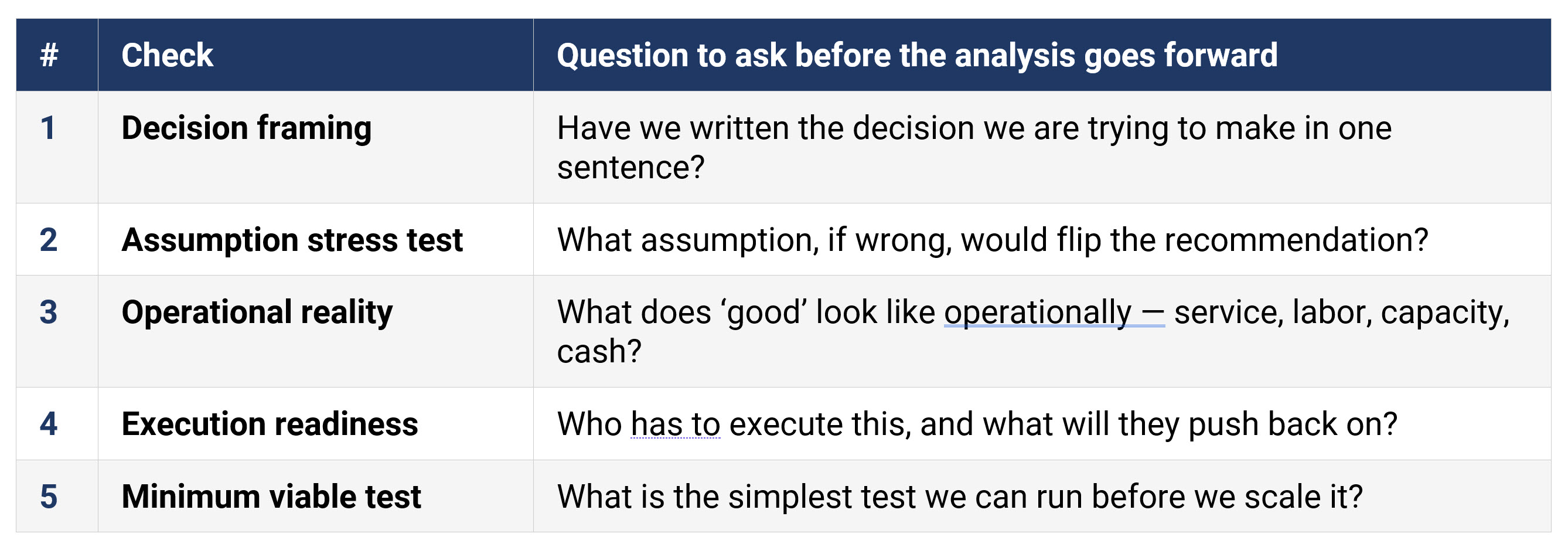
Figure 1: A Five-Question Diagnostic (accessible version)
These are questions that should have specific, grounded answers before a recommendation reaches leadership. If the team cannot answer question two (what assumption would flip the result) then the recommendation rests on unexamined ground. If question four cannot be answered, the change management work has not started yet.
In the Powerade situation, questions one and two were the misses. In Little Rock, it was question three. The models were not the problem. The diagnostic would have surfaced both gaps before the decisions were made.
This Gap Is Well Documented
What I am describing from my own experience is consistent with what the research shows.
A long-running finding in operations research is that many models are built and comparatively few actually drive decisions, and the breakdown is organizational, not technical. A widely cited review in the European Journal of Operational Research frames this as an implementation problem rooted in how models are connected (or not connected) to the people and processes that own the decision.
Professional credentialing bodies have recognized the same gap. The INFORMS Certified Analytics Professional blueprint explicitly lists business problem framing, stakeholder analysis, and business case development as core analytics competencies—not optional additions. The signal is clear: being analytically strong is necessary but not sufficient.
On the training side, a field study published in the European Journal of Operational Research tested the effects of structured decision training across roughly 1,000 decision makers and analysts. The results showed measurable improvement in proactive decision-making skills and decision satisfaction. The gap is real, and it is addressable. It is a training and design issue, not a talent issue.
The 4 C’s: A Decision-Focused Framework
At Georgia Tech SCL, we organize this thinking around what we call the 4 C’s. These soft skills play a key role in the decision process. Each one asks a specific question about whether the decision, not just the analysis, was made well.
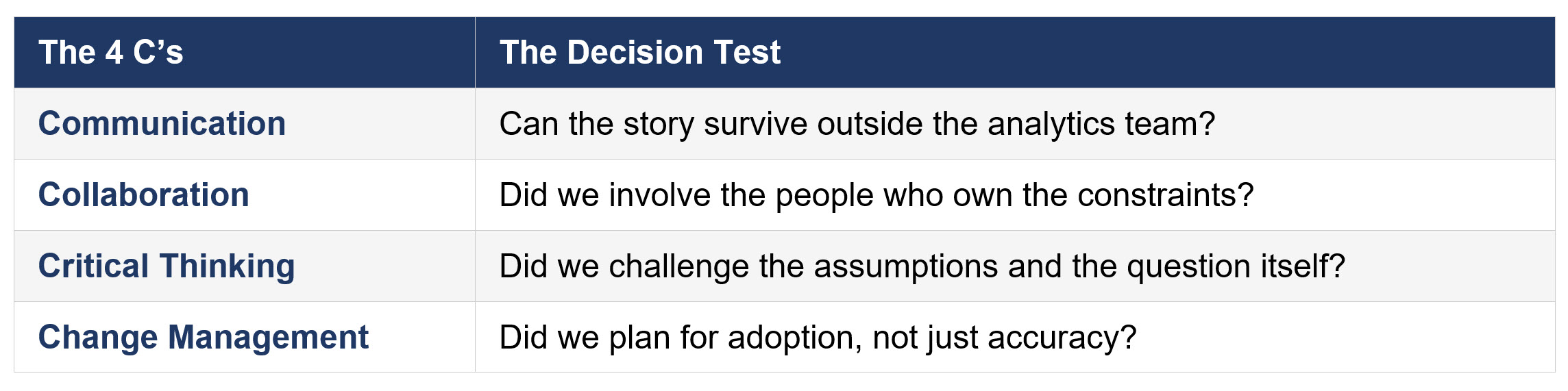
Figure 2: The 4 C’s: A Decision-Focused Framework (accessible version)
Notice what this framework does not include: model accuracy, data quality, or visualization quality. Those matter, and they are inputs to the decision. But a team can have a perfect model, a clean dataset, and a compelling dashboard and still fail all four of these tests.
The Powerade situation failed the Collaboration test The supply chain team did not sufficiently interrogate the brand team’s assumptions. Little Rock failed the Critical Thinking test: the right question was not asked about what the model was not capturing. In both cases, the Communication and Change Management failures followed directly from those upstream gaps.
When all four are present, analysis becomes a decision. When one or more is missing, the analysis and translation to a solid recommendation are at risk.
Where to Start
This topic keeps coming up in conversations with companies, in work with practitioners, and in what we hear from students as they move into industry roles.
The tools are not the problem. AI-assisted analytics, optimization models, and advanced forecasting are real assets. But tools amplify the thinking behind them. Weak decision discipline and better tools is a faster path to the wrong answer.
If this shows up in your org, try the five-question diagnostic on your next recommendation before it hits leadership. If it surfaces gaps you cannot close quickly, SCL can help. We are building workshops and courseware on decision-focused critical thinking, and we will cover this in our June Lunch and Learn.
Questions or comments? Reach out to SCL.
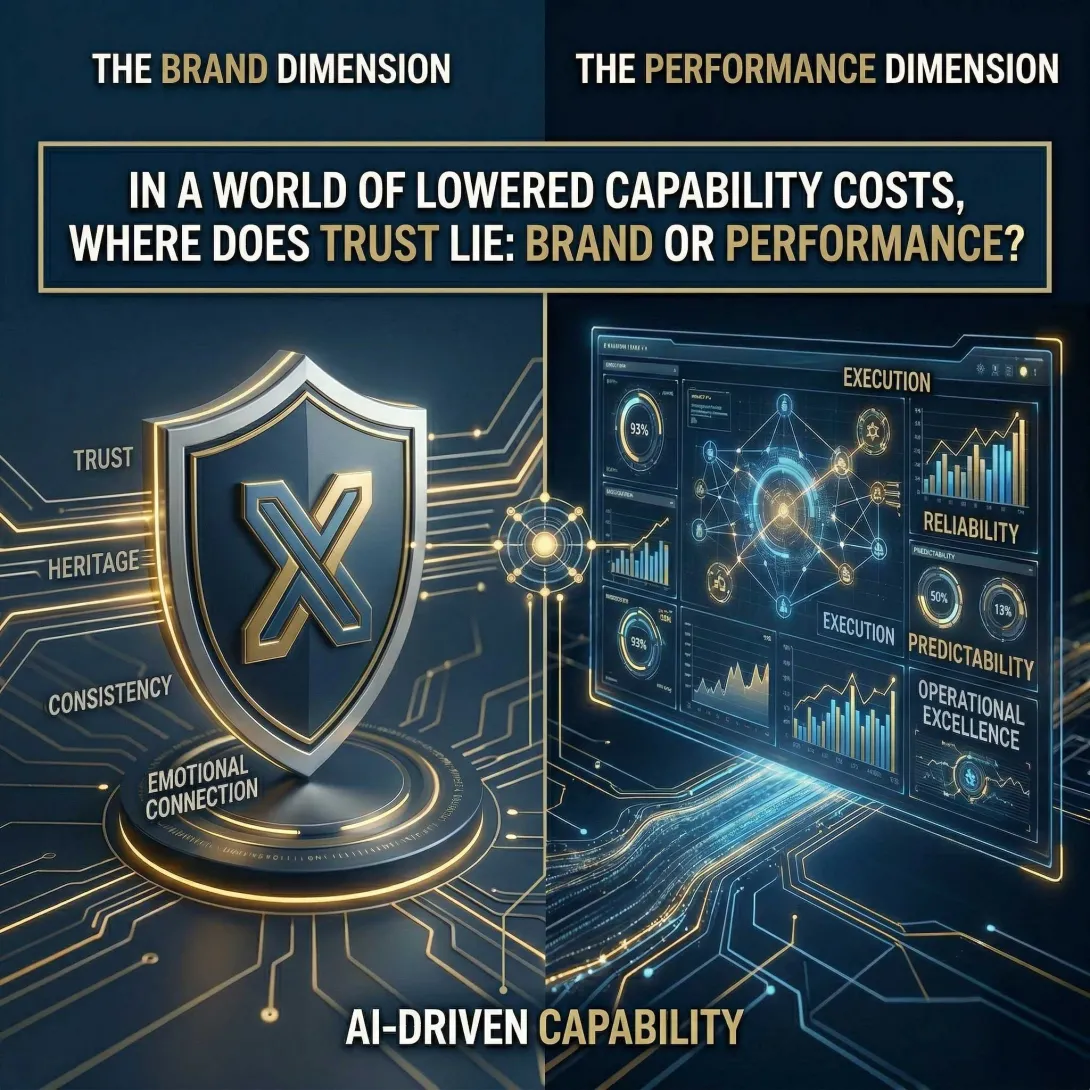
Chris Gaffney
By Chris Gaffney, Managing Director of the Georgia Tech Supply Chain and Logistics Institute, Supply Chain Advisor, and former executive at Frito‑Lay, AJC International, and Coca‑Cola
We recently wrapped our semi‑annual industry advisory board meeting, where a core element of the agenda is a set of "hot topics" sourced in advance from our member companies, curated, and facilitated to reflect what is most top of mind in the field. This cycle, one of those topics focused on the impact of AI on supply chain technology investment.
What began as a discussion on technology quickly surfaced a broader issue:
AI is not just changing supply chains—it is raising the standard for execution, and in doing so, redefining what it takes to sustain a brand.
When Capability Becomes Cheap
Within that discussion, a simple example sparked debate. Most of us would trust a platform like DocuSign without hesitation. It has earned that trust through reliability, security, and consistent performance.
But what if a new entrant—call it “FredSign”—offered similar functionality, powered by AI, at lower cost and with comparable features? Would you use it?
The room split. Some argued that established brands are durable because of the trust they have built over time. Others pushed back, suggesting that AI‑enabled challengers could close that gap faster than expected, making brand less relevant.
The discussion quickly moved beyond software to a broader question:
In a world where AI lowers the cost of building capability, does trust shift from brand to performance—or does brand become even more important?
Brand as a Promise
From a supply chain perspective, this is no longer theoretical. It is already happening.
At its core, a brand is a promise. For product companies, that promise is built on quality, consistency, and the experience of using the product over time. For supply chain technology and service providers, it is grounded in reliability, security, and confidence in execution.
Historically, brand has been reinforced by performance—but also protected by time, scale, and familiarity.
AI is changing that balance.
Lower Barriers, Higher Expectations
On one hand, AI lowers barriers to entry. New entrants can replicate functionality faster, improve user experiences, and target specific gaps in incumbent offerings.
In supply chain technology, this is particularly relevant. Many organizations have made significant, long‑term investments in systems that have not always delivered as expected. That creates an opening for AI‑enabled providers to enter through narrow use cases, solve specific problems better, and establish a foothold. Over time, they build credibility.
But there is a second dimension that is more immediate—and more consequential.
AI Raises the Execution Standard
One way to frame this is simple: data is a terrible thing to waste.
For years, supply chains have generated vast amounts of data across planning systems, transportation networks, warehouses, and customer interactions. Much of that data has been underutilized—captured, stored, but not fully leveraged to anticipate risk or improve outcomes.
That is changing.
The capability now exists—and is rapidly maturing—to sense, interpret, and act on that data in ways that were not previously practical. Risks can be identified earlier. Disruptions can be predicted. Corrective actions can be taken before the customer ever feels the impact.
From Disruption to Preventability
Over the past week, in the span of just six days and four unrelated conversations with members of my network, I heard a series of examples that all pointed to this shift.
- A global food company managing risk tied to a critical supplier whose quality issues could impact multiple major brands—raising the question of whether AI could have surfaced a near sole‑source dependency earlier.
- An e‑commerce retailer using machine learning to reduce theft and damage in its fulfillment network, improving the customer experience.
- An organization proactively shifting its fulfillment partner mix based on AI‑driven insights into which nodes can and cannot handle surge capacity.
- A high‑end clothing shipment arriving wet due to a fulfillment breakdown—where the loss was not just the product, but a time‑sensitive moment that could not be recovered.
- A consumer receiving an empty box after successfully purchasing a limited‑release product that could not be replaced.
These are not isolated anecdotes. The common thread is not disruption—it is preventability.
As AI enables earlier detection of risk, better prediction of disruptions, and faster response to exceptions, the tolerance for failure is declining. Companies are no longer judged simply on whether something went wrong. They are judged on whether it should have been avoided.
Brand Is the Delivered Experience
From a brand perspective, that is a fundamental shift.
A product brand may invest heavily in innovation and customer engagement. But if the product arrives damaged, late, or not at all, the customer does not distinguish between the brand owner and the supply chain behind it.
There is only one experience—and therefore only one brand.
In an AI‑enabled supply chain, failure is no longer just a risk—it is increasingly a choice.
The Weakest Node Defines the Brand
A brand is now only as strong as its weakest node.
That node may be a supplier, a logistics provider, a fulfillment partner, or a technology platform. Many sit outside the direct control of the brand owner, yet their performance is inseparable from the customer’s perception of the brand.
AI makes it possible to identify and address these weak points—but it also makes it more apparent when companies fail to do so.
Implications for the Supply Chain Ecosystem
This dynamic extends directly to platform and software providers. In an AI‑enabled environment, it is no longer sufficient for supply chain technology to be stable or functionally adequate. It must evolve—continuously—to sense risk earlier, enable better decisions, and improve execution outcomes. If it does not, its limitations will be exposed quickly, and alternatives will emerge.
Technology providers are not insulated by their brand; they are judged by the outcomes they enable. Their brand will strengthen if their platforms improve execution—and erode if they do not.
Product companies must use AI to protect the customer experience end‑to‑end. Logistics providers must adopt AI to remain credible partners. Technology providers must evolve their platforms to meet a higher execution standard.
If one part of the system advances while another does not, the gap will be visible—and acted upon quickly.
Winners and losers are being judged daily.
What This Means for Leaders
None of this suggests that brand is no longer important. In high‑trust, high‑risk environments—contracts, financial transactions, healthcare, and other sensitive use cases—brand remains critical.
Even in this environment, trust must be continuously reinforced through performance. Leaders must clearly understand what underpins their brand. Brand is not an asset to be protected; it is the result of consistently delivering on a promise. Any performance gaps must be addressed before others move in. AI‑enabled challengers will not challenge strengths—they will target weaknesses.
Finally, leaders must elevate their ecosystem. Brand performance is now inseparable from partner performance. That requires greater visibility, tighter integration, and higher expectations—not only internally, but across suppliers, logistics providers, and technology partners.
One Question to Answer Now
This execution dimension is only one part of how AI is reshaping brand—but it is already decisive.
A great product can still win. A strong brand can still endure. But in an AI‑driven world, where disruptions can be anticipated and failures mitigated, the margin for error is disappearing.
And in many cases—especially where the purchase is infrequent or the moment is critical—you only get one shot. At the conclusion of our discussion, one participant framed it simply:
What is our secret sauce—and what are we doing to build on it?
That is the question every supply chain leader should be answering now.
Because in an AI‑enabled world, your brand will be defined by what your system consistently delivers.
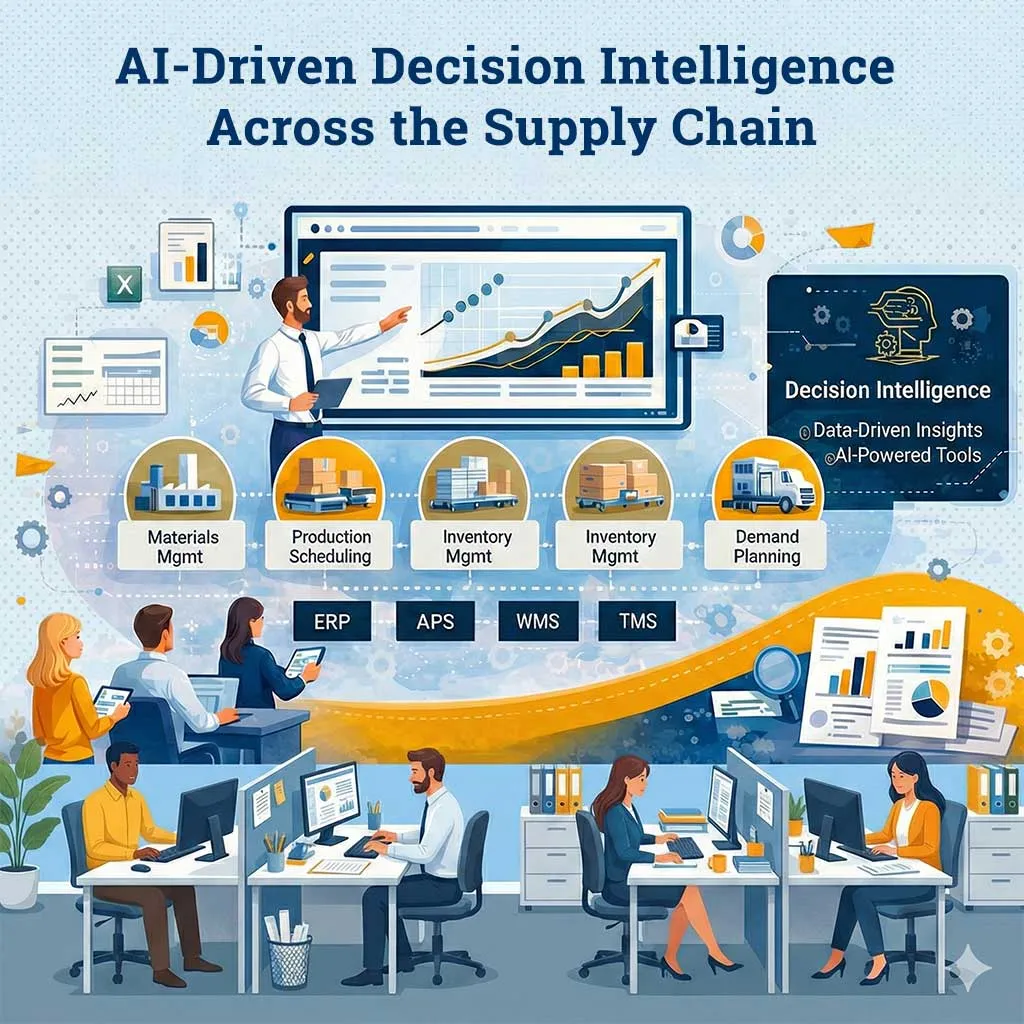
Chris Gaffney

By Chris Gaffney, Managing Director of the Georgia Tech Supply Chain and Logistics Institute, Supply Chain Advisor, and former executive at Frito‑Lay, AJC International, and Coca‑Cola, and Michael Barnett, Founder and Principal of Synaptic SC, former global leader of Supply Chain AI at BCG, and former executive at Aera Technology and Koch Industries.
Entering 2026, one thing is clear: staying on the sidelines is no longer a viable option. We both agree that 2025 was the last year when being “behind” on AI adoption could be rationalized. In 2026, leaders cannot stay in the foxhole. They need to move forward, doing so in a way that reduces the risk of failure.
The past two years have been full of promise for AI in supply chain: we have seen impressive pilots, compelling research findings, and no shortage of claims about what agents and large language models can do. At the same time, many supply chain leaders are frustrated; there has been significant activity and investment in centralized capabilities without meaningful results in the supply chain. Too many efforts stall. Too many pilots never scale. Many organizations feel they have kissed a lot of frogs and are still waiting for something that works reliably.
The question for 2026 is no longer whether to engage with AI, but how to do so in a way that consistently delivers results. This is the year to put points on the board through disciplined, repeatable progress rather than moonshots.
Two Principles Separate Progress from Experimentation
Across our work and conversations with supply chain leaders, organizations that are driving tangible results tend to follow two principles, sometimes explicitly, sometimes intuitively:
1. Leverage GenAI Where It Adds Differential Value
Large language models are exceptionally strong at working with language. They summarize, explain, code, and translate intent into logic. This makes them powerful tools for accelerating development, analysis, and communication.
Much of supply chain execution, however, depends on precision. Planning rates, forecasts, production schedules, routing logic, and inventory policies rely on structured data, mathematical relationships, and deterministic logic. In these environments, hallucinations or probabilistic answers are not just inconvenient. They can be operationally disruptive.
Many early failures stem from applying LLMs where deterministic logic is required, rather than using them to support the creation, maintenance, and monitoring of that logic. In practice, GenAI is most effective upstream, helping teams build analytics faster, surface issues earlier, and lower the friction of development and maintenance.
2. Design with People in the Loop
This is not only a philosophical stance. It reflects technical reality. While recent research shows that collections of agents can outperform humans in controlled settings, production supply chains are not laboratories. They are complex, interconnected processes and organizations that operate in a dynamic, ever-changing environment. In contrast to AI that augments workers, fully autonomous systems introduce risks—technical, organizational, and reputational—that erode the incremental value relative to the increased costs to develop and maintain them.
Human-in-the-loop is not a concession. It is a design principle.
From Ideation to Error-Proofed Execution
Most supply chain organizations are not short on AI use cases. What they lack are clear, high‑probability paths to value creation.
A familiar pattern plays out: organizations rush into pilots without a clear view of where AI adds value. Results are mixed and hard to interpret. When early efforts disappoint, leaders become more cautious, not because they doubt AI’s potential, but because they are wary of repeating visible failures.
One executive described this dynamic as being "tired of kissing frogs." After aggressively leaning into new technologies early, the organization became skeptical, insisting on external proof and peer validation before investing further.
The more productive question is no longer "What is the most advanced thing we can try?" but instead: "What can we do today that has a high probability of working, scaling, and building our capabilities?"
How to Put Points on the Board in 2026
Across our experimentation and advisory work, two areas consistently emerge where GenAI is already delivering value.
Enterprise Productivity: The Safest On-Ramp
The most reliable progress comes from improving everyday productivity.
Most organizations take a restrictive approach, limiting AI access to a small group or tightly controlled pilots led by centralized technical teams, only to realize they were slowing learning and adoption across the enterprise. In one large retailer, leadership initially centralized AI use due to security and governance concerns. Over time, they shifted to enterprise licensing that centralized risk management while allowing broader employee access within guardrails.
The result was not chaos or "shadow IT." It was productivity: meeting summaries, analysis support, presentation development, and faster access to internal knowledge.
These gains may sound modest, but they matter. Giving people five to ten hours per week back changes how employees experience AI. It becomes a tool that helps them do their jobs better, not a signal that their jobs are being automated away.
For leaders, this means actively enabling access to approved tools, supporting skill development, and encouraging experimentation within clear boundaries. This is one of the most straightforward ways to quickly and visibly put points on the board.
Decision Intelligence: Rewiring the Operating Model
Advanced analytics, optimization, and planning systems predate GenAI. What is new is not the math, but rather the speed, accessibility, and maintainability of building and sustaining advanced analytics solutions.
GenAI acts as an accelerator. It reduces the friction of writing code, standing up, monitoring logic, and explaining results. It brings advanced capabilities closer to the business, rather than confining them to a small central team.
A concrete example comes from production planning. Planned production rates are often set during commissioning or early ramp up and then reused for long periods. Over time, changes in labor mix, maintenance practices, or product complexity cause actual throughput to drift. Plans continue to run, but they quietly degrade.
In effective implementations, GenAI does not update the planning system autonomously. Instead, it operates adjacent to it. It helps teams build monitoring logic that compares planned versus actual performance, surfaces statistically meaningful drift, and generates candidate adjustments with supporting context. Planners review and approve changes before they are re-ingested into the APS.
The system of record remains intact. Human accountability is preserved. What improves is the speed, frequency, and quality of assumption hygiene, enabling earlier detection of problems before they cascade into service, cost, or inventory issues.
Avoid Kissing Frogs: Technology and Organizational Choices
Many organizations “kiss frogs” not because the new technology is flawed, but because they are not ready to adopt it.
To avoid this fate, successful efforts often include the following elements:
- Leverage existing, approved AI platforms rather than onboarding new technologies
- Accelerates time to value
- Helps define the true limitations of your current technology stack to guide future platform selection
- Maximize the value of current systems (e.g., APS, production scheduling software) instead of chasing new applications
- Existing, complex supply chain software often under-delivers on its promised value
- AI agents and workflows are highly effective at improving master data quality and ensuring planning parameters are accurate
- Foster ideation and solution development with internal teams, while using third parties to accelerate capability building—not to replace it
- Make progress visible by sharing early wins, curating employee-driven experiments, and scaling what works
Change management is not an option; it must be designed into every aspect of an AI program from the start. When organizations invest heavily in advanced capabilities at the top while doing little to equip everyday employees, the message received is often, "This is happening to you, not for you." That perception creates resistance, fear, and organizational drag.
Effective leaders communicate a clear vision for how new capabilities will augment, not replace, their teams, so that scarce human intellect is applied where it adds the most value.
Key Actions to Win in 2026
The principles are clear. The opportunity is real. The question now is execution.
If 2026 is the year to put points on the board, supply chain leaders must move from experimentation to engineered progress. That begins with clarity.
1. Define a Multi-Year AI Value Vision
Develop a concrete view of how AI will create value in your organization over the next several years. Not a collection of pilots. Not a list of tools. A clear articulation of where and how AI will improve productivity, strengthen decision quality, and increase operational reliability.
That vision should:
- Clarify where AI will augment human decision-making versus automate tasks
- Identify the business outcomes you expect to improve (service, cost, inventory, resilience, productivity)
- Guide decisions on organizational design, platform selection, governance, and partnerships
- Establish sequencing - what you will enable now versus what must wait
Without a defined direction, AI efforts default to software deployment. With it, technology becomes a lever for measurable operational improvement.
2. Enable Broad, Responsible Access
Capability development accelerates when access is not unnecessarily constrained. Ensure that team members at every level - from executives to frontline planners - have access to approved enterprise AI tools and agent-building capabilities, along with practical training tied to real workflows.
Effective enablement includes:
- Enterprise licensing and governance that remove friction while protecting data
- Hands-on guidance tied directly to day-to-day supply chain work - reporting, master data cleanup, production monitoring, inventory analysis, schedule validation
- Clear operating guardrails that define appropriate data use and boundaries
- Leadership support for responsible experimentation
Restricting access may feel prudent. In practice, it slows learning and reinforces dependency on centralized teams. Broad enablement builds capability across the organization.
3. Create Local Ideation and Scaling Mechanisms
Durable progress does not originate only from centralized programs. It often begins at the front line.
Leaders should create simple, visible mechanisms for individuals and teams to experiment within defined guardrails and to share what they are building.
This includes:
- Recurring forums or showcases where teams present working solutions
- Curated libraries of effective prompts, workflows, and agents
- Clear channels for submitting ideas and documenting results
Most importantly, organizations must be able to move from local experimentation to scaled adoption. That requires:
- Identifying the strongest minimum viable solutions emerging from the field
- Refining and hardening them into repeatable workflows
- Productizing and scaling what demonstrably improves performance
The objective is not activity. It is building capability that compounds over time.
These steps are straightforward. They require intention and follow-through. That is what separates durable capability from scattered experimentation.
It is not too late to lead. The last several years have provided lessons - technical, organizational, and cultural. Leaders who absorb those lessons and design deliberately for scale will build AI capabilities that strengthen over time.
That kind of progress is not flashy. It does not depend on moonshots or fully autonomous systems operating in isolation. It depends on clarity, access, discipline, and accountability.
In 2026, novelty will attract attention. Durability will create an advantage.
The organizations that win will not be the ones with the most pilots. They will be the ones who consistently translate AI into measurable operational improvement.
This is the year to move from experimentation to engineered results.