After working with Georgia Tech researchers, two high school teachers are sparking curiosity, encouraging experimentation, and helping students envision their futures in a technology-driven world.
Robin Osborn spent years telling her students to work through their frustrations in science class. This summer, she had to take her own advice.
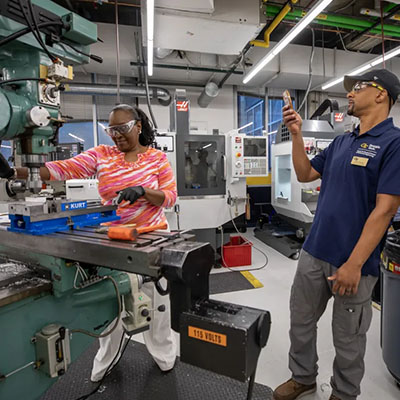
Osborn teaches ecology at Meadowcreek High School in Gwinnett County. She spent six weeks working with nanotechnology researchers at Georgia Tech’s Institute for Matter and Systems (IMS) through its Research Experiences for Teachers (RET) program.
And that work tested her more than she expected.
By her second lesson on using a scanning electron microscope, Osborn was nearly in tears. The powerful instrument reveals tiny surface details invisible to ordinary microscopes, and even getting a clear image takes practice and careful adjustments. “I was just thinking, ‘I can’t do this. I don’t understand. If I leave now, I’m done. There won’t be any completing this program, and I want to complete this,’” she said.
She pushed past her doubts and eventually earned clearance to operate the microscope on her own. “I pat myself on the back for that,” Osborn said, “because that’s something I would have never imagined I could do.”
Back at Meadowcreek High, she’s putting that experience to work.
Her first lesson of the school year introduced nanotechnology through something her students already cared about: sports. Together, they explored how the technology could improve sporting equipment.
She’s also spending less time lecturing and more time taking her class outside for hands-on ecology lessons. “My biggest impact that I got out of the program has to do with the way I’m trying to teach my class now,” Osborn said.
“I want to try to find that wonder for my students.”
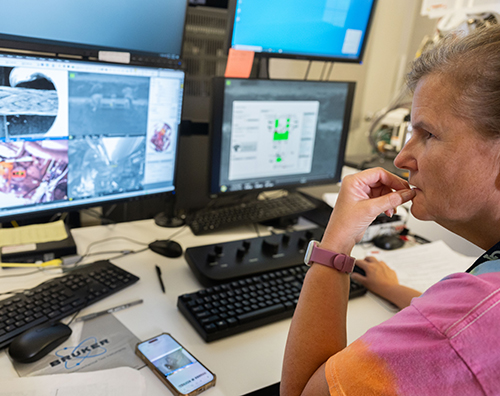
“I want my students to have a curiosity about the world, and I want them to feel safe that they can make mistakes, and they can ask me questions. … You have to leave room open to do something amazing.”
— Robin Osborn
Opening Doors
Supported by the National Science Foundation, the program gives high school teachers firsthand experience in nanotechnology research. Since 2021, 28 teachers have participated in the RET program at IMS.
“As engineers and scientists, we do a poor job talking to kids about what we do and the positive impact our work has on society,” said Mikkel Thomas, IMS associate director for Education and Outreach and senior research engineer. “By educating teachers, we can reach thousands of students each year we otherwise would not have been able to talk to.”
Now, Osborn is always looking for chances to introduce students to nanotechnology. When they mention engineering or show an aptitude for math, she tells them about her experience working in a Georgia Tech lab. She also wants students to know that careers in science and engineering don’t always require a four-year degree.
The Marvel of It All
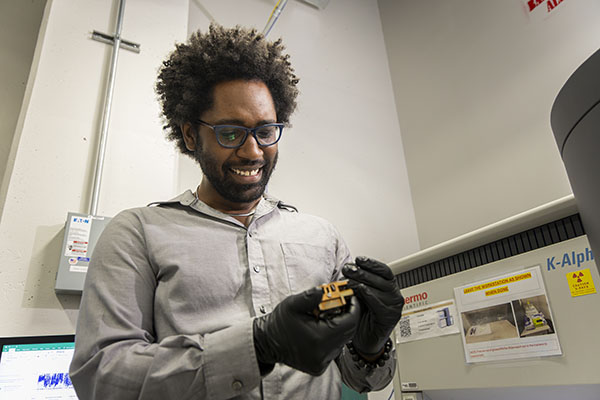
When David Battle asked his science students what came to mind when they heard the word nanotechnology, some thought of Iron Man. Battle understood. Before participating in the RET program, he’d associated nanotechnology with science fiction, too.
He teaches at Georgia Cyber Academy, a statewide virtual charter school with more than 10,000 students. At Georgia Tech, he worked on flexible electronics that could potentially be used as sensors on plants or people.
Back in class, Battle showed students a video he made about his research experience. It included footage of him working in Georgia Tech’s cleanroom, where he helped deposit extremely thin layers of gold onto electrodes.
The video also featured a high school student working in the Georgia Tech lab. In her interview with Battle, the student explained how she had gotten there: she spent three months emailing professors at colleges around Atlanta, looking for someone willing to give her a chance. Eventually, a Georgia Tech professor said yes.
Battle wanted his students to see that someone their age could find a place in a research lab. He offered extra credit to anyone who emailed Thomas to ask about research opportunities. “Kids need to see examples of what’s out there for them to think that they can do it,” he said. “You don’t know what you don’t know.”
At Georgia Tech, Osborn watched researchers struggle with experiments that went wrong and equipment that wouldn’t cooperate. They didn’t always know the answers. They kept looking.
“I want my students to have a curiosity about the world,” she said, “and I want them to feel safe that they can make mistakes, and they can ask me questions. You have to leave room open to do something amazing.”
Research for Real Life
Research comes to life in the people and communities it touches. Research for Real Life tells the stories of people whose lives are enriched by Georgia Tech research and discovery. Their experiences are a reminder of why this work matters.