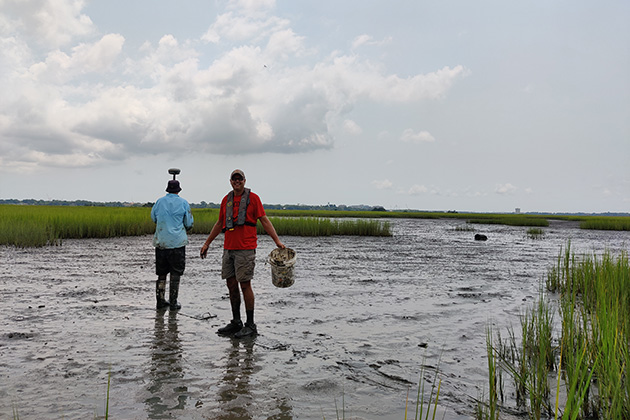
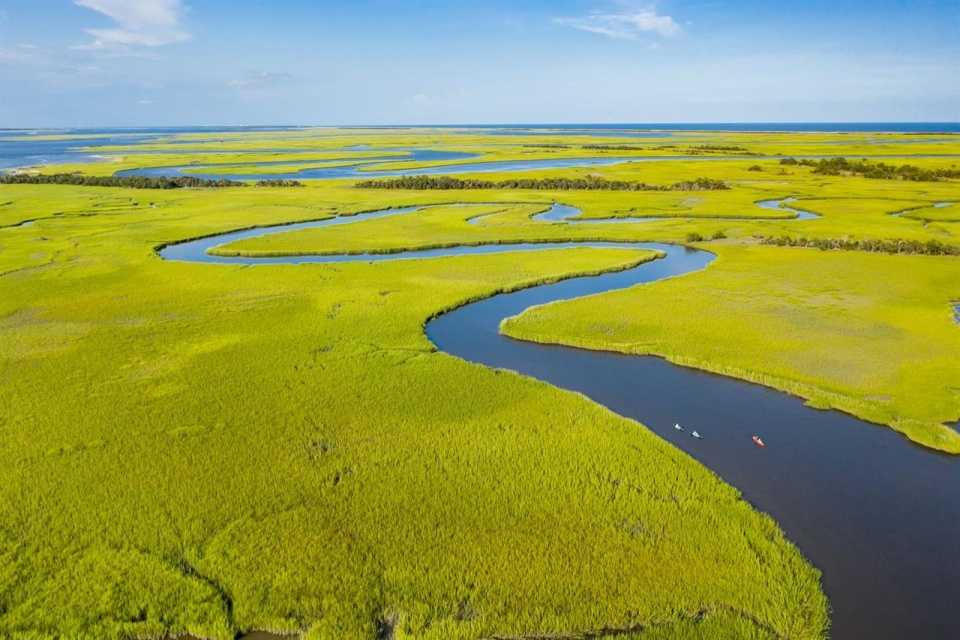
Georgia Tech and UGA researchers have joined their expertise in marsh restoration, coastal science, and computational modeling to protect Georgia’s salt marshes.
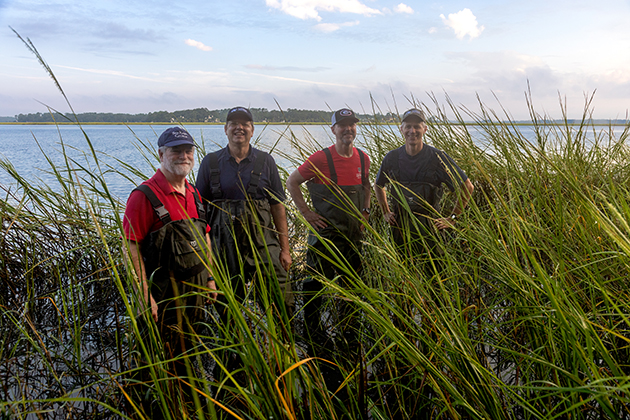
Clark Alexander, Joel Kostka, Chris King, and Tim Lieuwen.
When storms and rising seas threaten Georgia’s coast, some of its best protection comes from the landscape itself. Salt marshes act as natural buffers against storm surge, flooding, and erosion while sustaining wildlife, fisheries, and coastal economies. Georgia contains about a third of the East Coast’s salt marshes, making the question of how to restore and preserve them especially important.
“The marshes of Georgia are not keeping up with sea-level rise,” said Clark Alexander, University of Georgia (UGA) professor and director of Skidaway Institute of Oceanography. “So, at some point, we’re going to start seeing marsh loss because they’re being flooded too frequently.”
The cost of not protecting the marshes looks different across Camden County, located in the state’s southeastern corner. In St. Marys, flooding endangers a waterfront community. On Cumberland Island, degraded marsh and shoreline erosion threaten both habitat and historical areas such as the Carnegie family’s Dungeness Mansion ruins. Near Naval Submarine Base Kings Bay, keeping navigation channels open requires regular dredging, the removing of sediment to keep waterways deep enough for marine vessels.
These issues affect not only the marshes but also the communities, infrastructure, and coastal economies depending on them. Restoring marshes will help address these problems by strengthening shorelines, protecting habitat, and creating uses for dredged material. To solve these problems, Georgia Tech and UGA are partnering to remedy what affects the whole state.
The marshes of Georgia are not keeping up with sea-level rise. So, at some point, we’re going to start seeing marsh loss because they’re being flooded too frequently."
– Clark Alexander
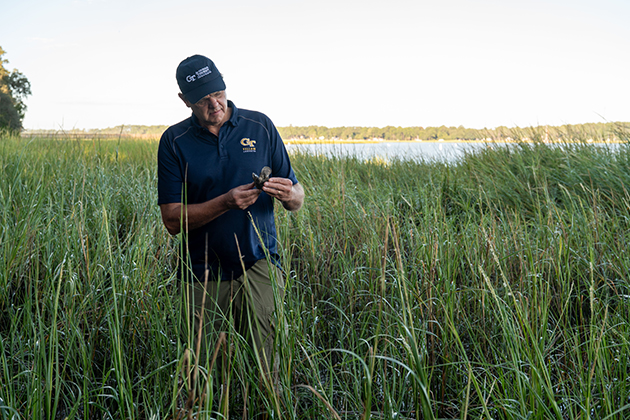
Joel Kostka’s research focuses on marsh health.
From Rivalry to Research
The two universities began collaborating in 2022 in Camden County. The initial project, funded by the National Fish and Wildlife Foundation, examined marsh conditions, sediment movement, shoreline erosion, and water circulation. Now, with more funding, the researchers are expanding the project’s footprint. Georgia Tech’s strength in marsh ecology and ecosystem science combines with UGA’s strengths in coastal processes and computer modeling to move from understanding the challenges to designing restoration solutions.
“We can either improve coastal resilience in a way that ends up degrading the habitat, or we can do it in a softer, resilient way that can adapt to changing conditions and provide ecosystem benefits,” Alexander said. “What I find rewarding is whenever we get insights that can be used to better inform communities and coastal managers to make better decisions.”
Instead of relying solely on traditional hardscape infrastructure such as seawalls, the team is exploring nature-based solutions that augment the natural protections of coastal ecosystems improving wildlife habitats. Those approaches include planting native grasses, oystershell living reefs, biodegradable coconut-fiber logs, and adding thin layers of dredged sediment to elevate vulnerable marshes.
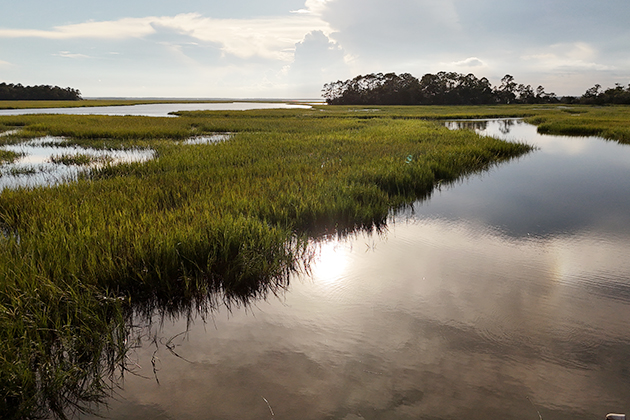
Salt marshes are natural buffers against storm surge, flooding, and erosion.
Joel Kostka is project lead and a Georgia Tech professor jointly appointed in the Schools of Biological Sciences and Earth and Atmospheric Sciences. He and his team with Georgia Tech for Georgia’s Tomorrow study marsh health and the conditions that allow marsh plants to adapt to stress and survive. They use that knowledge to help boost the success of nature-based solutions as well as to identify where and how restoration could better protect vulnerable stretches of Georgia’s coast.
“A salt marsh is a gift that keeps on giving. As long as it’s healthy and you give it room to grow, the salt marsh will migrate inland as sea level rises, continuing to protect coastal communities and serving as crucial wildlife habitat,” said Kostka, who is also a strategic lead in the Renewable Bioproducts Institute. “This project works because Georgia Tech and UGA bring complementary strengths. Together, we can better design nature-based solutions that boost the resilience of salt marshes, so that they can continue to protect coastal Georgia into the future.”
Protecting and conserving the coastline is a community effort. All of us stakeholders — including the scientists; the city, state, and federal leaders; and the public — have to work together to protect and conserve these ecosystems."
– Joel Kostka
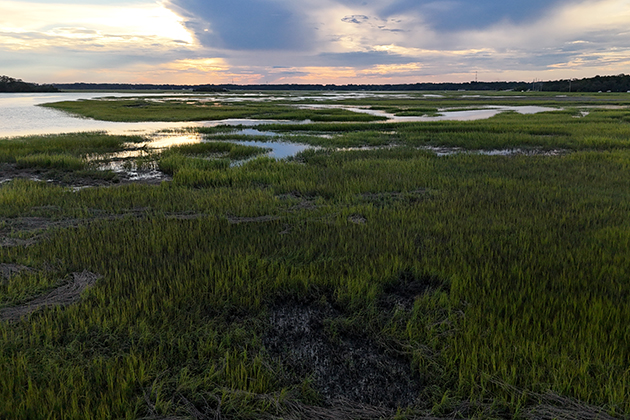
Salt marshes help sustain wildlife, fisheries, and coastal economies.
Following the Sediment
While Kostka’s team focuses on marsh ecology, Matthew Bilskie, associate professor in UGA’s College of Engineering, examines another piece of the puzzle: the constant movement of water and sediment. Georgia’s muddy estuaries constantly change as tides and currents move sediment through the system, making it difficult to predict where shorelines will erode and where sediment will accumulate.
Alexander’s data from Cumberland Sound, including information about sediment size and properties, are fed into Bilskie’s physics-based computer models, which simulate how sediment moves through the marsh system. Modeling tides and sediment transport helps the team investigate where sediment comes from, how it moves, and where it ultimately settles.
Sediment also builds up in navigation channels around Naval Submarine Base Kings Bay, requiring regular dredging. But dredging creates another issue: what to do with the removed material. Researchers are exploring whether some of that sediment could help restore vulnerable salt marshes. They use Bilskie’s models to evaluate where dredged sediment might be beneficially reused and how different strategies could affect the surrounding environment.
“It’s a huge need,” Bilskie said. “There’s plenty of work to be done in Cumberland Sound and Kings Bay, and nationally, there’s a growing emphasis on finding beneficial uses for dredged sediment.”
A Community Effort
But preserving Georgia’s coastline will take more than marsh science and computer models. For Kostka, the communities that live alongside these ecosystems are also an essential part of determining what comes next.
“Protecting and conserving the coastline is a community effort,” Kostka said. “All of us stakeholders — including the scientists; the city, state, and federal leaders; and the public — have to work together to protect and conserve these ecosystems.”
It’s a huge need. There’s plenty of work to be done in Cumberland Sound and Kings Bay, and nationally, there’s a growing emphasis on finding beneficial uses for dredged sediment."
– Matthew Bilskie
 Writer and Media Contact: Tess Malone | tess.malone@gatech.edu
Photos: Joya Chapman and Maxwell Guberman
Video: Maxwell Guberman and Shanon Wise, UGA Marine Extension and Georgia Sea Grant
Copy Editor: Brigitte Espinet