Meghna Iyer came to Georgia Tech trying to understand her mother’s illness. What she discovered is changing how scientists connect three neurodegenerative diseases.
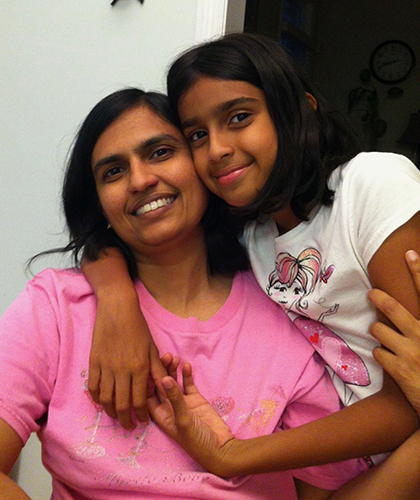
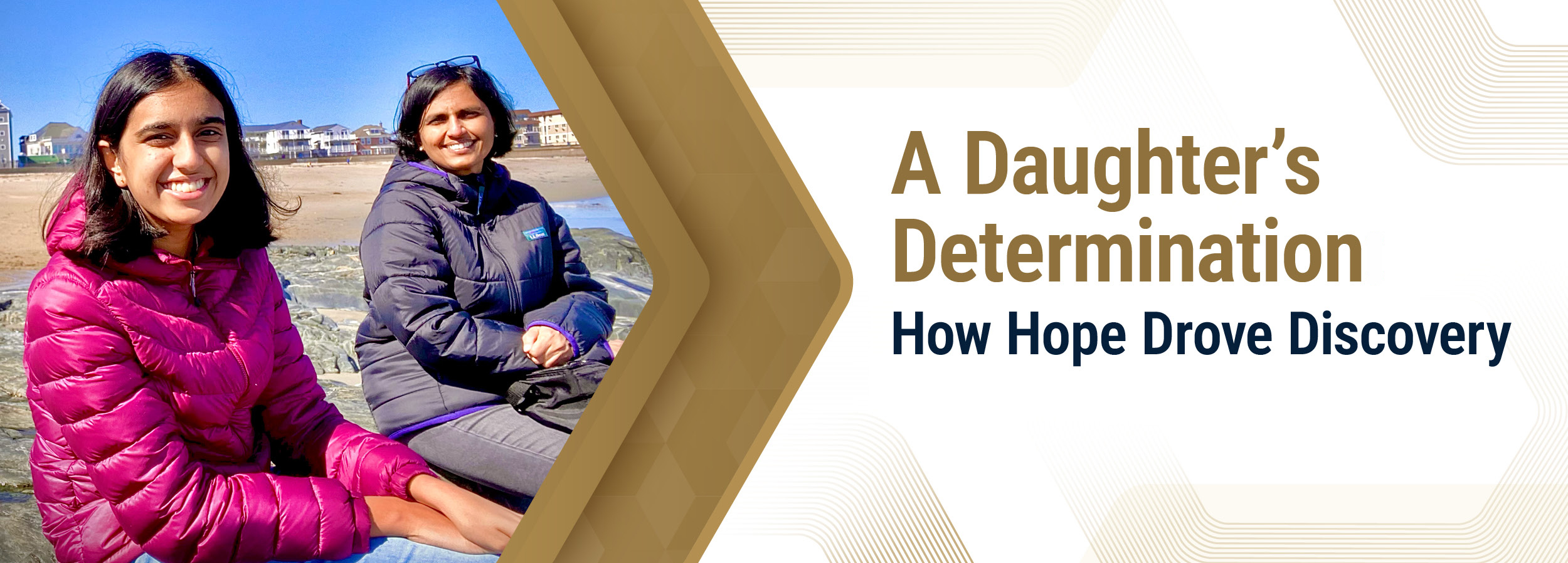
Meghna and Suneeti Iyer in June 2014.
Every morning as a child, Meghna Iyer crawled out of bed, crawled into her mother’s lap, and talked about whatever was on her mind.
“She was my built-in best friend,” Meghna said. “She was always there for me. Always.”
Her mother, Suneeti Iyer, was a speech-language pathology professor who helped students understand how voice and communication connect people.
Years later, ALS — amyotrophic lateral sclerosis — would steal Suneeti’s ability to speak.
ALS is a neurodegenerative disease that progressively weakens the muscles needed to move, talk, and — eventually — breathe. There is no cure.
By the time Meghna left for college, doctors at two hospitals had confirmed her mother’s diagnosis.
“That’s when it clicked for our family,” Meghna said. “This was terminal.”
Meghna started reading everything she could find about ALS, matching scientific literature to what was happening to her mother.
What she found revealed shared patterns across ALS, Alzheimer’s disease, and frontotemporal dementia — links that, until relatively recently, were less often examined together on a large scale.
“I had never even heard of ALS before she got diagnosed,” Meghna said. “So, after my family’s research and all the conversations we had with doctors, I wondered why these diseases are treated as separate, when actually they could technically be interconnected and fall upon a continuum.”
“She was my built-in best friend. She was always there for me. Always.”"
– Meghna Iyer
Looking for Answers
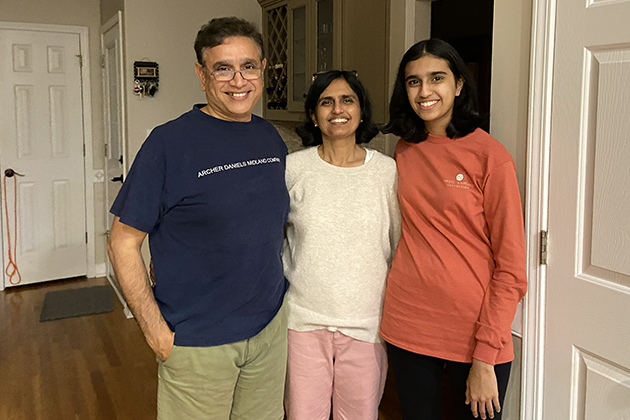
Meghna, Rajan and Suneeti Iyer celebrating New Year's Day in 2022.
In her first semester at Georgia Tech, Meghna emailed professors across campus, searching for anyone who might know about treatments, technologies, or research that could help her mother.
Cassie Mitchell answered.
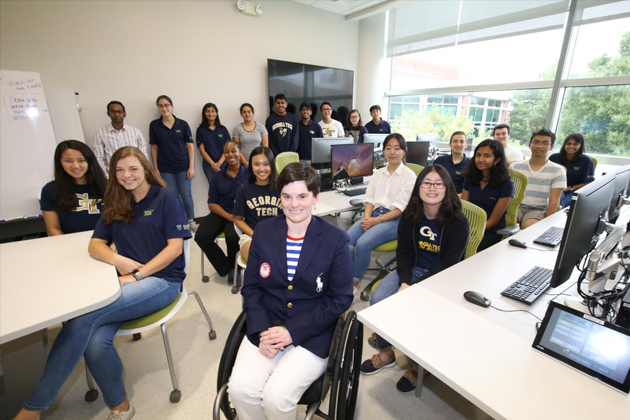
Mitchell, an associate professor in biomedical engineering and founder of Georgia Tech’s Laboratory for Pathology Dynamics, is affiliated with the Center for Machine Learning and the Institute for Neuroscience, Neurotechnology, and Society (INNS). She uses artificial intelligence (AI) to study neurodegenerative diseases and offered Meghna a job in the lab.
Meghna had no formal research background and no coding experience. What she did have was firsthand knowledge of ALS.
“You’ve seen this disease every day,” Mitchell told her. “I have coders. I don’t have someone who knows what ALS looks like from the inside.”
Researchers had begun to recognize connections among ALS, Alzheimer’s disease, and frontotemporal dementia, but they were rarely studied together.
“Biomedical science is very siloed,” Mitchell said.
Mitchell’s lab was already exploring how brain diseases overlap. With Meghna, that effort took a more focused turn: an AI-driven study that examined ALS, Alzheimer’s disease, and frontotemporal dementia together.
The existing AI could scan millions of papers. Meghna helped shape what it searched for, drawing on her mother’s illness and months of reading to identify patterns across all three diseases.
I believe Meghna was put in my lab for a reason. It almost felt like divine intervention. It was a perfect fit."
– Cassie Mitchell, Associate Professor in Biomedical Engineering
Teaching ALS to AI
Meghna wasn’t the one writing thousands of lines of code, but she became the person everyone turned to when deciding what the code should do. Mitchell described Meghna as the lab’s “in-house expert” on ALS and related dementias. Meghna grounded the AI in both the scientific literature and what she’d seen in her own family. What the system ultimately revealed surprised even Mitchell. “I was shocked, honestly, at the degree of overlap we saw,” she said. “I thought it would be a little bit more distinct.”
What the Diseases Shared
Meghna’s team used AI to analyze 36 million biomedical research papers, looking for biological connections that linked ALS, Alzheimer’s disease, and frontotemporal dementia.
Looking at the papers together changes the question. Instead of asking what makes these diseases different, researchers can look for the biology they have in common. Those commonalities may help explain why symptoms like memory loss, speech problems, or movement changes don’t always point clearly to a single diagnosis.
And, while that overlap does not identify a cause or lead directly to new treatments, it gives researchers a framework for studying ALS, Alzheimer’s disease, and frontotemporal dementia together instead of separately.
While Time Was Running Out
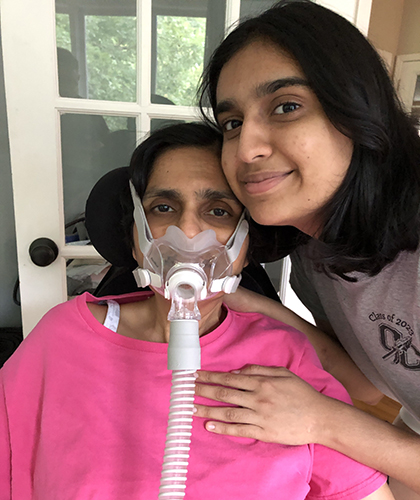
Meghna and Suneeti after Sunseeti received a breathing tube mask. July 2024.
Meghna spent her first year of college in two places.
During the week, she was a Georgia Tech student. She arranged her class schedule to finish coursework by Thursday evenings, then she drove 40 miles north to her family’s home in Lawrenceville.
From Friday through Sunday, she helped her father care for her mother. Meghna attended medical appointments, tracked medications, and managed schedules.
By the end of Meghna’s first year, Suneeti was using a walker. Soon after, the family hired a professional caregiver. By Meghna’s sophomore year, Suneeti relied full-time on an electric wheelchair. Then came a feeding tube. Then a ventilator.
The ventilator kept Suneeti breathing. It also kept her from speaking.
“It was always in her head,” Meghna said. “How in the world can I not speak as a speech-language pathologist?”
Even as her body failed, Suneeti remained deeply engaged in the search for treatments.
“She never gave up hope that there was something else out there,” Meghna said.
In June 2025, Suneeti found a new clinical trial that might slow the disease’s progression. Even after years of decline, she was still searching for more time.
About a week later, the family was driving her to a hospital appointment when Suneeti suddenly slumped against the seat.
By the time they arrived, she no longer had a pulse. Meghna said doctors tried resuscitating her mother, but it failed.

“So, then we had to let her go.”
The next day, Meghna called Mitchell and walked through every detail of the previous 24 hours.
“She was looking for answers as to why her mom was gone,” Mitchell said. “And sometimes, there just aren’t any.”
Three weeks later, Meghna returned to the lab.
“I think I was even more motivated because I knew now that I couldn’t help her, and I had a stronger desire to help other people,” Meghna said.
Meghna pushed to get the findings accepted by a peer-reviewed journal. When Biomedicines published the study in February 2026, Meghna was listed as first author, a rare distinction for an undergraduate.
“I believe Meghna was put in my lab for a reason,” Mitchell said. “It almost felt like divine intervention. It was a perfect fit.”
I think I was even more motivated because I knew now that I couldn’t help her, and I had a stronger desire to help other people."
– Meghna Iyer
A Tool for the Next Family
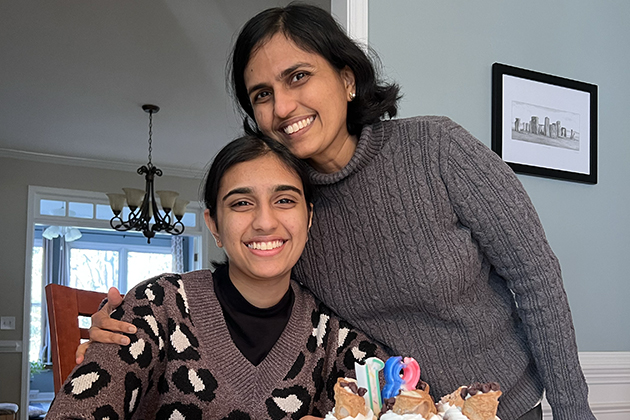
Meghna and Suneeti celebrating Meghna’s 18th birthday. November 2022.
Meghna’s research became the foundation for a platform called SemNet Explorer.
The platform allows researchers to analyze scientific literature the way Meghna’s team did — analyzing millions of studies. It removes the need for the kind of computing power usually reserved for major research institutions.
The platform also shows researchers why it made a connection, tracing how papers, pathways, and biological processes link together.
Mitchell said this transparency matters because scientists need to understand how the AI reached a conclusion before using it to guide future research or patient care.
“If you don’t have a Meghna in your lab,” Mitchell said, “this basically clones her.”
Meghna earned her bachelor’s degree in Biology in May 2026. She is now preparing for medical school entrance exams.
In the quiet moments, she returns to those mornings spent in her mother’s lap — and wonders what they would talk about now.
“I always hoped she would get better,” Meghna said. “That’s what kept me going, that my research might help make that happen.”
Meghna continues with the hope that another family’s story may end differently.
That’s what keeps her going now.
This research was supported by the National Science Foundation.

Writer: Michelle Azriel
Media Contact: Institute Communications Media Relations
Photos: Courtesy of Meghna Iyer
Copyediting: Kelly Adams
Institute for Neuroscience, Neurotechnology, and Society
The Institute for Neuroscience, Neurotechnology, and Society (INNS) at Georgia Tech is an Interdisciplinary Research Institute dedicated to advancing a deeper understanding of the brain and developing responsible neurotechnologies with broad societal benefit. INNS brings together more than 150 faculty across scientific discovery, engineering innovation, and the social sciences to address fundamental challenges in neuroscience while exploring the ethical, policy, and human dimensions of emerging brain technologies.
Institute for Data Engineering and Science (IDEaS)
The Institute for Data Engineering and Science (IDEaS) serves as a support base for Georgia Tech’s campus-wide research community via the development of applied AI and ML techniques, specialized research software, and providing high-performance computing infrastructure and the requisite training to use these tools effectively. Our faculty and staff support AI- and data-driven discovery across disciplines, including the physical and social sciences, arts, engineering, and public affairs.