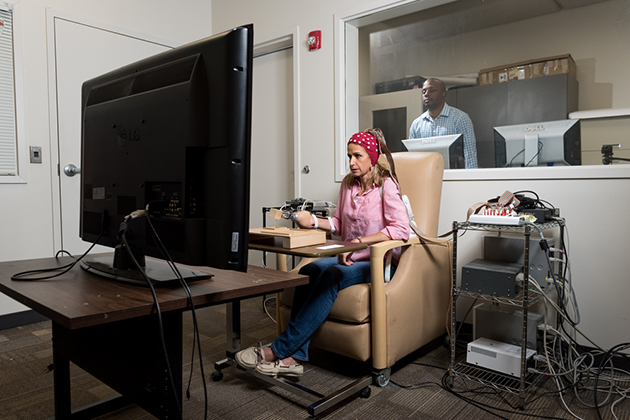
As neuroscience and neurotechnology accelerate, Georgia Tech researchers are grappling with how a neuro-connected future could reshape society — and humanity itself.
Neuroscience research is revealing how the brain and body “talk,” all the way down to the level of individual neurons. The newest brain implants can detect and decode attempts at speech, enabling paralyzed people to communicate in new ways.
The scientific momentum of this research is undeniable. Now, these technologies are moving beyond laboratories and into everyday life.
How might these mind-bending, and potentially mind-altering, technologies shape society? And, just as importantly, how will society shape these tools? The answers depend on the questions we choose to ask now.
At Georgia Tech’s Institute for Neuroscience, Neurotechnology, and Society (INNS), those questions are central. Across INNS, researchers use neuroscience to explore creativity, collaboration, design, aging, ethics, and human behavior. Others investigate the implications of neurotechnology, pulling at the threads of a neuro revolution whose impacts are still emerging, elusive, and ill-defined — but undeniably high-stakes.
“The neuro-connected future is coming, and it’s going to change society,” said Christopher Rozell, executive director of INNS and the Julian T. Hightower Chair and professor in the School of Electrical and Computer Engineering. “We should start having conversations about societal impacts now so our values as a society are baked into the research and innovation from the beginning.”
Neuroethics by Design
Preparing for that future requires more than technological breakthroughs.
Karen Rommelfanger, a leading neuroethicist who recently joined INNS as a professor of the practice, studies how society can responsibly develop technologies that interface directly with the brain. Her work focuses on questions of mental privacy, autonomy, consent, and identity — issues she believes society must address before neurotechnologies become commonplace.
Broadly, neurotechnology encompasses tools that can measure, decode, and increasingly influence activity in the brain and nervous system.
“Part of preparing society for advanced technology is pointing out potential roadblocks to flourishing,” she said.
Rommelfanger advocates for “neuroethics by design,” embedding ethical thinking directly into the development of neurotechnology. “The brain is special; it’s central to who we are,” Rommelfanger said. “When you intervene with the brain, there are unique responsibilities.”
As neurotechnology advances, she argues, there is still a narrow window to shape how these tools are governed. “It’s really difficult to get your arms around something once it’s out of the gate,” she said. “With neurotechnology, we still have a little bit of time, but not that much time.”
It’s really difficult to get your arms around something once it’s out of the gate. With neurotechnology, we still have a little bit of time, but not that much time."
– Karen Rommelfanger
Warfare, Power, and the Next Technological Frontier
Today, brain-computer interfaces are often associated with rehabilitative medicine. They are helping restore cognitive abilities after brain injuries, enabling stroke patients to regain movement, and allowing paralyzed individuals to control external devices with their minds — and even communicate without speaking.
But technologies that connect brains to machines do not exist in a vacuum. Could tools designed to assist the brain also be used to disrupt it, or even undermine the will of entire populations?
Margaret E. Kosal, professor in the Sam Nunn School of International Affairs, studies emerging technologies and what they mean for nation-states, geopolitical conflict, and cooperation. By combining expertise in basic science and technology development, she examines how innovation alters the nature of warfare and how past breakthroughs can illuminate what lies ahead.
“Neurotechnology and neuroscience will have a greater impact on the nature of warfare than all the emerging areas of science and technology,” Kosal said. “Even more than artificial intelligence.”
For Kosal, the implications extend beyond physical augmentation alone. Technologies that connect the brain to robotics, cyber systems, and military networks are likely to transform how decisions are made, coordinated, and carried out in conflict. Brain implants connected to cyber capabilities could allow service members to communicate directly with others in their battalions, or even policymakers operating remotely.
To anticipate technological impact, she also looks to history — such as the development of nuclear weapons and other transformative capabilities — to understand how disruptive technologies alter global power structures and why societies must prepare for technological surprise before it arrives.
The military implications of neurotechnology are no longer purely speculative. Many are extensions of technologies already being developed today.
“We know we can control robots from a distance because we do that with unmanned aerial vehicles,” Kosal said. “Now, what happens when instead of needing to do it with a joystick, you just do it by thinking? We are moving in that direction.”
Redefining Privacy in the Age of Brain Data
If neurotechnology can reshape warfare, it may also reshape something far more personal: the boundaries of privacy, autonomy, and even thought itself.
As devices grow more sophisticated, capable of detecting emotional states or decoding signals associated with speech and intent, neural data may become one of the most intimate and sensitive categories of information imaginable.
DeBrae Kennedy-Mayo, senior academic professional in the Scheller College of Business, specializes in law and ethics at the edges of emerging technology.
“What does privacy mean when I can read your thoughts, look at your memories, or even know your intentions?” Kennedy-Mayo said. “With neurotechnologies, certain diseases could be cured and people with severe depression can experience life-changing treatments. On the commercial side, I think we’re going to see some fun stuff that used to feel like sci-fi.”
For her, the challenge is ensuring that society can benefit from neurotechnology while protecting individual rights. While not all brain data is equally vulnerable, she can envision a future in which criminal investigations seek access to neural data tied to memory or intent.
“We have to redefine privacy in these contexts and make sure we have legal protections in place,” she said. “But that’s not going to be enough. We also need to have cybersecurity measures in place.”
She warns that without those protections, society could gradually surrender forms of mental privacy and individual sovereignty that people take for granted.
“If we don’t address these issues now, then democracy could get pushed in a way that we don’t want it to,” Kennedy-Mayo said. “If we have access to this brain data in the criminal justice system, one could easily imagine things going wrong quickly unless we start to act now.”
What does privacy mean when I can read your thoughts, look at your memories, or even know your intentions?"
– DeBrae Kennedy-Mayo
Designing for Brain Health
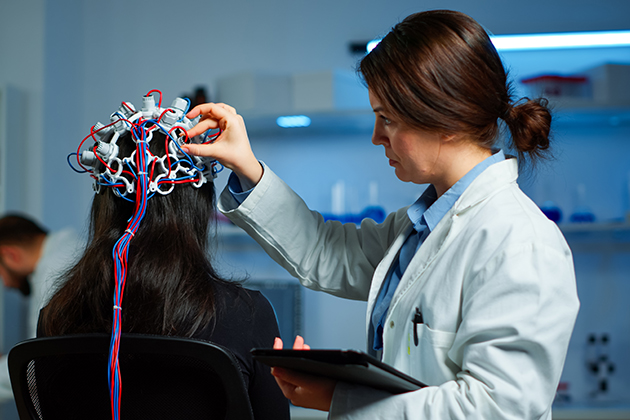
Implanted devices aren’t the only technologies changing how we understand the brain. Neuroscience research is also illuminating how the built environment affects our health.
Hui Cai, professor of architecture and director of the SimTigrate Design Center, analyzes how built environments affect behavior, cognition, emotion, and health. Her work focuses on evidence-based design.
“People are very excited about the convergence of neuroscience and architecture, because we as humans intuitively know there’s a relationship between our brains and our built environments. But so far, it’s been very hard to quantify the impacts of the built environment on our brain health,” Cai said.
Her research spans healthcare and community environments, examining how factors such as lighting, visibility, spatial layout, and environmental graphics, including signage, influence cognition, communication, navigation, and quality of life.
The SimTigrate team uses behavioral observation, eye-tracking, and physiological measures to study how people respond to real-world environments. SimTigrate’s collaboration with the Emory Brain Health Center on the Charlie and Harriet Shaffer Cognitive Empowerment Program is an example of integrating research, technology, therapy, and the built environment to promote long-term health and independence for people with mild cognitive impairment.
As neurotechnology becomes more accessible, Cai sees new opportunities to study brain activity outside laboratory settings — bringing neuroscience into the everyday environments where people live, age, navigate, and connect.
“In the past, most neuroscience-related research happened in the lab or in simulated settings, rather than in real-life environments,” she said. “But the development of technology such as portable EEG devices that measure brain activity, coupled with eye-tracking devices to capture environmental contexts, has opened up exciting possibilities for gaining more insights into brain function in real-life settings.”
Much of Cai’s work focuses on aging populations, for whom design can influence autonomy, social connection, and health outcomes.
“Across the world, we have an aging population,” Cai said. “How do we design better environments to support their needs and understand how our brains age? I think neuroscience and neurotechnology can help us find the answers.”
Creativity, Expression, and the Human Mind
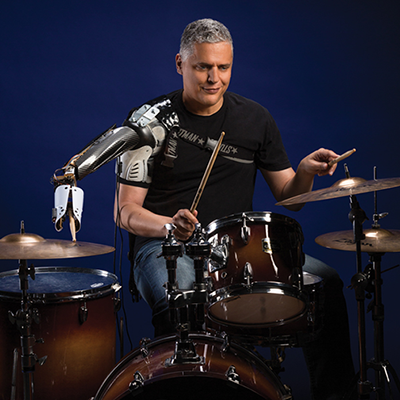
A robotic drumming arm developed at Georgia Tech collaborates with musicians by sensing and responding to their movements.
For some INNS researchers, neuroscience and neurotechnology offer new pathways for better understanding the qualities that make us human, including creativity and expression.
Brian Magerko, Regents’ Professor in the School of Literature, Media, and Communication (LMC), uses neuroscience tools like EEG to study one of creativity’s most elusive phenomena: the “aha” moment.
“We’re interested in understanding how we create together,” said Magerko, who collaborates with LMC Professor Michael Nitsche for the project. “Not just generating ideas, but understanding how people improvise, negotiate meaning, and collaborate creatively.”
Magerko probes what he calls moments of “clamping” and “unclamping” around ideas — the shifts that occur when people move from searching and interpreting toward moments of insight.
By studying neural patterns associated with those moments, he hopes to shed light on how technologies like artificial intelligence might support human creativity.
For Gil Weinberg, professor in the School of Music and director of the Georgia Tech Center for Music Technology, the overlap between neuroscience and neurotechnology opens new possibilities for music, rehabilitation, and artistic expression.
Across projects involving robotic prosthetics, AI-assisted music systems, and stroke rehabilitation, Weinberg explores how music and neuroscience can work together to help people communicate, recover, and create in new ways.
In one project, Weinberg collaborated on musical rehabilitation tools designed to help stroke survivors regain finger movement through personalized musical exercises. In another, he used EEG and ultrasound signals to enable amputee musicians to play musical instruments such as drums and piano.
“At the edges of all of these disciplines is a lot of white space,” Weinberg said. “When you bring together music, computer science, and neuroscience, you can create entirely new knowledge.”
The neuro-connected future is coming, and it’s going to change society."
– Christopher Rozell
Understanding the Brain to Shape the Future
For Rozell, the stakes extend beyond any single application to questions of identity, human flourishing, and what it means to be a person. “The brain is everything about who we are,” he said. “It is the source of our creativity and what makes us uniquely human.”
He argues that understanding the brain is inseparable from understanding how we learn, feel, create, heal, and coexist with artificial intelligence.
“It’s really about how we thrive as a species,” Rozell said. “We can't do that without better understanding our brains.”
As neurotechnologies become more powerful, portable, and accessible, INNS researchers are working to ensure that society is not simply reacting to a neuro-connected future after it arrives. By bringing together perspectives from neuroscience, ethics, law, design, and the arts, they help shape technologies that could fundamentally alter how humans communicate, create, govern, heal, and understand themselves.
The neuro revolution is still unfolding. But the conversations shaping what comes next are already underway.
Funding: Specific projects mentioned were supported by several organizations, including the James M. Cox Foundation and Cox Enterprises Inc. (Cai); the GVU Center at Georgia Tech (Magerko); the National Institute on Disability, Independent Living, and Rehabilitation Research (Weinberg); and Google (Weinberg).

Writer and Media Contact: Catherine Barzler | catherine.barzler@gatech.edu
Photos: Josh Meister (Weinberg photo) and Stock
Copyediting: Stacy Braukman