The lesson only nursing home residents can teach Georgia Tech design students.
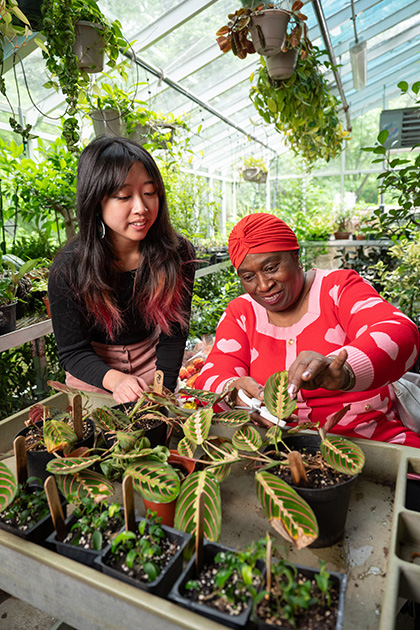
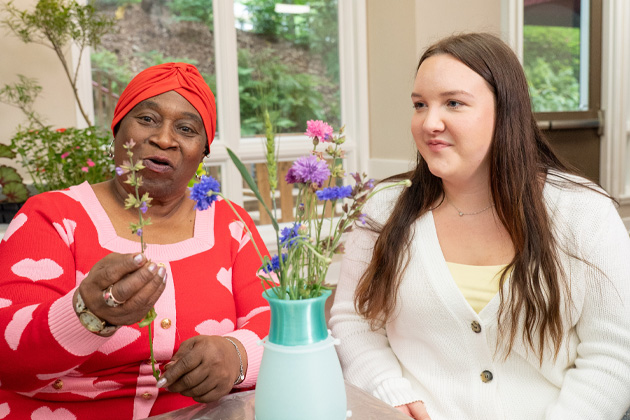
LEARNING FROM EXPERIENCE: Georgia Tech industrial design student Olivia Chan (left) works alongside A.G. Rhodes resident Essie Bailey-Demic during a horticultural therapy session. By observing and designing with residents rather than for them, students developed tools that help restore independence.
Potting soil lingered under Essie Bailey-Demic’s polished fingernails.
“I don’t mind getting my hands dirty. Not at all,” she said with a smile.
Essie earned that dirt in a horticultural therapy session at A.G. Rhodes.
Georgia Tech industrial design students came to the Atlanta nursing home to redesign gardening tools — not just for the residents, but with them.
In the beginning, they didn’t design a single thing. Instead, they observed.
They watched where hands slipped. Which tools frustrated residents. Which everyday activities had become impossible alone.
When the students returned with their first prototypes, Essie reached for a redesigned pruning tool.
She turned it over.
Then she held it backward.
“She made sure to tell us she didn’t understand the pruning tool,” said Olivia Chan, a fourth-year industrial design student. “What we assume is obvious might not be. We’re going to adjust it.”
It was exactly the lesson Leandro Tonetto hoped his students would learn.
“People don’t experience products the same way young designers do,” said Tonetto, associate professor in Georgia Tech’s School of Industrial Design and core faculty at the SimTigrate Design Center. “I would like my students to be able to design for real people, not for people they make up in their heads.”
I don’t mind getting my hands dirty. Not at all."
– Essie Bailey-Demic
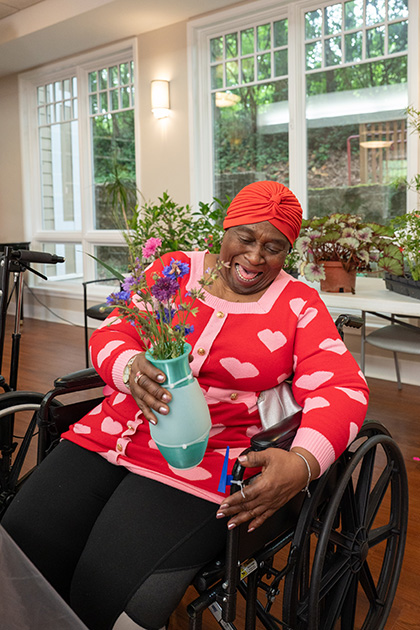
“I LOVE IT. IT’S MINE.” Essie Bailey-Demic beams as she tries a wheelchair-mounted vase attachment designed by Georgia Tech industrial design students, allowing her to transport the flower arrangement she created without assistance.
Where Independence Blooms
Essie considers herself fortunate because she doesn’t face the same limitations as some of her friends and neighbors.
“There are people here that have tremors. They can’t hold their hand steady. They can’t use their limbs as well as I can,” she said. “People want to do something, and they can’t. They’re stopped.”
As A.G. Rhodes’ horticultural therapist, Kirk Hines helps residents adapt as changes in strength, dexterity, and mobility make favorite hobbies more difficult.
“When you’re in a setting where so much care is being done for you, it’s vital for someone’s self-esteem to have that sense of independence and be able to do things for themselves,” he said.
“Those moments when a resident can say, ‘I did this myself’ are huge. You see it in their posture, in their smiles. That’s when I know horticultural therapy is really working.”
Planting Solutions
One particular session brought the residents’ challenges into focus.
Residents spent the morning arranging flowers. When they finished, they admired what they had created.
Then they waited.
They needed help. They couldn’t put the flowers away on their own.
Those moments when a resident can say, ‘I did this myself’ are huge."
– Kirk Hines, Director of Horticultural Therapy at A.G. Rhodes

LEARNING FROM ESSIE: A.G. Rhodes resident Essie Bailey-Demic (left) shares feedback with Georgia Tech industrial design student Olivia Chan and Professor Leandro Tenetto (center) during a horticultural therapy session. Residents’ lived experiences helped shape designs that better support everyday independence.
“It was such a disheartening moment,” Tonetto said. “They created these beautiful arrangements, but they weren’t able to take them back to their rooms themselves.”
Tonetto didn’t see a limitation in the residents. “I think it’s a design problem,” he said.
The students went back to work.
The solution they developed was a lightweight vase attachment that clips onto a wheelchair, allowing residents to transport their flower arrangements on their own.
When Sabrina Hebert, a third-year industrial design student, returned with the prototype, Essie immediately understood how it works.
“She just grabbed it,” Hebert said. “Essie told me, ‘I’m making this work. I’m doing it myself.’”
Essie clipped it onto her wheelchair without any assistance.
“I love it. I love it. It’s mine,” Essie said. “You can take it to your room and sit it on your dresser. Or you can leave it on your wheelchair, and when you go down the hall, people can see what you made.”
For the students, it was proof design changes could restore a measure of independence.
For Essie, it was a chance to do something herself — and to give something back.
“You know, it’s good to help,” Essie said. “I feel that I’m helping the students. That makes me feel good.”
You know, it’s good to help. I feel that I’m helping the students. That makes me feel good."
– Essie Bailey-Demic
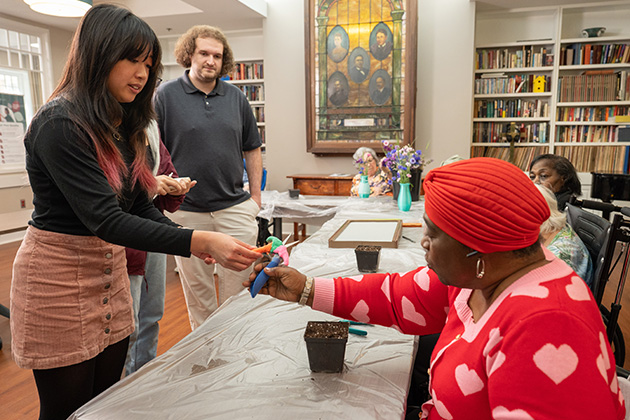
DESIGN IN PROGRESS: Georgia Tech industrial design student Olivia Chan (left) tests a prototype pruning tool with A.G. Rhodes resident Essie Bailey-Demic. Residents’ feedback shaped the students’ final designs.
TESTING THE DESIGN: Essie Bailey-Demic beams as she tries a wheelchair-mounted vase attachment designed by Georgia Tech industrial design students. The attachment allows her to transport her flower arrangement on her own.
This research work was supported by a Transformative Teaching and Learning Innovation Incubator grant from Georgia Tech’s Center for Teaching and Learning.

Writer and Media Contact: Michelle Azriel | mazriel3@gatech.edu
Photos: Rob Felt
Video: Christopher McKenney
Copyediting: Stacy Braukman