
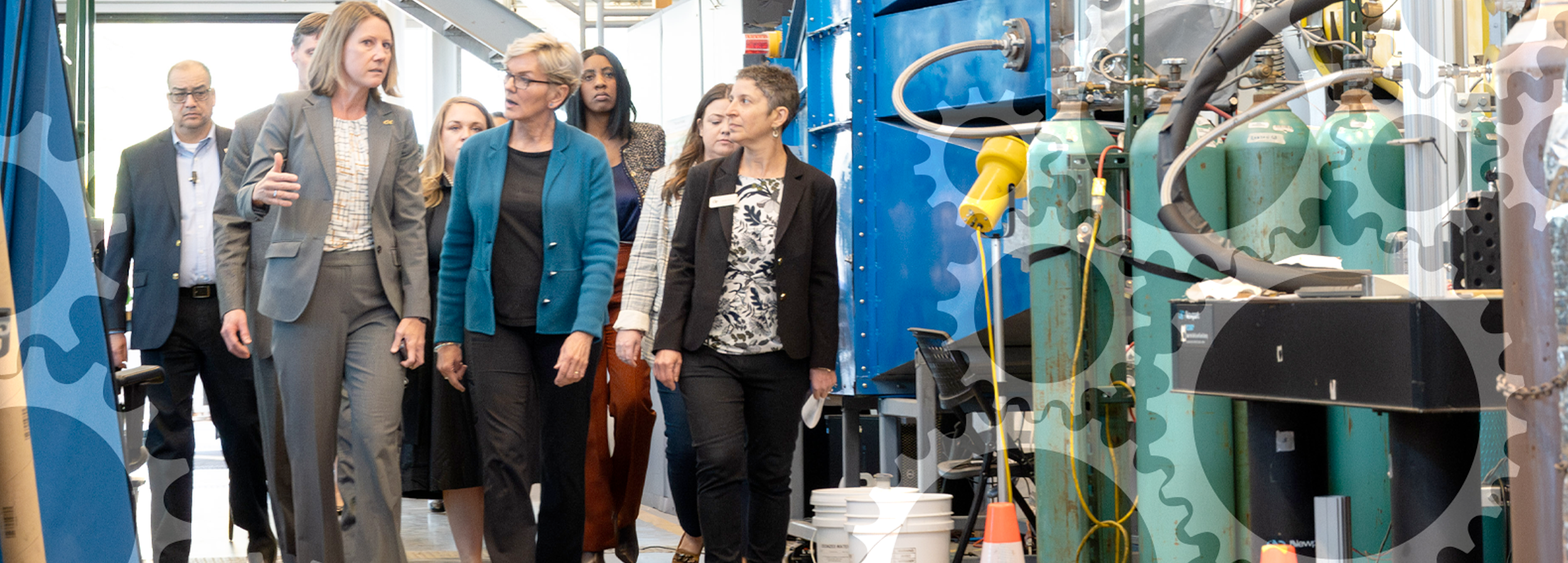
A community of multidisciplinary researchers at Georgia Tech has taken on the job of cleaning up the Earth’s carbon-riddled atmosphere through direct air capture (DAC). It’s a technology that scrubs carbon dioxide (CO2) from the ambient air, pioneered by Georgia Tech researchers in the early 2000s.

Tim Lieuwen, Georgia Tech’s interim executive vice president for Research.
DAC is like a combination giant vacuum cleaner and massive air purifier for the planet. Through an array of fans, a DAC machine pulls in air that flows across special filters loaded with molecules that trap CO2. The captured gas is then pumped underground for storage or used for other purposes.
But in addition to growing and improving the underlying technology, Georgia Tech is demonstrating leadership in other areas critical to the success of DAC in addressing one of humanity’s greatest challenges — climate change — on a global scale.
“Georgia Tech’s strategy is focused on overall impact,” said Tim Lieuwen, Georgia Tech’s interim executive vice president for Research and executive director of the Strategic Energy Institute (SEI), which houses the Direct Air Capture Center (DirACC). “That means that we continue to excel in the foundational science and technology we are known for, but we are also partnering with companies, and we start new companies. We license intellectual property, we inform policy makers, and we engage with local communities.”
The climate issue must be addressed, Lieuwen added, “and net-zero carbon emissions is the most cost-effective way for our society to get there. But it’s going to take expertise beyond the technology for DAC to succeed.”
“Net zero” refers to balancing CO2 emissions with an equivalent amount removed from the atmosphere, leaving no overall increase in the greenhouse gas.
“The CO2 problem is massive, and no one technology will solve it. We’ll need multiple technologies, including air capture.” —Krista S. Walton
Unlike technologies that capture greenhouse gases at the source — a coal power plant or another industrial pollution site, for example — DAC can be effective anywhere, pulling carbon from ambient air. As scientists across the globe work on different responses to climate change, Georgia Tech’s DAC experts are racing the clock to help the Earth reach that net-zero goal.
“The CO2 problem is massive, and no one technology will solve it. We’ll need multiple technologies, including air capture,” said Krista Walton, Tech’s associate vice president for Research Operations and Infrastructure and professor and Robert “Bud” Moeller Faculty Fellow in the School of Chemical and Biomolecular Engineering (ChBE). Her research program focuses on functional porous materials used in air purification, atmospheric water harvesting; and gas separations, storage, and capture (including CO2 capture).
Building Corporate Partnerships
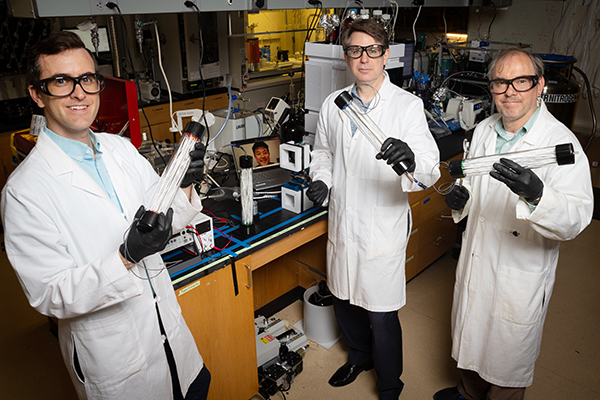
Direct air capture (DAC) thought leadership: (L-R) Ryan Lively, Christopher Jones, and Matthew Realff are trying to clean up the Earth’s carbon-riddled atmosphere.
No academic institution has authored more publications on DAC than Georgia Tech, where three other researchers from ChBE — Chris Jones, Matthew Realff, and Ryan Lively — are thought leaders in the global cleanup effort.
Jones and Realff co-direct DirACC, one of the few research centers in the U.S. devoted to direct air capture. DirACC brings together researchers in energy, sustainability, policy, and other fields, “to help solve a critical need and leverage our expertise in multiple areas, and build partnerships with various stakeholders, including industry,” said Realff, professor and David Wang Sr. Fellow.
“We’re part of a rapidly growing and vibrant commercial sector, with about 125 companies in the world focused on direct air capture right now,” added Jones, co-founder and CEO of ZeoDAC, a company launched earlier this year in Georgia Tech’s Advanced Technology Development Center (ATDC). “You can even argue that Georgia Tech was a major player in the largest U.S. startup.”
Georgia Tech essentially helped create the DAC commercial sector. Global Thermostat, launched in 2010, was built on Georgia Tech intellectual property — technology and patents from the Jones lab.
“In football, you don’t throw a Hail Mary pass on every play. But we’ve kind of gotten ourselves into a position where that is the best play we have.” —Ryan Lively
“We’re also fortunate to be able to collaborate with different industry partners, including some major energy companies,” said Jones, John F. Brock III School Chair.
Corporate members of DirACC include 3M, Chevron, and Meta, among others — Meta recently collaborated with Georgia Tech researchers to create a massive open dataset designed to accelerate AI solutions for carbon capture. Jones and Realff have led research projects for Global Thermostat, one of the first companies devoted to DAC. Lively collaborates with several companies, including DAC start-up Avnos. Lively and Realff also have worked with ExxonMobil.
Materials Matter
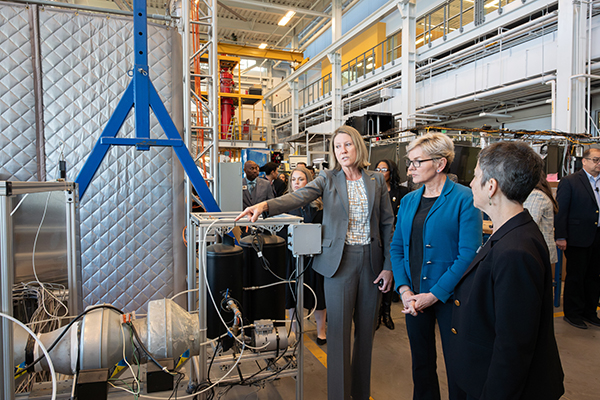
Krista Walton, Georgia Tech’s associate vice president for Research Operations and Infrastructure, explains direct air capture technology to U.S. Secretary of Energy Jennifer Granholm.
Lively also directs a multi-institutional Energy Frontier Research Center (EFRC), which studies the materials used in DAC and other clean energy technologies. In 2022, the EFRC, called the Center for Understanding & Controlling Accelerated and Gradual Evolution of Materials for Energy, received $13.2 million for four years in a rare third round of funding from the Department of Energy.
“All DAC processes are materials-based processes — some kind of material interacting with the atmosphere,” said Lively, who followed Walton in the director’s role of the EFRC. “And all materials age, so our research center is focused on understanding that process, because one of the key cost drivers right now in DAC is how long the materials last.”
The goal is to develop carbon capture materials that can last longer. But DAC isn’t a silver bullet. Addressing climate change still requires a commitment to alternative energy sources, according to Lively.
“Had we seriously started addressing climate change 30 years ago, there would have been much easier, cheaper, and efficient ways to deal with it,” he explained. “But the longer we go without changing our energy systems, the more we need DAC. In football, you don’t throw a Hail Mary pass on every play. But we’ve kind of gotten ourselves into a position where that is the best play we have.”
But even with that, the success of DAC will require a balanced approach from policy makers to grow and nurture DAC technology so that it can ultimately do the job.
All Carrot and No Stick

Valerie Thomas, Anderson-Interface Chair of Natural Systems and professor in the H. Milton Stewart School of Industrial and Systems Engineering.
The 2021 Infrastructure Investment and Jobs Act provided $11.5 billion to support carbon management innovation, including $3.5 billion for four DAC hubs.
“That has been the major aspect of current policy related to DAC — subsidies,” said Valerie Thomas, Anderson-Interface Chair of Natural Systems and professor in the H. Milton Stewart School of Industrial and Systems Engineering. She holds a joint appointment in Georgia Tech’s School of Public Policy. “Government is paying a subsidy for early-stage technology to bring down the cost, so that it can grow.”
And DAC technology must grow quickly, according to Georgia Tech’s experts and almost everyone else studying climate change. According to the Intergovernmental Panel on Climate Change, the world will need to remove up to 10 billion tons of CO2 from the atmosphere annually by 2050 to achieve net-zero emissions.
Without some restrictions on current CO2 emissions, that may be an unreachable goal, particularly in the U.S., where the Supreme Court recently overturned the 40-year-old “Chevron doctrine.” The Chevron doctrine allowed government agencies to establish reasonable rules of corporate conduct — including greenhouse gas emissions — when Congress hasn’t provided clear guidance.
Basically, the Court removed an important regulatory stick, and that represents a significant policy challenge going forward.
“Georgia Tech’s strategy is focused on overall impact.” —Tim Lieuwen
“Almost all of our policy around DAC is carrots,” said Thomas. “I like carrots, but there are so many, and the question becomes, when do we need sticks? Subsidizing technology and research to make things better is great. But were we more serious about limiting the emission of greenhouse gases, that would make it easier for the technology to take us where we want to go.”
Thomas, who has worked with the U.S. Congress in an advisory role and teaches a graduate course on technology policy, believes stronger political engagement (i.e., better communication with legislators), as well as knowledge of the policymaking process, can only help. With that in mind, the Direct Air Capture Center has added Micah Ziegler, assistant professor in both ChBE and the School of Public Policy, who brings both engineering and policy expertise into the mix.
Engaging the Community
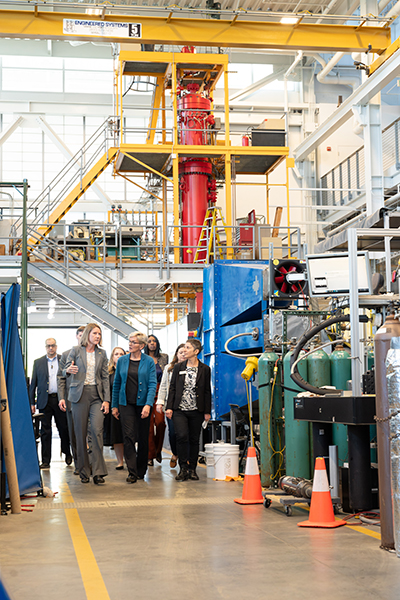
Walton leads a tour of one of Georgia Tech's high-bay labs used for direct air capture research.
Last year, Georgia Tech joined with the Southern States Energy Board and other partners to establish the Southeast DAC (SEDAC) Hub in Mobile, Alabama, with $20.5 million in funding from the DOE and other stakeholders. It’s the first step in what could become a $1 billion DAC facility development, according to Lieuwen.
For this initial stage of the hub project, Georgia Tech’s Center for Sustainable Communities Research and Education (SCoRE) is taking the lead in community engagement. The Community Benefit Plan is being led by SCORE’s senior director, Jennifer Hirsch, a cultural anthropologist whose work fosters university and community engagement in sustainability and climate action.
“We’ll work on bringing the community to the table in a meaningful role for SEDAC,” said Hirsch, who spearheaded an April symposium, “Advancing Direct Air Capture for Community Benefits and Decarbonization,” at Georgia Tech. The event brought together people from the research, government, industry, and community sectors to discuss the concept of equitable decarbonization.
According to Hirsch, the success of DAC’s rapid deployment could hinge on the ability to shift the decision-making process from the traditional developer-led model to a more inclusive, collaborative process.
“We believe in supporting community-driven visions,” she said. “Key to the success of this project — and of DAC hubs and ethical decarbonization overall — is developing decision-making processes and models that center community voices and leadership.”
“Key to the success of this project — and of DAC hubs and equitable decarbonization overall — is developing decision-making processes and models that center community voices and leadership.” —Jennifer Hirsch
Developing a Diverse Workforce
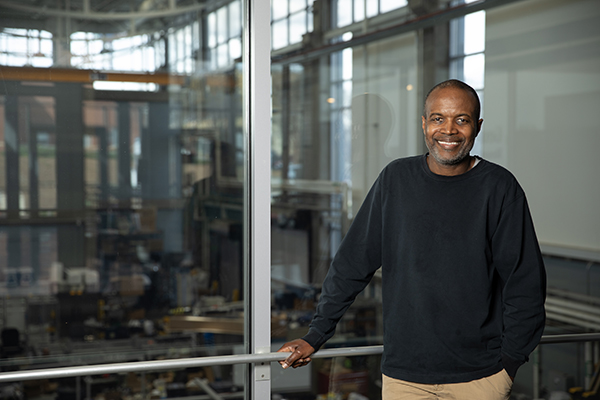
Comas Haynes, faculty member and principal research engineer in the Georgia Tech Research Institute (GTRI).
Meanwhile, Georgia Tech is helping to expand the scope of community in other ways, engaging historically Black colleges and universities (HBCUs) and minority-serving institutions (MSIs) in SEDAC’s ongoing development. The emphasis here is on developing a diverse workforce, a critical component in the continuing innovation of science and technology.
“The Department of Energy has prioritized workforce development, and that’s not exclusive to graduate school — the emphasis is on talented people with undergraduate degrees, two-year institutional degrees, and technical college certification,” said Comas Haynes, faculty and principal research engineer within the Georgia Tech Research Institute (GTRI). He’s co-leading the effort to develop a collaborative program with HBCUs and MSIs in the Southeast, alongside Taiesha Smith, senior program manager for HBCU and MSI Research Partnerships at Georgia Tech.
Haynes, an expert in thermal system management and design and an SEI hydrogen initiative lead, is still defining what that engagement will look like. But the broad aim would be to include aspects of DAC science and technology in the relevant curricula at HBCUs/MSIs, ultimately leading to internship and employment opportunities in direct air capture.
It’s just one part of a holistic plan to keep the planet habitable for everyone. As researchers work on overcoming the technical issues related to DAC’s widespread implementation, Georgia Tech’s multidisciplinary experts in policy, community engagement, and other areas are working to ensure these projects are successful on the ground, right where people live.
The big — and hopeful — idea is that if they can integrate this growing body of broad knowledge and perspective — fostering long-term, wide-ranging collaborations along the way — it will only help clear the air.
DAC Research Roundup
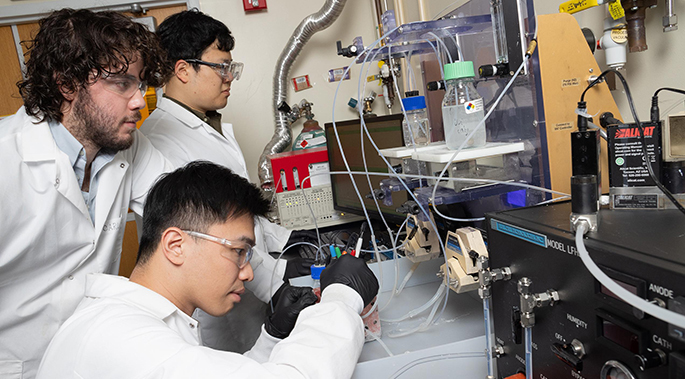
New Approach Could Make Reusing Captured Carbon Far Cheaper, Less Energy-Intensive
A research team led by Marta Hatzell designed a new electrochemical reactor to seamlessly integrate into direct air capture systems and turn CO2 into useful raw materials.
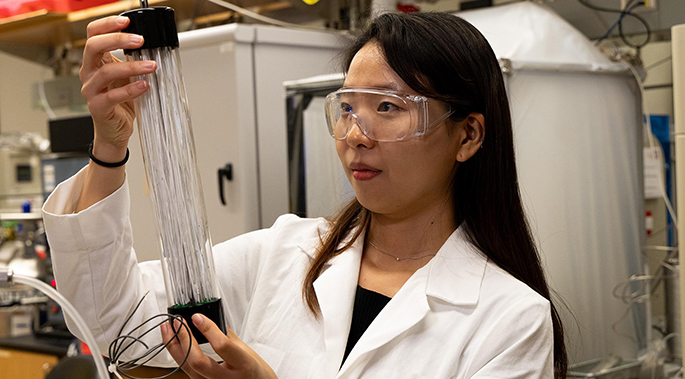
AI Solutions for Carbon Capture: Georgia Tech, Meta Create Massive Open Dataset
Andrew Medford and David Sholl developed OpenDAC, designed to accelerate climate solutions with an AI model that is orders of magnitude faster than existing chemistry simulations.
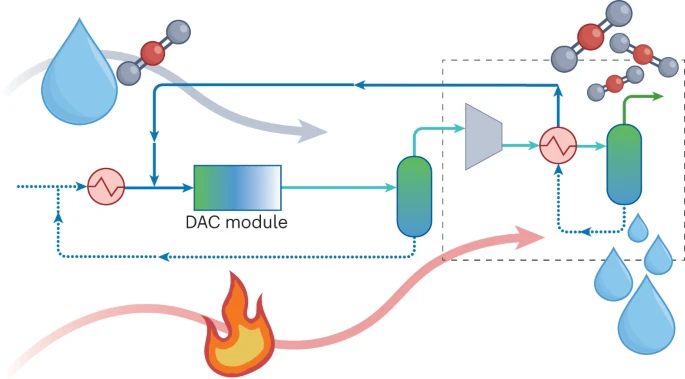
Water Management and Heat Integration in Direct Air Capture Systems
Water impacts every step of the DAC process and is crucial for making it affordable. Cost-effective water-management strategies, combined with heat recovery techniques, are essential for improving the efficiency and reducing the energy demands of DAC systems.
Ocean Capture: Three EAS Researchers Awarded DOE Funding for CO2 Removal
Annalisa Bracco, Taka Ito, and Chris Reinhard will create computer models to measure how well CO2 removal works on land, rivers, and oceans; part of $264 million in grants.
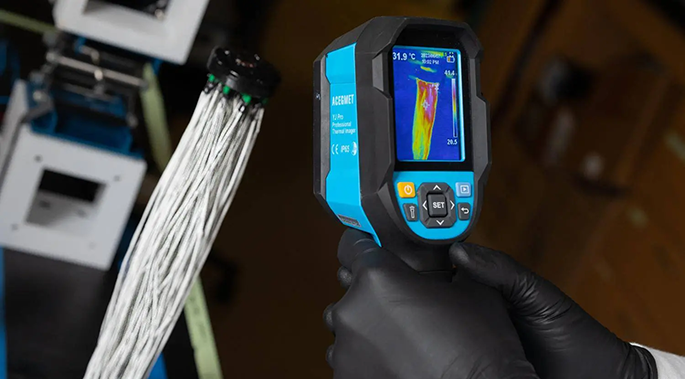
Inside-Out Heating and Ambient Wind for Cheaper, Efficient DAC
Chemical engineers use coated carbon fibers and eliminate steam-based heating in their simpler DAC system, which also can be powered by wind energy.
Scrubbing Carbon Directly From the Air
DirACC will leverage Georgia Tech’s leadership in a burgeoning field: COE feature story details Georgia Tech’s DAC ecosystem.
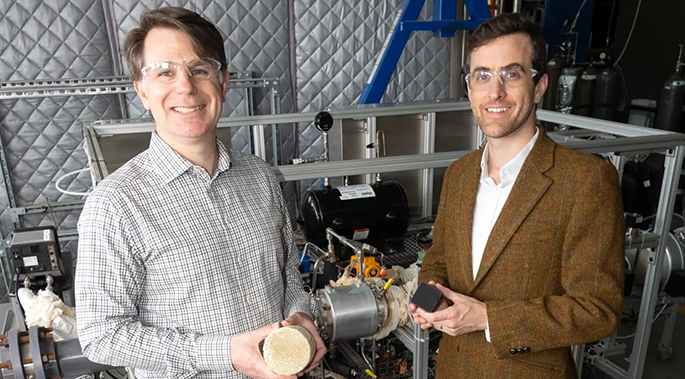
Chris Jones Wins Award for Excellence in Industrial Gases Technology
Georgia Tech researcher recognized for contributions to ultra-dilute CO2 separations, such as the extraction of CO2 from air.