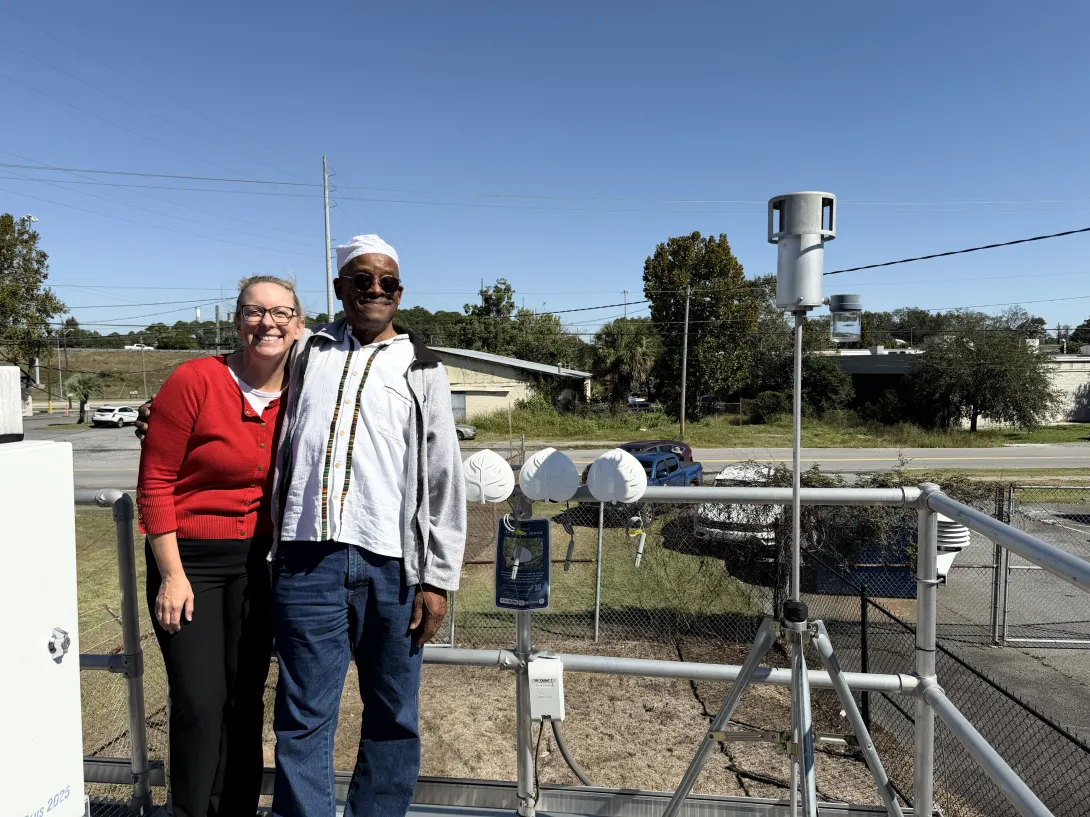
IPaT researcher Jill Gambill is pictured with David Shabaka, Harambee House, in Savannah. Behind them are three newly designed air monitors (white plastic leaf enclosures) waiting for installation in different locations.
SAVANNAH, Ga. (Oct. 23, 2026) – The City of Savannah, along with multiple community partners and stakeholders, hosted the successful installation of specialized air quality sensors in portions of greater West Savannah to monitor possible air pollutants.
Earlier this week, researchers with Georgia Institute of Technology’s (Georgia Tech) CEAR Hub and Massachusetts Institute of Technology (MIT), joined Savannah’s Harambee House, Inc., and other City leaders at the Bethel Missionary Baptist Church in the Ogeecheeton neighborhood to address residents’ concerns prior to assembling an air quality monitor at the nearby intersection of Julia Law St. and Dempsey St. The installation was one of four that take place this week on Savannah’s west side. Greater West Savannah residents and neighborhood leaders had previously identified two priority sources of air pollution: fugitive dust emissions and traffic emissions.
“This area has been plagued by these air pollution issues for years. Residents have complained about ongoing breathing problems and large amounts of dust escaping from industrial sites and blowing into their neighborhoods, and it is time for us to find real solutions,” said Savannah City District 1 Alderwoman Bernetta Lanier. “I am grateful to Ga. Tech, MIT, and our own Harambee House for leading the effort to make changes that could positively benefit generations to come.”
“We started the Savannah Air Quality Monitoring Network with Georgia Tech and the City of Savannah because this is a team effort. The residents and community leaders are involved because they make up the advisory board and have an essential role in guiding the project, and making sure their experiences, concerns, and priorities are considered throughout the research,” said Cristina Cordova, sustainability coordinator with Harambee House, Inc. “This is not just about collecting data, but also about working together with the community to better understand local air quality concerns and identify possible solutions. Our goal is to make environmental information accessible and useful to residents, and to work together toward meaningful actions that can help improve air quality and protect community health.”
The partnership between the universities, city government, and the non-profit launched four years ago to facilitate the installation of wireless, solar-powered air sensors in key locations affected by environmental pollution. Fugitive dust, fine particles of air pollution that come from open air sources near cement/concrete factories and industrial facilities, can be monitored by such devices to collect real-time, air quality data. The impacted area for Wednesday’s installation, in the heart of Ogeecheeton, is in proximity to industrial facilities and transport truck routes.
“Westside residents are experiencing combined impacts from industry and commercial trucks traveling through their neighborhoods. We’re starting with sensors that focus on pollution from factories, and we’ll soon deploy monitors to measure truck emissions,” said Jill Gambill, executive director and senior research associate, CEAR Hub, Georgia Tech.
The City of Savannah has been working with the CEAR Hub and Harambee House to install air quality monitors in areas that bear a heavy pollution burden since 2018. Researchers at MIT joined the efforts in 2026, offering additional support and working to help identify sensor locations, develop and test monitoring equipment, and establish the technical foundation for data storage and visualization.
“Through the development and deployment of low-cost environmental sensing devices, such as the air quality ones recently installed, we can collect continuous data in locations across the city,” said Alex Cabral, assistant professor at MIT. “This data will support residents advocating for heathier environments, help the city plan interventions and future developments, and aid researchers in tracking how environmental harms vary between neighborhoods and communities.”
While researchers collect and analyze air quality data, work is done to identify and implement risk reduction strategies. Additional sensors may be deployed based on community needs and feedback.
“These sensors will help us paint a clearer picture of the air quality concerns residents have expressed and give us better information to guide our next steps,” said Manny Dominguez, innovation team director with the City of Savannah Office of Information and Public Affairs. “By working together with residents and our research community partners, we can use that information to identify opportunities to improve environmental conditions in these neighborhoods.”
Three monitors were installed this week, in Ogeecheeton, West Savannah, and Old West Lathrop. An additional installation will take place soon at the Woodville Community Center with plans to expand in the future.
###
News Contact
Walter Rich