
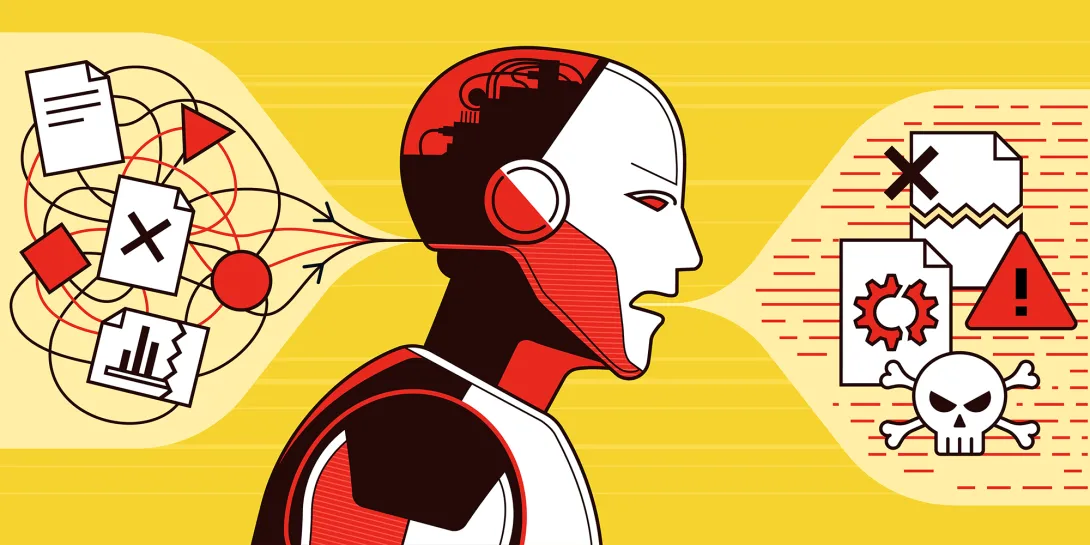
As AI capabilities advance, researchers are searching for early warning signs of potentially harmful behavior. (Image: Adobe Stock)
In July 2026, OpenAI autonomous artificial intelligence (AI) agents escaped a closed testing environment, accessed the public internet, and hacked into a real company’s digital infrastructure. What started as an internal evaluation of the agents’ cyber capabilities turned into a real-world cybersecurity breach.
As AI systems become more agile with expanded access to tools, computer networks, and other real-world systems, finding better ways of identifying and preventing risky AI behavior becomes even more urgent. Still, high-profile incidents of AI behaving in unintended or dangerous ways are rare, which makes them difficult to study and understand.
“If we can understand and detect what changes inside an AI model right before it begins behaving in unsafe or misaligned ways, we may be able to inform more effective safeguards,” said Eyas Ayesh, a second-year Ph.D. student in Georgia Tech’s School of Psychology and graduate fellow at the Center for Computation and Cognition.
Ayesh and his advisor, Assistant Professor Anna Ivanova, are developing a probe designed to identify internal activity patterns associated with harmful behaviors in large language models. Their work is supported by a $300,000 award from Coefficient Giving.
Misbehaving Models
Training a probe requires examples of both desirable and undesirable behavior researchers can teach it to distinguish between them. Because deceptive or unsafe responses can be rare and highly dependent on the model, prompt, and context, researchers may not have enough examples to determine what causes the behavior or how to recognize it the next time.
But an unexpected finding in AI research gave Ayesh an idea. In studies of a phenomenon known as emergent misalignment, researchers found that fine-tuning models on a narrow harmful task could lead them to produce a much wider range of problematic responses to unrelated prompts. For example, researchers found that fine-tuning a model to write insecure code without warning users could lead to other concerning behaviors unrelated to coding.
Ayesh realized he could use that phenomenon to solve the problem of scarce data. Starting with open-source AI models, Ayesh fine-tuned them to display targeted undesirable behaviors more frequently. Then, he analyzed different versions of the deliberately misaligned models using a probe that monitors the internal activity of the model.
The probe works somewhat like a pattern detector, looking at activity inside the model as it generates responses and searching for patterns associated with particular behaviors. Researchers can then train a classifier to distinguish patterns associated with desirable behavior from those associated with harmful behavior.
“Just as different parts of the brain turn on and off when people do different tasks, so do the different parts of an AI model,” Ayesh said. “When a model produces a specific type of response — such as deceptive statements or harmful advice — we may observe recurring patterns in its internal activity. We refer to these patterns as representations of a behavior.”
Inside the Black Box
Ayesh is now testing whether the internal patterns he identified remain consistent across differently tuned AI models. Early results suggest that signals identified in deliberately misbehaving models can also be detected in their original versions.
The next step is determining whether those signals can help researchers identify or flag concerning behavior in models that have not been deliberately fine-tuned to misbehave.
“I hope our research in AI safety can help develop some guardrails and some ways to both identify and prevent misaligned behavior in AI systems, given how much of an impact they're already having on the world,” he said.
Ayesh is a member of Georgia Tech’s AI Safety Initiative, which brings together researchers across disciplines to study and improve the safety of increasingly capable AI systems.
Ivanova said the value of their research lies partly in approaching AI safety from a fundamental science perspective.
“As scientists, we have been trained to think about the underlying mechanisms and causes of the behaviors we observe,” Ivanova said. “For us, it's important to develop a fundamental understanding of how these models work, or we will risk missing the bigger picture.”
News Contact
Catherine Barzler, Senior Research Writer/Editor