
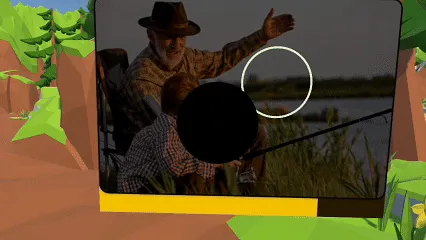
The images shown in the VR headset for the Macular Mailbox
Look directly at someone you love. What do you see?
For people living with age-related macular degeneration (AMD), the answer can be unexpectedly complicated. Over time, AMD can blur the details that make a face familiar: a crooked smile, a furrowed brow, the expressions that make someone unmistakably themselves.
But vision loss affects more than sight.
“You’re looking at your loved ones, but you’re not really seeing them,” said Soyoun Jang, a Georgia Tech Ph.D. candidate in digital media and the project’s lead researcher. “Macular degeneration requires us to build new relationships with not just other people, but the world that surrounds us.”
AMD gradually damages the macula, the part of the eye responsible for sharp central vision. As their sight changes, patients can use vision training to make better use of the sight they still have.
But Jang and a team of Georgia Tech researchers wondered whether that training could do something else: help people with AMD stay connected to family and friends.
Special Delivery
The answer arrived in a place few researchers would think to look: a mailbox.
The team created Macular Mailbox, a virtual reality prototype that combines vision-training exercises with personalized digital postcards that connect patients with family members and clinicians.
Each completed exercise delivers more than feedback — it delivers a message.
Inside the prototype, users focus on a postcard image as part of a vision-training exercise. When they complete the task, the postcard flips over, revealing a message and voice note.
Instead of earning points or badges, users receive something personal: a grandchild’s voice, a note from a spouse, or an update from another family member.
Signed, Sealed
The researchers chose postcards because they offered something familiar to older adults inside an unfamiliar technology.
“A postcard isn’t new,” Jang said. “It’s probably the oldest thing in the whole Macular Mailbox system.” Its front-and-back format also fit the exercise, and postcards do not require family members to be available at the same time.
Sending postcards back wasn’t part of the original design. The idea came later: What if patients could make something of their own and send it back?
Write Back
Until then, the mailbox only accepted incoming mail. The team decided the mailbox needed a return address.
The updated prototype allows patients to take a picture, record a message, and create their own digital postcard. And the act of making it becomes part of the training: framing a photo and holding focus use some of the same visual skills patients have been practicing.
The person receiving care could now make something and send it back.
Postcards might carry a glimpse of the garden, a pet curled up in a chair, or a sunset from the porch.
Keep in Touch
Many vision rehabilitation tools focus on reading, navigation, and other daily tasks. This project puts people at the center — not how well they can read a screen or navigate a room, but how they can remain part of the moments, relationships, and routines that make up everyday life.
“What this project offers is a different way of thinking about care,” Jang said. “Not just one way, but really putting family, clinician, and patient at the same table.”
For now, Macular Mailbox remains a prototype.
The next step is a series of co-design workshops with patients, family members, and clinicians. Participants will test the headset and help the researchers better understand each group’s roles, concerns, goals, and constraints.
_____________________________
AMD can make it difficult to look directly at someone you love and see the details that make them familiar, but connection lives beyond what the eye can see. It exists in the sound of their voice, an inside joke, or a moment in an ordinary day. And at the mailbox, there’s still something to send back — and someone waiting to receive it.
Jang, S., Huang, H., Hanna, B. E., Wang, X., Primo, S., & Nitsche, M. (2026). Asymmetric VR design to support connected care for older adults with AMD. Design Research Society, 2026: Edinburgh. https://doi.org/10.21606/drs.2026.817
News Contact
Michelle Azriel
Senior Writer-Editor
Research Communications
mazriel3@gatech.edu