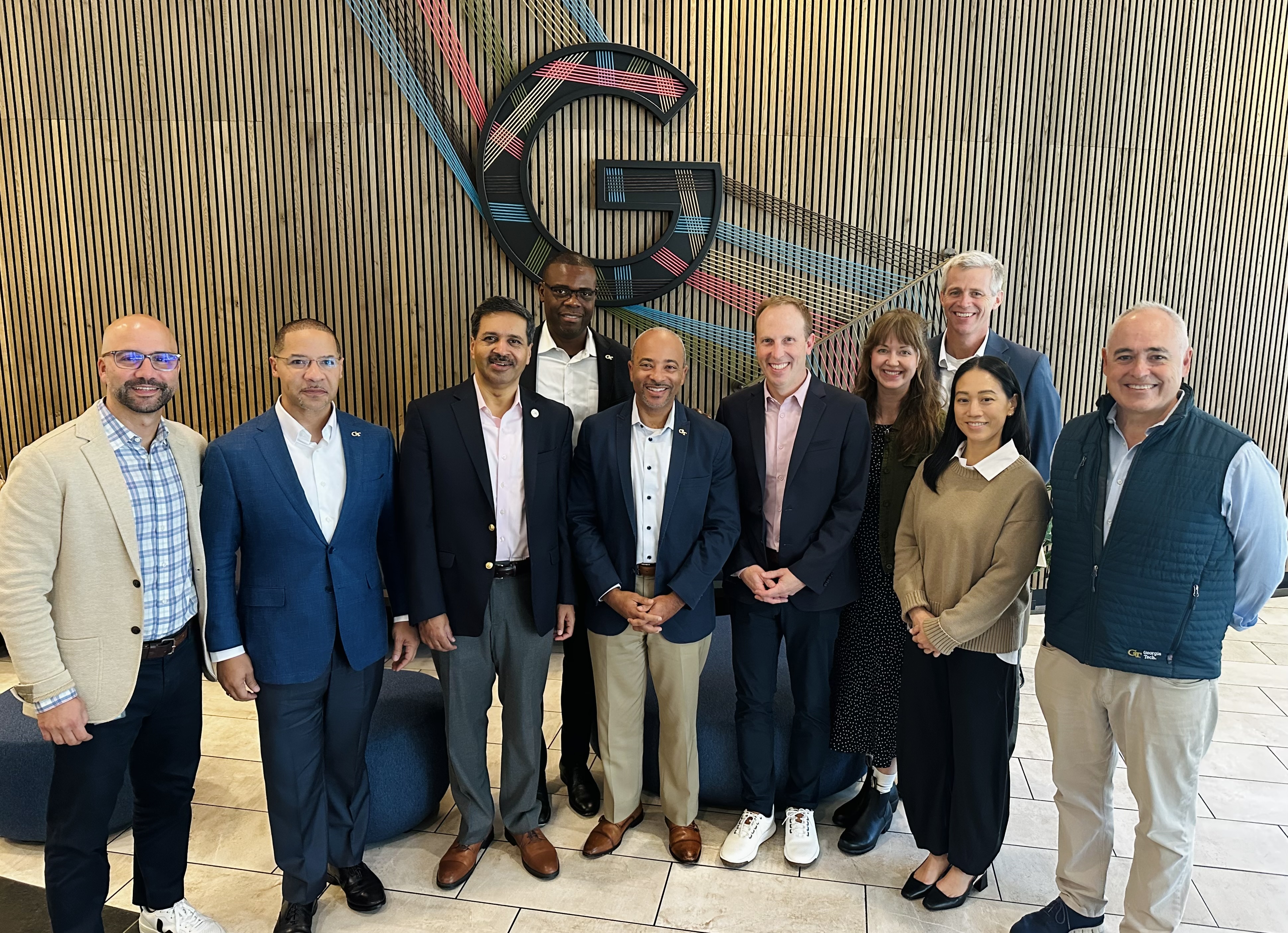
Georgia Tech researchers, educators, students, and industry leaders met at Exhibition Hall on Sept. 28 for the Tech AI Symposium to address the challenge of turning AI research into practical tools.
Two morning panels explored research collaboration and workforce adaptation, while an afternoon student poster session and a concurrent Tech AI Career Fair connected the discussions with research and career opportunities.
For Tim Brown, Georgia Tech’s academic program director for AI, helping people find the right expertise is a practical starting point. When people ask how to become involved in AI research and partnerships, he said, Tech AI can help connect their interests with researchers and projects.
“We get these inquiries every day,” Brown said. He encouraged students to share their résumés and areas of interest, and to seek out faculty whose research methods and fields of study align with their goals.
Tech AI’s broader purpose is to help industry, government, and other organizations move from research ideas to AI systems they can put to use. Part of the university-wide Georgia Tech AI ecosystem, Tech AI draws on expertise across the Institute’s colleges and schools, interdisciplinary research institutes, AI institutes, advanced computing infrastructure, and the Georgia Tech Research Institute (GTRI).

The "How Tech AI Collaborates" panel, moderated by Brown, examined what it takes to make those partnerships work, particularly when research depends on sensitive information or creates intellectual property.
Belinda Vogel, research engagement manager for the Georgia Tech Manufacturing Institute and the Renewable Bioproducts Institute, described plans to open advanced manufacturing capabilities to remote users in academia and industry. Such access could extend the reach of research facilities, but it also raises questions about how companies can benefit from AI while keeping their data private.
Kevin Dalmeijer, a senior research associate in Georgia Tech’s H. Milton Stewart School of Industrial and Systems Engineering and managing director of the NSF AI Institute for Advances in Optimization, described safeguards used in projects involving sensitive or controlled data. Those measures can restrict where information is stored, how students access it, and which AI tools they can use.
Dalmeijer also discussed internships that divide a student’s time between Georgia Tech research and work embedded within a company. Establishing clear boundaries at the outset, he said, helps distinguish academic research from company-specific implementations and clarifies expectations for data and intellectual property.
Brown brought Ajay Upadhyaya, Tech AI’s associate director for research administration, from the audience into the discussion to explain another approach. Upadhyaya described developing foundational models with synthetic data, allowing students to publish academic work, then defining separate ownership for work incorporating a company’s proprietary data. He emphasized the importance of clearly specifying those boundaries.
The panel also looked toward emerging computing capabilities. Jeffrey Young, a Georgia Tech principal research scientist working with the Partnership for an Advanced Computing Environment, discussed how AI could help researchers improve quantum systems and determine how best to map applications onto quantum hardware. His remarks pointed to a relationship in which AI can support the development of other computing technologies, even as researchers continue exploring their potential.
The second panel, “Workforce Adaptation in the Age of AI,” shifted the focus to the people learning and working with these tools. Moderator Leigh Hopkins, assistant director of Georgia Tech’s Center for Economic Development Research, described a workforce being asked to adapt while the technology itself rapidly changes.
David Joyner, Georgia Tech’s interim vice provost for AI in Education and executive director of its Online Master of Science in Computer Science program, said AI familiarity is moving toward becoming an expected professional skill. He compared that transition with an earlier era when applicants listed typing speed on their résumés before such capabilities became “baseline.”
People still need the knowledge and judgment to do the underlying work themselves, Joyner said. Learning to use AI must be paired with learning to evaluate its output and avoid overreliance on the technology.
Georgia Tech faculty are exploring that balance through classroom experimentation, from changing assignments to developing tools tailored to particular courses. Joyner described the Academic AI Playbook as a way to share what individual instructors tried, the challenges they encountered, and what others might learn from their experiences. The 2026 edition includes 67 faculty-authored articles and 20 lessons drawn from classroom experience.
Joyner also raised a longer-term question for employers and educators: If AI takes on tasks traditionally assigned to entry-level employees, how will those employees gain the experience needed to advance? He suggested that evaluating work, framing problems, and defining clear requirements will become increasingly important as people take responsibility for directing AI-assisted work.
Georgia Tech alum Brian Greene, an operations and supply-chain executive, brought the discussion back to organizational decision-making. Companies can become so focused on acquiring an AI tool, he said, that they overlook the business need it is supposed to address.
“What’s the problem you’re trying to solve?” Greene asked. He urged organizations to begin with that question and work backward to the capabilities and partnerships they need. For smaller businesses with limited resources, choosing a tool without a clear purpose can be especially costly.
Narayanan (KK) Krishnakumar, chief technology officer at Delta Air Lines, offered examples of AI at work in a large organization. He described systems that help optimize baggage routing and generative AI tools that summarize information for customer-service employees. Across those applications, he emphasized the continuing need to verify AI-generated information.
For both Krishnakumar and Greene, the qualities employers value remain the same as they have traditionally been: curiosity, problem-solving, collaboration, and an ability to deliver results. AI fluency adds to those capabilities while making sound judgments about data and answers all the more necessary.

The afternoon poster session demonstrated how widely those questions now reach. Student projects explored trustworthy optimization, AI agents and responsible design alongside research on education, city planning and biomedical diagnostics. Other work addressed materials discovery and sustainable material selection, quantum chemistry, signal analysis, and AI that could support aging in place.
A well-attended career fair ran simultaneously with the symposium. In a large auditorium filled with company booths, students lined up to meet employers as both sides sought to connect research with potential positive industry outcomes.