
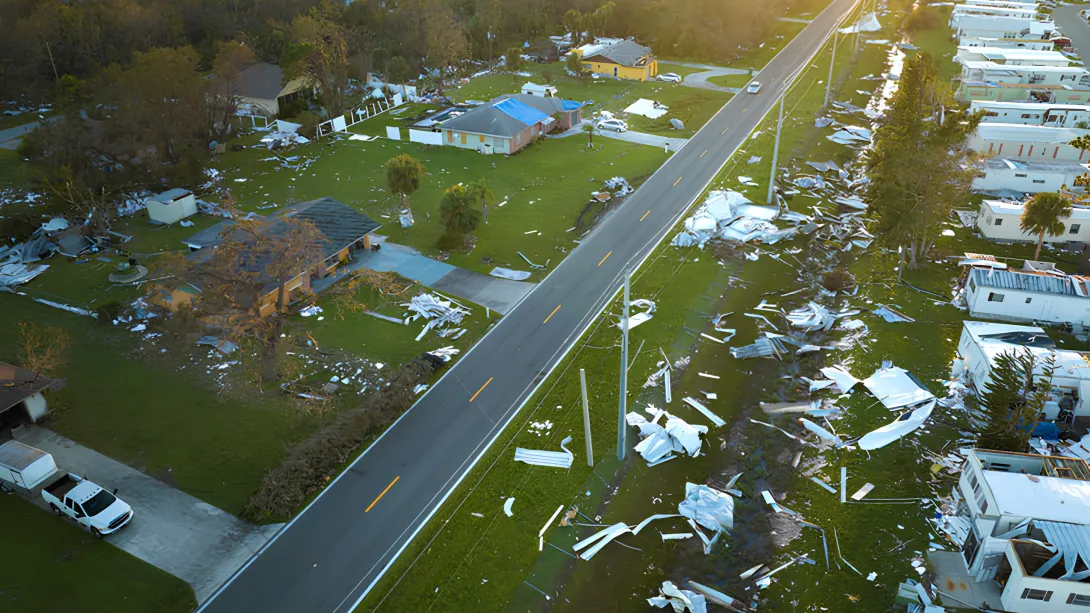
A Florida neighborhood destroyed in the aftermath of Hurricane Ian, 2002.
The storm ends, the fire goes out, floodwaters recede.
And, for some, the rent rises.
Long after a natural disaster fades from the headlines, economic aftershocks can still push people out of their communities, not because their homes were destroyed, but because they can no longer afford to remain there.
A new Georgia Tech-led study found that rents were 6.5% to 12.5% higher than expected four years after a disaster. Similar communities that weren’t hit did not see the same jump.
Brian An, an associate professor in the Jimmy and Rosalynn Carter School of Public Policy within the Ivan Allen College of Liberal Arts, and his team studied two decades of rental housing data and federal disaster records from California and Florida.
“We often think of housing as a market that will sort itself out,” An said. “But a natural disaster is not a normal market condition. Housing is destroyed. People are displaced. In those moments, renters can become especially vulnerable.”
After a disaster, the housing market’s usual rules no longer apply. Damaged apartment buildings mean reduced supply. Displaced homeowners enter the rental market while their homes are repaired or rebuilt. Construction, repairs, and insurance all get more expensive.
The largest rent increases followed hurricanes and wildfires more than earthquakes, flooding, and tornadoes. For communities hit repeatedly, each new storm or fire added more rent pressure.
More Demand, Less Room
“When rents go up after a disaster, we're not talking about a small segment of housing,” An said. “We're talking about the broader rental market. That means the effects reach far beyond the homes that were damaged.”
For renters, the consequences extend beyond monthly housing costs. Higher rents can make it harder for families to remain close to support networks. Children may have to change schools. Workers may face longer commutes. Longtime residents can find themselves priced out of communities they helped build.
The findings point to a central tension in disaster recovery: Rebuilding homes is not the same as keeping communities intact.
A Different Path Home
Not every community experienced the same outcome.
Areas that received federal support through Community Development Block Grant Disaster Recovery (CDBG-DR) funds saw smaller rent increases than similar communities that did not. The money can be used to build and preserve affordable rental housing, giving residents more options as their communities recover.
An said the study cannot prove that funding alone caused rents to rise more slowly. But the pattern suggests that recovery resources may shape who can afford to stay in a community once rebuilding begins.
Rebuilding Lives, Not Just Homes
As communities face repeated hurricanes, wildfires, and other disasters, An believes policymakers need to think differently about recovery. That could mean investing in more resilient housing, expanding affordable rental options, and strengthening protections for renters after disasters strike.
“Everyone needs a place to live,” An said. “As disasters become more frequent, housing can't be an afterthought in recovery.”
An’s research is published in The Russell Sage Foundation Journal of the Social Sciences.
News Contact
- Michelle Azriel
Senior Writer-Editor
Research Communications
mazriel3@gatech.edu