
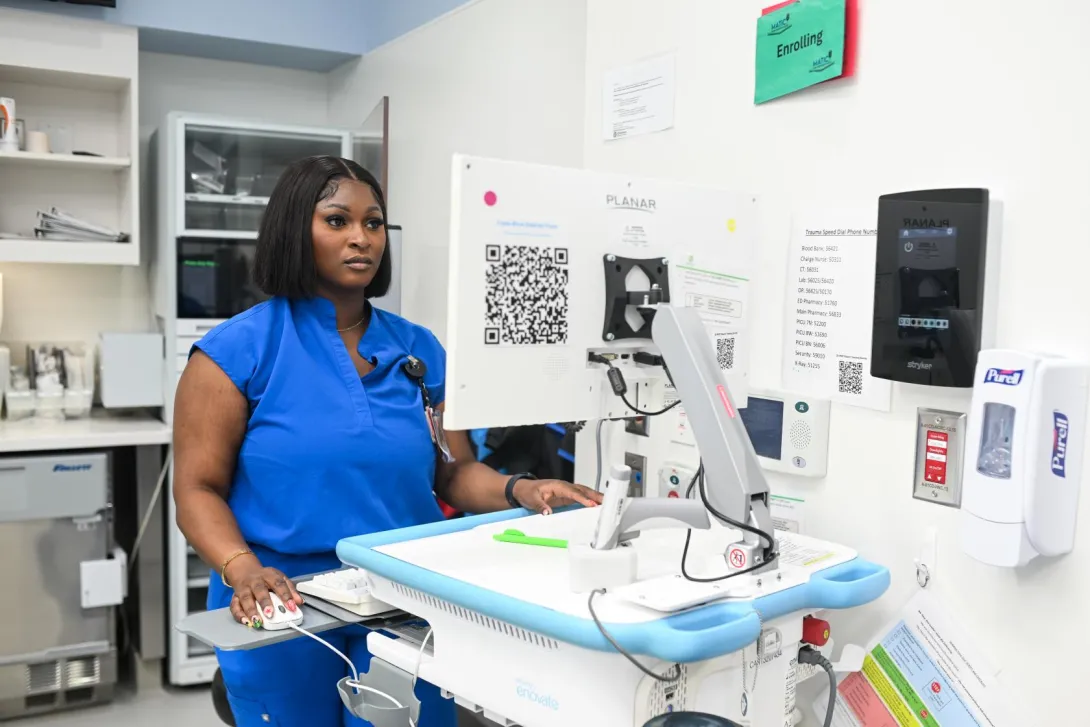
Pediatric healthcare professional reviewing electronic health record information at Children’s Healthcare of Atlanta Arthur M. Blank Hospital. (Photo courtesy of Children's Healthcare of Atlanta)
A child can be in the hospital and seemingly getting better. Then, suddenly, everything changes.
One moment they're playing games or watching television. The next, they experience breathing failure, shock, or neurological decline. If the warning signs aren't recognized early enough, the child may require emergency transfer to the intensive care unit (ICU), where interventions can include breathing tubes, blood pressure medications, and other lifesaving measures.
The phenomenon is called “emergent deterioration.”
"Kids will look fine, and then all of a sudden they'll fall off a cliff and rapidly deteriorate," said Dr. Mark Mai, a pediatric intensivist at Children’s Healthcare of Atlanta, who cares for critically ill children in the ICU. "When those kids go to the ICU and need emergency interventions, they have a much higher rate of death than kids we bring up to the ICU in a controlled fashion."
To help clinicians identify those high-risk patients sooner, researchers at Georgia Tech are partnering with Children's clinicians and technology teams to create an artificial intelligence-powered warning system. Known as Algorithm for Counteracting the Clinical Onset of Rapid Deterioration (ACCORD), the three-year project is one of the first funded projects focused on a software solution by the Children’s Healthcare of Atlanta Pediatric Technology Center at Georgia Tech (PTC). Project teams are working simultaneously on model development, app design, and user testing. And, unlike many healthcare AI projects that remain confined to research papers, ACCORD is being designed from the beginning for use in a real hospital. The ultimate goal is to help clinicians intervene before a child reaches a life-threatening emergency.
Teaching AI to Spot Trouble Earlier
Today, clinicians rely on an early warning score that combines measurements such as heart rate, blood pressure, and breathing rate into a single risk assessment. While helpful, the approach simplifies a complex clinical picture.
"The current system is a pretty basic rubric that sums up all the data points and then decides whether they are high-risk or low-risk, but from the data science and machine learning perspective it's not optimal," said Kai Wang, an assistant professor in the School of Computational Science and Engineering and project co-principal investigator with Mai.
Rather than evaluating patients through a fixed scoring system, ACCORD's AI model analyzes dozens of data streams, including vital signs, laboratory results, and clinical observations. The goal is to uncover subtle patterns that may signal deterioration hours before the physical warning signs become obvious to clinicians.
"We want to build a more sophisticated algorithm that can look into vitals, blood pressure, heart rate, and other measures to provide a more granular forecast of risk," Wang said.
Building that capability into an algorithm requires making sense of one of healthcare's biggest challenges: messy, incomplete, and constantly changing data. To develop the model, researchers are training and testing it using information pulled from Children's electronic health records. Some information, such as vital signs, is collected continuously. Other information may be recorded less frequently or at irregular intervals, such as nursing observations.
"That is both the most challenging and the most exciting part of this project," said Himadri Pandey, a machine learning Ph.D. student working on ACCORD. "We have to consider the realities of a healthcare setting. Data may be incomplete or delayed, staffing and resources may change, and any recommendation must be understandable and usable by clinicians."
"The goal is not simply to build a model that works mathematically," she added. "It's to build something that could genuinely support decision-making in a hospital."
Building Technology Nurses Will Use
For ACCORD to improve patient outcomes, the technology must fit naturally into clinicians' daily workflow. Most nurses care for multiple patients simultaneously and cannot continuously monitor a single child. Because episodes of emergent deterioration are relatively rare in a full day of care, opportunities to gain experience recognizing the earliest warning signs can be limited. Acknowledging that reality, project leaders involved frontline nurses from the beginning.
"We went straight to the nurses and said, 'This is what we're trying to do. You tell us what would make your job easier, how you need the flow, what it needs to look like, and we will build according to that,” said Christina Roberts, program manager for PTC and the Health Informatics Core at Children’s. "We brought them into the process very early and gave them a say in the development, so they know exactly what to expect when the tool comes to the floor."
The team plans to integrate ACCORD directly into the Children’s electronic health record system, where clinicians already access patient information. The application will combine vital signs, laboratory results, and other clinical data into a single dashboard that can automatically flag patients at elevated risk of deterioration.
Researchers and clinicians continue to meet regularly as the platform evolves.
"How do we distinguish what the algorithm finds important and what is just always there?" said Dr. Claire Stokes, a pediatric hematologist and oncologist with the Aflac Cancer and Blood Disorders Center at Children’s, who is involved in the project. "Because a clinician probably always wants to see the vital signs, even if they're not alert levels, for example."
Those conversations help ensure that the system provides useful information without overwhelming clinicians with additional data or alerts. The team hopes to begin testing the system in clinical settings by 2027 before broader deployment. For the researchers working on ACCORD, however, the project's success will ultimately be measured by the patients it helps.
"I know that one research project cannot solve every problem in healthcare," said Pandey, who has experienced the hospitalization of a close family member. "But being able to contribute, even in a small way, allows me to replace some of that earlier helplessness with purpose."
If successful, ACCORD could give clinicians something they rarely have when a child begins to decline — time.
News Contact
Tess Malone, Senior Research Writer/Editor
tess.malone@gatech.edu