
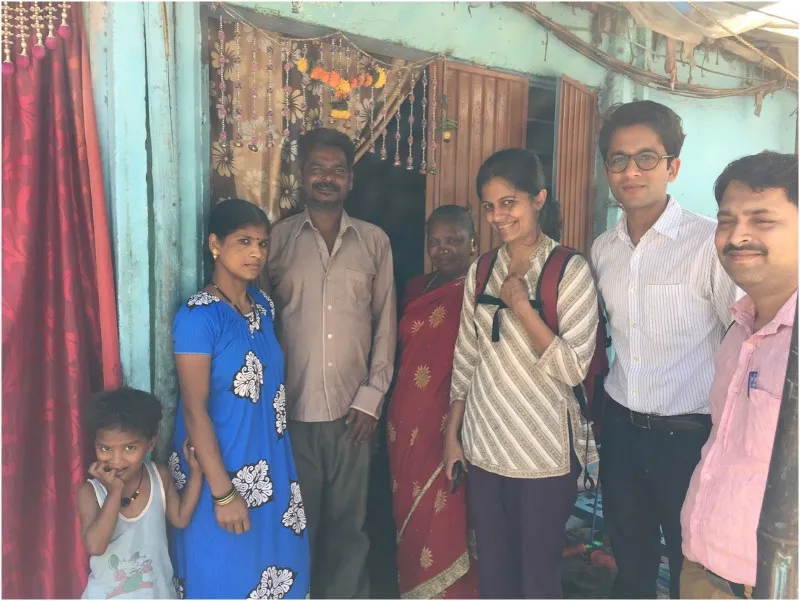
The researchers during a field visits to one of the informal settlements in the study. (Photo courtesy of Anjali Thomas)
Access to clean drinking water is a basic human need, yet many residents struggle to obtain it. In Mumbai, India, one of the world’s largest and most populated cities, hundreds of informal settlements housing millions of citizens face barriers to securing government-provided water connections. New research from Georgia Tech found that neither administrative assistance nor political advocacy alone was enough to overcome those obstacles. But together, the two bottom-up approaches produced dramatic results.
Over five years, researchers tracked nearly 7,000 households across 154 Mumbai settlements to determine which strategies most effectively helped residents secure water connections. They found that helping residents navigate the application process — while also organizing community advocacy — increased official water connections by 45% compared to households that received no assistance.
“There have been many studies looking at just using administrative assistance to help communities get water access,” said Anjali Thomas, an associate professor in the Sam Nunn School of International Affairs, director of the Global Development Program, and co-lead author of the study. “But combining this with community organizing, which helped people also exert their voice, was unique to our study.”
Thomas and collaborator Nikhar Gaikwad, an assistant professor at Columbia University, published the findings in the American Journal of Political Science, long ranked among the top three journals in the discipline.
Navigating Bureaucracy and Building Voice
The researchers first examined why so few residents applied for water connections. Residents were often unaware that recent policy changes had made them eligible for water connections and didn’t bother applying. The municipal corporation also only accepted online applications, and many residents didn’t have access to computers. Additionally, applications required onerous documentation, including tenant or land titles, plumbers’ approvals, and other proof-of-eligibility deeds. To address these barriers, the research team worked with an extensive team of nongovernmental organization workers to help residents gather required documents, complete applications, and navigate bureaucratic follow-up requests.
The second intervention focused on community advocacy. Researchers helped residents organize through WhatsApp groups, petitions, public awareness campaigns, and facilitated group visits to bureaucrats and elected officials’ offices to press for water access.
“Our community advocacy intervention helped citizens convey their collective water access demands to elected politicians,” said Gaikwad. “Local elected politicians are important actors because they help bureaucrats understand citizen needs, prioritize competing demands, and coordinate complex interagency work.”
The study’s most important finding was that neither intervention was effective on its own. Meaningful gains occurred only when administrative support and community advocacy were combined.
“Administrative assistance got citizens through the paperwork, but actually getting the water turned on took collective public pressure,” Thomas said. “Interestingly, we find that this pressure worked only in the period before local elections, when politicians were most motivated to respond.”
The finding suggests that improving access to public services often requires more than helping residents navigate government systems. Communities may also need the collective ability to demand action from decision-makers.
A Large-Scale Effort
Conducting a study of this scale required a large team. Thomas and Gaikwad partnered with local nonprofit organizations that deployed hundreds of community workers, survey enumerators, and students across participating settlements. The researchers personally visited many neighborhoods multiple times during the five-year project.
Thomas also spent time in India and witnessed the impact firsthand.
“I was in the field when one of the pipes was being laid, and people from the community all circled around and were watching,” Thomas said. “My research assistant and I felt the gratitude from the community.”
For Thomas, moments like that underscore the broader lesson of the project: expanding access to essential services often requires both helping people navigate bureaucracy and empowering them to make their voices heard.
“These findings offer vital lessons for sustainable development initiatives worldwide,” she said.
Gaikwad agreed.
“While our study provided novel evidence to test and advance our theoretical understanding of the barriers that marginalized citizens face in accessing core government services, the real-world impact of our interventions in Mumbai’s informal settlements was also an important contribution of our study,” he said. “We believe there are important lessons for governmental and nongovernmental organizations working on service delivery in a wide range of informal settlements that also lack essential services across the Global South.”
This research was funded by Evidence in Governance and Politics, the Department for International Development, Columbia University, and Georgia Tech’s Neal Family Endowment.
CITATION: Gaikwad, Nikhar, and Thomas, Anjali. (2026). “Getting on the grid: A field experiment on bottom-up political pressure and access to essential public services.” American Journal of Political Science 1–22.
News Contact
Tess Malone, Senior Research Writer/Editor
tess.malone@gatech.edu