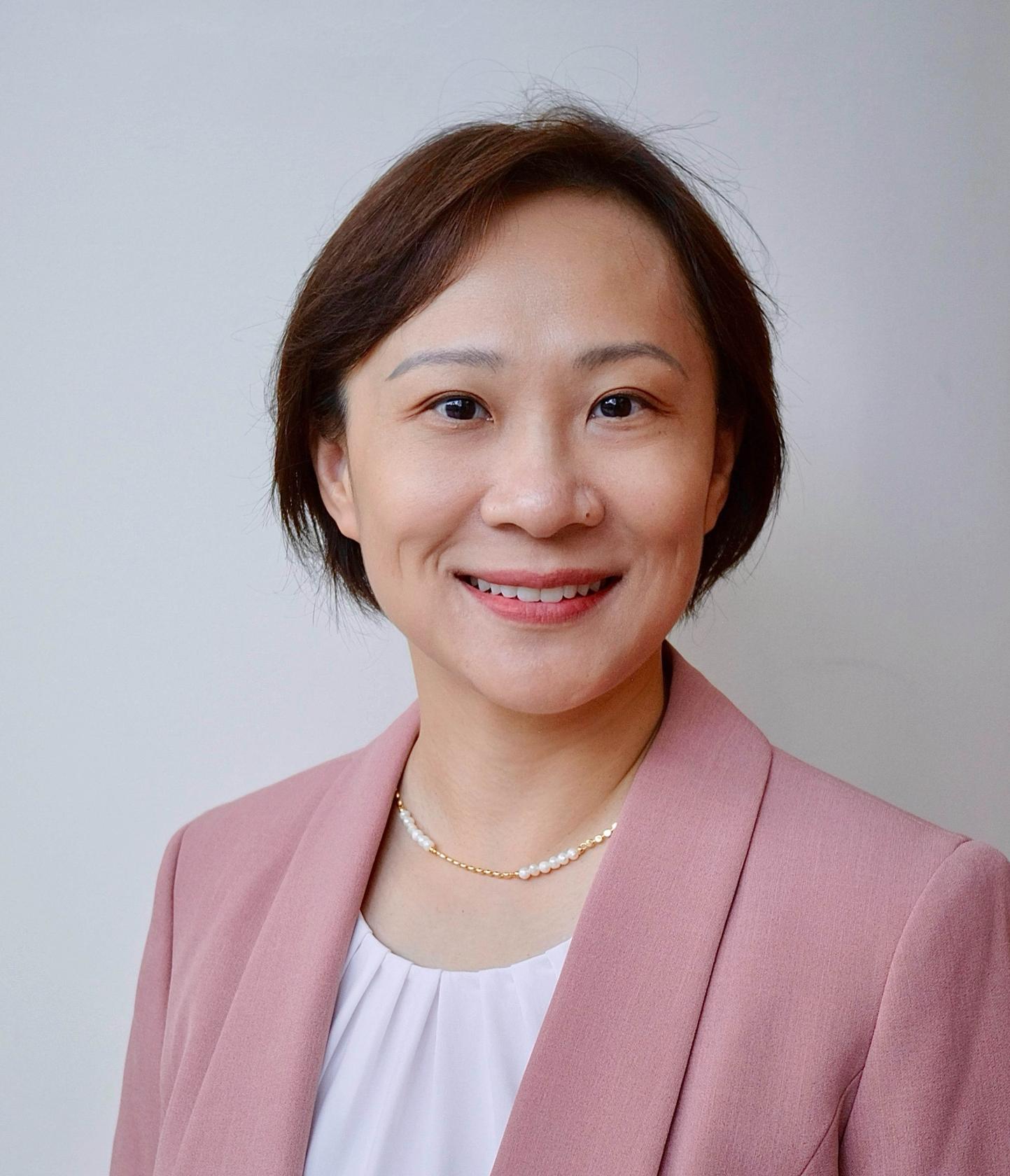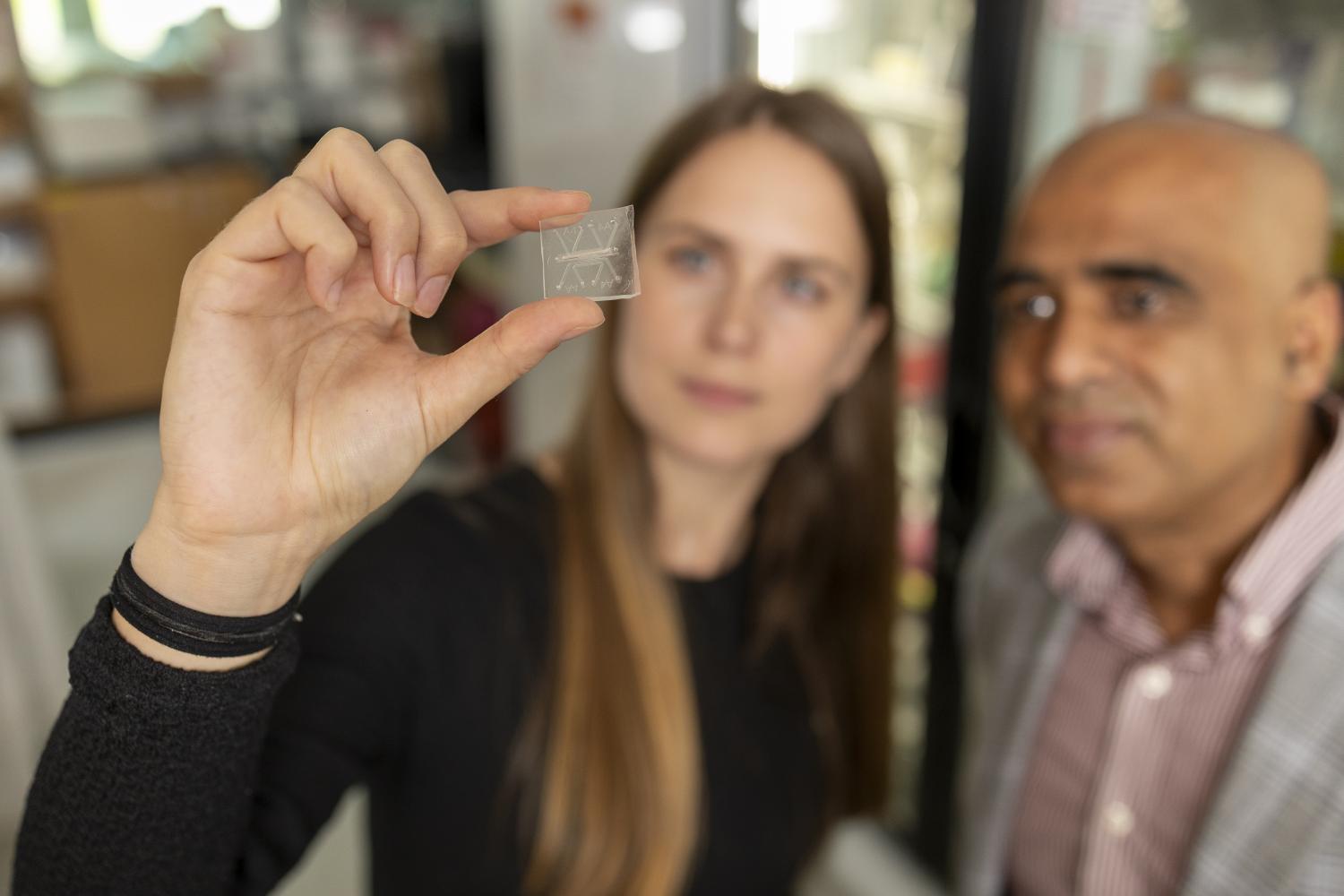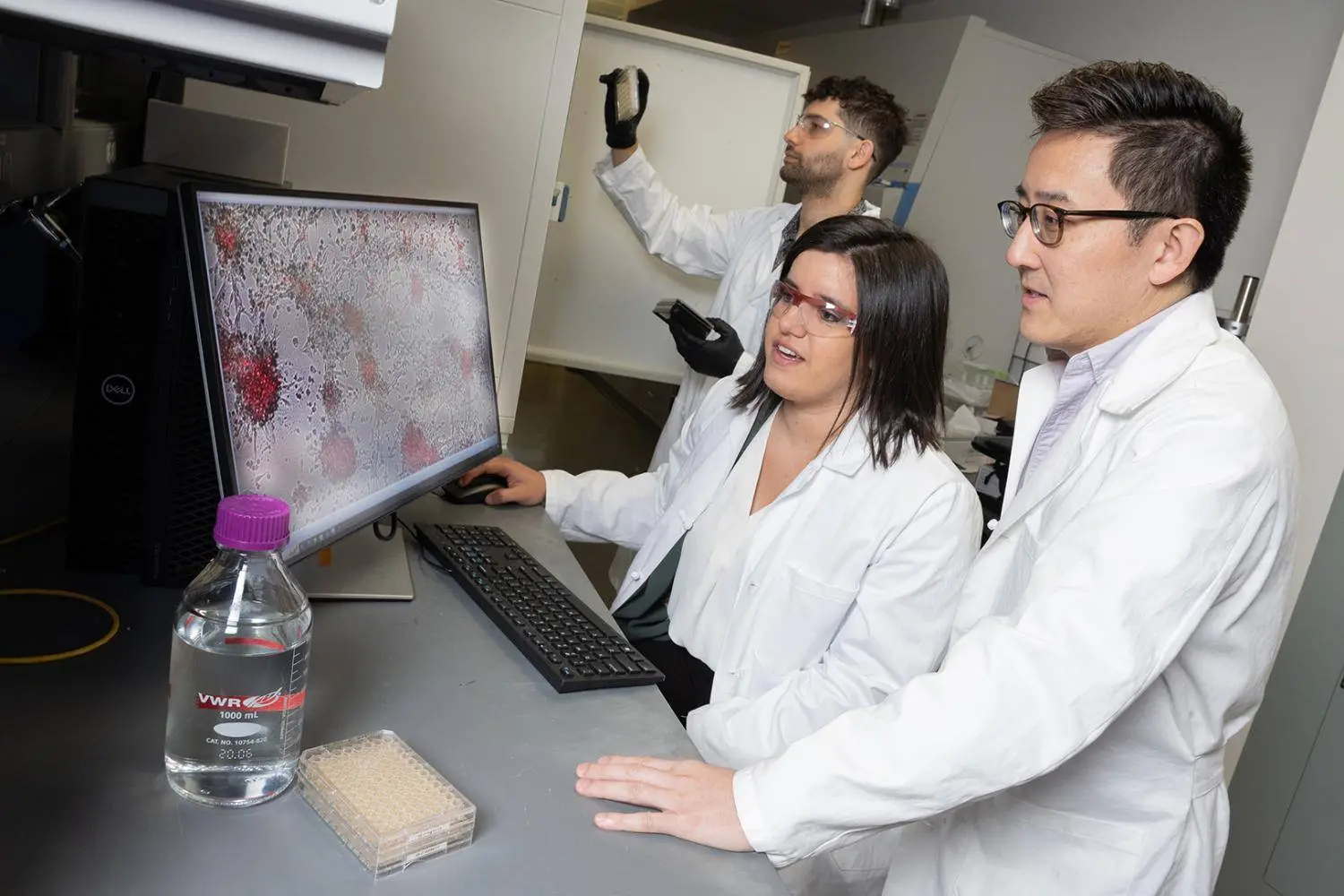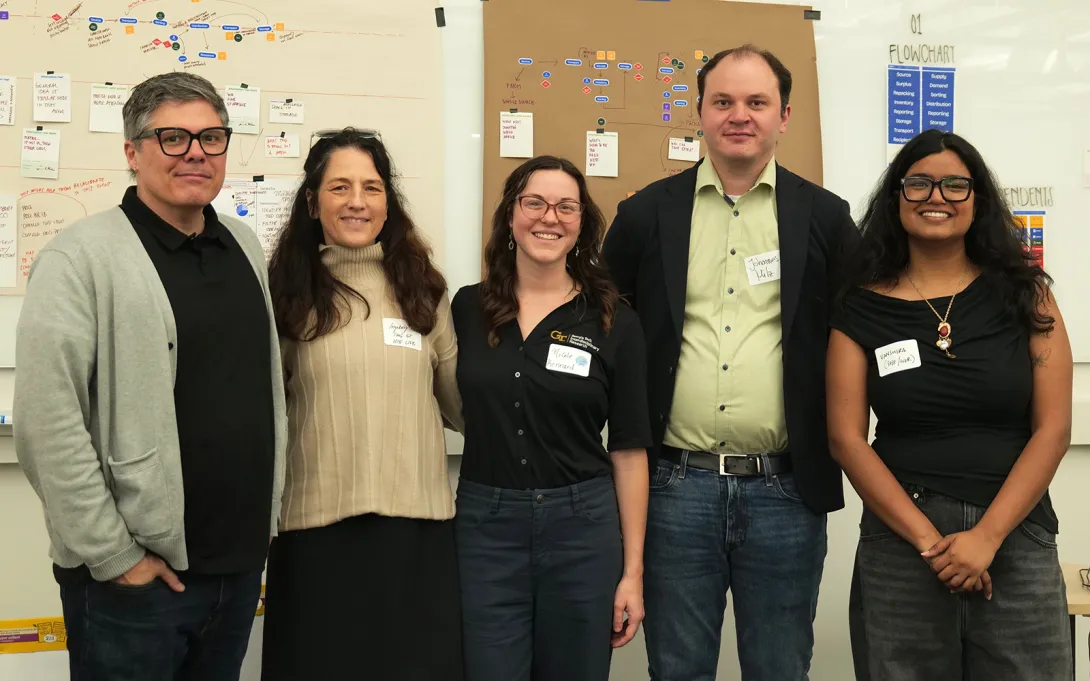
L to R: Carl DiSalvo, Ingeborg Rocker, Nicole Kennard, Johannes Milz, and Vanshika Kumar.
BBISS researcher Nicole Kennard is mapping how Atlanta's local food ecosystem functions today, how the people inside it envision its future, and where the opportunities for transformation lie. A summer research trip to Europe brought back fresh models and new energy for the work.
How does Atlanta's local food ecosystem function today? How do the people working inside it envision its future? And where are the opportunities for transformation?
Those three questions drive the systems and network mapping research of Nicole Kennard, a research scientist and assistant director for Community-Engaged Research at Georgia Tech’s Brook Byers Institute for Sustainable Systems (BBISS). Within a systems map, Kennard charts intersecting food challenges and the intervention strategies that could address them. A companion social network map reveals the relationships that already exist across the food ecosystem and who needs to be brought together to create change. Both feed into the Atlanta Food System Research Network, an effort to increase coordination and build teams around the food system's most stubborn, systemic challenges.
The mapping regularly shows one significant gap: One in eight metro Atlantans are struggling to access food. Although more local farmers are growing good food, there is a “missing middle layer” of infrastructure connecting that food to those who need it, according to Atlanta’s 2026 Climate Resilience Action Plan. Food produced by smaller farms often can’t enter traditional supply chains due to small quantities, so new models are needed to move that food in ways that people can access it within their everyday routines. A summer research trip through France, Belgium, and the U.K. provided her with fresh models for closing that gap.
"I learned a lot from these models that I'm trying to bring back to Atlanta for my systems mapping research," Kennard said. "One of the biggest issues is we're missing that middle layer — better ways to distribute local food so it's reaching all neighborhoods equitably, and it's actually accessible."
It's not Kennard's first time working on food systems abroad. After graduating from Georgia Tech with a degree in materials science and engineering and running a student-led hydroponics project that grew food for the Atlanta Community Food Bank, she spent nearly four years in the U.K. as a Fulbright Scholar, earning a master's in sustainable agriculture and food security at Newcastle University before completing a Ph.D. in chemistry and biosciences at the University of Sheffield in 2023. That background, she said, is part of what draws her to the field. "Food is the great connector."
Bringing Ideas Home From Europe
This summer, Kennard split her time between France, Belgium, and a return visit to Sheffield. At Georgia Tech-Europe, the institute's Metz campus, she met with Paul Voss, director of academic programs, to explore future partnerships around sustainable entrepreneurship and research, potentially bringing BBISS-affiliated faculty and coursework to the campus.
In Montpellier, she presented her work to three organizations clustered on a single campus: INRAE (France's National Research Institute for Agriculture, Food, and Environment), L'Institut Agro Montpellier, and CIRAD, the country's international agricultural development research arm, along with MOISA, an interdisciplinary CIRAD-affiliated research unit focused on sustainable food systems. There, she encountered a "right-to-food" pilot in which Montpellier residents, half of whom live in poverty, pay a voluntary monthly amount on a sliding scale, from as little as 1 euro to 150 euros, and all receive a flat 100 euros back, redeemable at a handful of partner supermarkets. She also saw "social grocery stores" reaching rural areas through mobile markets, and digital platforms, letting neighbors pool their money to buy directly from local farmers.
Kennard also attended the European Ecological Economics Society Conference in Belgium, where she presented her food systems mapping research and learned about other local food models, specifically farmer-based cooperatives.
In Sheffield, Kennard gave a talk on community-engaged research methods and came away with insights from their local food network, ‘ShefFood,’ which is community-led rather than run by the university or city (though both have seats on its board). Leadership rotates every couple of years to keep it grounded in the community it serves.
From Campus to Community
Kennard's Atlanta work leans heavily on the students and community partners building it with her. This semester, she is working with incoming computer science Ph.D. student Tristan Daniel to automate her network map, scraping newsletters, news articles, and annual tax filings to keep the map's data updated in near-real time. Rhutvi Ahir, a master’s student in city and regional planning, has been working on integrating the systems map into a publicly available and interactive online platform.
Last semester, through a BBISS 2025 Sustainability Next Seed Grant project, Kennard, along with principal investigators Johannes Milz, Ingeborg Rocker, and Carl DiSalvo, professor in the School of Interactive Computing, convened 16 community and civic partners for a participatory design workshop mapping how food moves across metro Atlanta and where better data sharing could prevent waste. Drawing on feedback from that session, DiSalvo’s team is now exploring tools such as digital maps that show where surplus food, refrigerated trucks, and distribution sites are located, as well as a dedicated messaging system to coordinate what is now handled through ad hoc texts and calls.
This fall, DiSalvo’s graduate students in the interdisciplinary M.S. in Human-Computer Interaction program — from computing, design, and social science backgrounds — will turn those concepts into early prototypes to test with partners, giving students experience designing technology for real community needs rather than just commercial products.
DiSalvo says the core issue isn’t only a lack of food, but the difficulty of coordinating people, resources, and logistics at scale. “There’s so much need with food insecurity, and resources as well. It’s a coordination challenge. Most people didn’t get into this because they love logistics; they have a commitment to feeding people,” he said.
He credits Kennard with helping position Georgia Tech as a hub for food systems and community-engaged sustainability research. “Nicole’s work is important — not just her food systems research, but also the oversight she gives to community-based research. It’s amazing we have her as a colleague.”
DiSalvo isn't the only faculty collaborator. Sofía Pérez-Guzmán, an assistant professor in the School of Civil and Environmental Engineering and a BBISS Faculty Fellow, has partnered with Kennard to survey Atlanta residents in West End and citywide about how they access food. Their next step: building a tool based on what they learned.
"We're designing a decision-making tool that helps connect food locally, from producers to distributors and food access points in the community," Pérez-Guzmán said.
Not every connection requires a grant or a formal project. Through the networks she is building and her continued engagement, Kennard has linked a local consulting group with a co-op needing strategic guidance and introduced a farmers market organizer to a food rescue partner. Community partner Fresh Harvest even referenced her food system network map in a recent presentation to WABE radio. According to Kennard, it generated a lot of buzz, underscoring the appetite that Atlantans have for a shared picture of the food distribution ecosystem.
Two Maps, One Goal
Both of Kennard's maps are expected to go live by the end of the summer. The network map identifies the organizations working in the space and how they connect. The systems map, still being finalized, distills her interviews and engagement work into nine key thematic areas emerging as priorities for the city, along with competing visions of what a more resilient food system could look like.
The maps also anchor the research network Kennard co-leads with Emory University Associate Professor Emily Burchfield and agrifood systems researcher Kate Mundon-Dixon. The network has held two gatherings so far, one at a local hydroponic farm, where attendees added their own connections to the map. The network’s active listserv now includes more than 55 organizations.
For Kennard, the goal was never a single map or tool. It was building the foundation and the infrastructure that let everyone else act together. "I wanted to create this foundational research so that the academics and partners most poised to address specific challenges can create those teams and move forward together," she said.
She added that while most of her work is Atlanta-focused, it has implications for regional food access across Georgia. “A key insight that came from my systems mapping work is the need to connect rural and urban growers to move forward a statewide agenda for a resilient food system,” Kennard said. “My colleague at Emory, Emily Burchfield, is doing a lot more of the rural engagement, and we hope to align our work later.”
Everybody in Atlanta's food space is doing amazing work, she added, noting that, "If we can better align and coordinate under a shared vision and strategy, then we can actually move the needle on systems change, instead of just a few isolated things happening in different neighborhoods.”
News Contact
Brent Verrill, Research Communications Manager, BBISS