Before building a fusion reactor, designing a new aircraft, or forecasting tsunamis, scientists and engineers test their ideas using computer simulations. The people who create and use the software that powers these simulations are meeting in Atlanta this fall to share best practices and improve their tools.
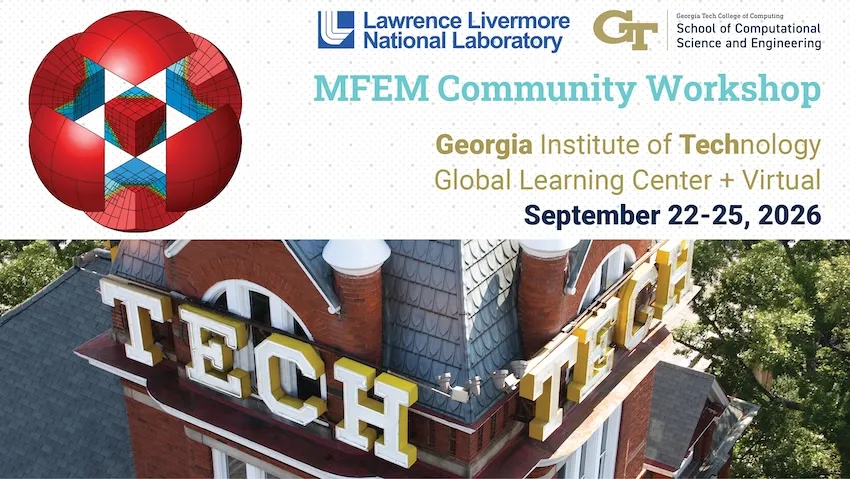
Georgia Tech is hosting the 2026 MFEM (Modular Finite Element Methods) Community Workshop, Sept. 22-25. MFEM supports research in computational physics, earth systems modeling, engineering, energy, and other fields.
The four-day workshop is being held at the Georgia Tech Global Learning Center and will focus on improving software for scientific computing and discovery. Participants can also attend online. Registration for the workshop is open through Sept. 11.
“We're very excited and grateful for the opportunity to have this workshop at Georgia Tech,” said Tzanio Kolev, a computational mathematician at Lawrence Livermore National Laboratory (LLNL).
“Georgia Tech has a great reputation in our field, and hosting at universities is a great way to connect with students. We see students as our future colleagues who will improve MFEM for generations to come.”
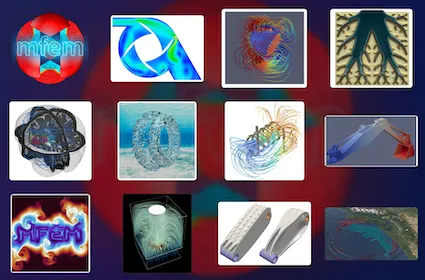
MFEM is an open-source software library for solving equations in computational models. Scientists and engineers use it to build and test virtual designs on some of the world’s most powerful supercomputers before creating real-world prototypes.
In fact, MFEM powered a tsunami early-warning model that ran on El Capitan, the world’s second-fastest supercomputer. The framework completed a simulation in a fraction of a second, 10 billion times faster than conventional algorithms. Kolev was part of the team that won the 2025 Gordon Bell Prize for the project.
MFEM’s impact extends beyond its original developers. The AWS Center for Quantum Computing uses the software as the foundation for a tool called Palace. This project runs 3D electromagnetic simulations to aid in the design of quantum computing hardware.
“These workshops have been very beneficial for both the broader user community and also for MFEM developers,” said Kolev.
“Every workshop, we are surprised by the ways people are building on our work, seeing what incredible, interesting, amazing things they do with it.”
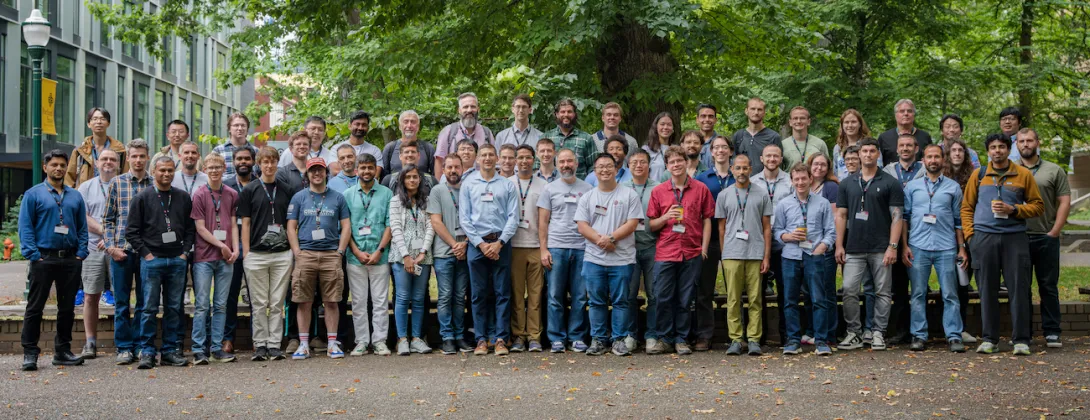
Next month’s workshop at Georgia Tech will connect MFEM users and developers from national laboratories, academia, government, and industry.
The United Kingdom Atomic Energy Authority joins LLNL and Georgia Tech in sponsoring this year’s workshop. Nearly 20 scientists from Department of Energy (DOE) laboratories are attending in person. They represent LLNL, Los Alamos National Laboratory, Princeton Plasma Physics Laboratory, and the Naval Nuclear Laboratory.
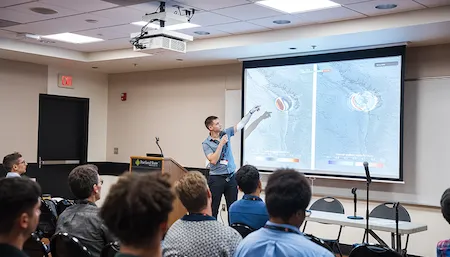
The workshop’s first day features a free, hybrid tutorial. LLNL’s High Performance Computing Innovation Center will lead the tutorial, helping new users get started with MFEM and learn what the software can do. The tutorial requires separate registration for virtual participants.
The workshop will also host a simulation and visualization contest. Participants can submit images and videos of simulations using MFEM, which will be posted in a gallery. The workshop organizers will select an overall winner.
Further workshop activities include:
- MFEM news and roadmap for future projects
- Talks from application developers
- Student-user lightning talks
- In-person poster sessions
- Office hours with MFEM experts
The MFEM workshop highlights the role open-source software plays in scientific discovery.
By making tools freely available, researchers can build on each other’s work rather than starting from scratch. This shared approach can accelerate innovation, improve software, and make advanced computing tools accessible to a wider community.
Georgia Tech hosts a Center for Scientific Software Engineering and an Open-Source Program Office. This year’s workshop connects these units with the MFEM community to help put the software into the hands of more researchers across science and engineering.
“The MFEM workshop aims to foster collaboration among all MFEM users and developers,” said Qi Tang, a workshop organizer and assistant professor in the School of Computational Science and Engineering.
“Hosting its annual community workshop brings researchers from DOE laboratories, universities, and industry to campus, giving Georgia Tech faculty and students direct access to experts from the field.”
News Contact
Bryant Wine, Communications Officer
bryant.wine@cc.gatech.edu