
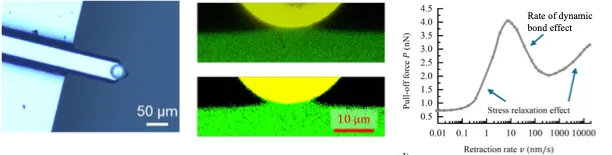
Anyone who has peeled off a bandage knows that speed matters. Conventional wisdom, and decades of adhesion research, suggest that pulling faster makes adhesive forces stronger. But researchers at Georgia Tech have discovered that soft materials can behave in a far more surprising way.
Instead of becoming steadily stickier as they are pulled apart, soft hydrogels first become less adhesive and then more adhesive as the pulling speed increases, revealing a previously unknown "sweet spot" where detachment is easier. The discovery challenges a long-held assumption in adhesion mechanics and reveals a new physical mechanism that governs how soft materials attach and detach.
"We expected the adhesion to increase continuously with pulling speed, as predicted by classical theories," said Yuhang Hu, associate professor in the George W. Woodruff School of Mechanical Engineering and the School of Chemical and Biomolecular Engineering. "Instead, we found the exact opposite over a broad range of speeds. That told us there had to be a completely different physical process at work."
Read the full story on the George W. Woodruff School of Mechanical Engineering website.
News Contact
Tracie Troha
George W. Woodruff School of Mechanical Engineering