Chris Gaffney
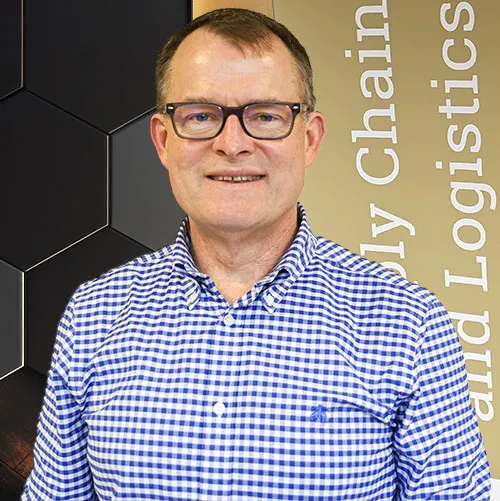
By Chris Gaffney, Managing Director of the Georgia Tech Supply Chain and Logistics Institute and a former Vice President of Global Strategic Supply Chain at The Coca-Cola Company.
Early in my career, AJC International was my introduction to the global frozen food trade. That is where I first got close to one of the stranger flows in global food: chicken feet, frozen solid and shipped across oceans to markets where they are a delicacy, not a byproduct. Nobody in that business thinks twice about it. But the whole model rests on one thing. You can hold protein at a precise temperature, without a break, across a plant, a port, a vessel, and the final mile. Lose the temperature for a few hours and you do not have a shipment. You have a claim. And nobody in the food trading business wants that.
So when my wife handed me Frostbite: How Refrigeration Changed Our Food, Our Planet, and Ourselves, she knew exactly what she was doing. She knows how much I geek out on this stuff. Nicola Twilley's history of the cold chain won the James Beard Award, and it reads like a beach read because it is built on stories and real characters, not jargon. I kept recognizing the plot. I have spent a career around protein, juice, and global cold chains, and this book is the long version of how that world got built.
How We Got Here
Twilley starts before refrigeration existed at all. For most of human history, the only way to keep food past its natural life was to change it. Salt it, smoke it, pickle it, ferment it. Flavor was not a bonus. It was the cost of survival.
Then she introduces Frederic Tudor, a Boston merchant who in the early 1800s decided he could ship frozen lake ice to the Caribbean. He failed, over and over, before it worked. Once it did, an entire industry grew up around cutting, storing, and moving naturally occurring ice, decades before anyone could manufacture cold on demand.
That sequence matters. Ice in a rail car was brute force. It proved there was demand to move perishable food across distance and time. But brute force was not the real innovation. It demonstrated the demand and created the bridge to mechanical refrigeration. The real one was mobile mechanical refrigeration, and it is worth knowing who delivered it.
The Innovators Rarely Get the Spoils
One of the harder lessons in this history is that the people who create the breakthrough are often not the ones who receive the recognition. The people who invent the breakthrough idea often are not the ones who get celebrated for it.
Frederick McKinley Jones built the first practical mobile refrigeration unit in the late 1930s. His work is the reason a refrigerated truck, rail car, ship, and eventually a reefer container with a genset became possible. He held more than sixty patents and co-founded the company that became Thermo King. And yet the recognition came a generation late. He was the first African American admitted to the American Society of Refrigeration Engineers, in 1944. He received the National Medal of Technology in 1991, thirty years after he died. The medal went to his widow at a Rose Garden ceremony. The man who rewired the global food supply spent most of his life uncelebrated relative to what he changed.
He was not the only one. John Gorrie, a physician, patented mechanical ice making in the 1850s, was ridiculed, could not raise the capital, and died broke and largely forgotten. Different men, same lesson. The breakthrough and the reward do not always land on the same person.
For anyone teaching or leading in this field, that is worth sitting with. We celebrate the optimization. We rarely trace it back to the engineer who made it possible.
Where the Supply Chain Lessons Live
This is the part of the book I would put in front of every student. Twilley keeps making one point from a dozen angles. Refrigeration did not just preserve food. It redesigned the network.
The Chicago stockyards are the clearest case. Once you can refrigerate a rail car, you no longer ship a live animal to the city and slaughter it there. You slaughter near the source and ship only the parts people eat. That one change collapsed cost, concentrated an entire industry into a few cities, and pulled population with it. The local butcher who knew the farmer and the animal gave way to a centralized, disassembly line model. Long haul trucking did the same thing again at a different scale.
Globalization did it a third time. Each time, the breakthrough did not just lower cost. It moved where the value was created and who captured it.
The smaller examples hit just as close to home, and they carry a lesson most readers will recognize from their own grocery cart. Refrigeration lets a business separate when food is harvested from when it is sold. That is postponement, and where you hold the inventory is a network design decision.
Watch how differently three products solve it. Oranges and apples are stored close to harvest, because the fruit is stable once it is cooled and the freight is cheaper after processing. I have stood in the juice tank farm in Auburndale, Florida, and the sheer scale was hard to describe. It looked like the final scene in Raiders of the Lost Ark, the government warehouse that just goes on forever. That is what it takes to make a glass of orange juice taste the same in January as it does in June, in a country where oranges grow in two states.
Bananas go the other way. They are picked green, moved green, and held in ripening rooms close to the consumer, where the gas mixture is tuned to the purchase and consumption occasion. Same physics, opposite network. The decoupling point moved because the product and the customer demanded it.
The postharvest science behind that is just as striking. Twilley notes that two apples from opposite sides of the same tree can need different cooling and atmosphere to stay sellable ten months after picking. The supply chain was no longer simply reacting to time and perishability. It could begin to optimize around these variables.
What the Network Bought Us, and What It Cost
Here is where the book earns its subtitle, and where I would add a note of caution.
Refrigeration bought us scale, lower cost, and food access no generation before us has had. It also bought us sameness. The same design choices that put apples in your store in July narrowed what gets grown. It is hard to contemplate that there are varieties of bananas and apples most of us will never taste, and tomatoes bred to survive a truck rather than to taste like anything. In many cases, we traded flavor and variety for availability and consistency, often without recognizing the tradeoff.
It bought us concentration risk, as production rolled up into fewer regions and fewer hands. It bought us rural decline, as people followed the rail line and the warehouse instead of the farm. And it carried a human cost, paid largely by the workers, many of them women and minorities, who staffed the packing houses and the cold docks and rarely got named in the story.
And there is the newest cost. The global cold chain is now one of the largest contributors to climate change, through the energy it consumes and the refrigerant gases that leak from it. As the developing world races to build the same system we built a century ago, Twilley asks the question our field should be asking too. Not just whether we can keep scaling this, but whether we should, and at what point the efficiency stops being worth the hidden cost.
The Monday Morning Takeaway
If you work in supply chain, here is what I would want you to carry out of this book.
Network design is real work, and it is roughly half the opportunity. Where you put plants, warehouses, and lanes sets the cost structure everything else lives inside. Get it right and you win for years.
But that design is not durable. Frostbite makes that point at scale, over and over. The refrigerated rail car did not improve the meatpacking network. It rebuilt it and moved an industry to different cities. Mechanical refrigeration did not improve the ice trade. It made it obsolete inside a generation. Every optimized network in this book was eventually reset by an innovation in processing, storage, or logistics that changed cost, quality, and service all at once, and usually faster than the incumbents expected.
So design your network as well as you can. Then assume it has a shelf life. The next breakthrough is already being built by someone who is not waiting for you to catch up. The job is not to declare the network finished. It is to keep watching for the technology or capability that will change the economics and force the next design.
Pick up Frostbite as you head out on your next break. It reads like a story because it is one. It also happens to be the story our profession is still living inside.