
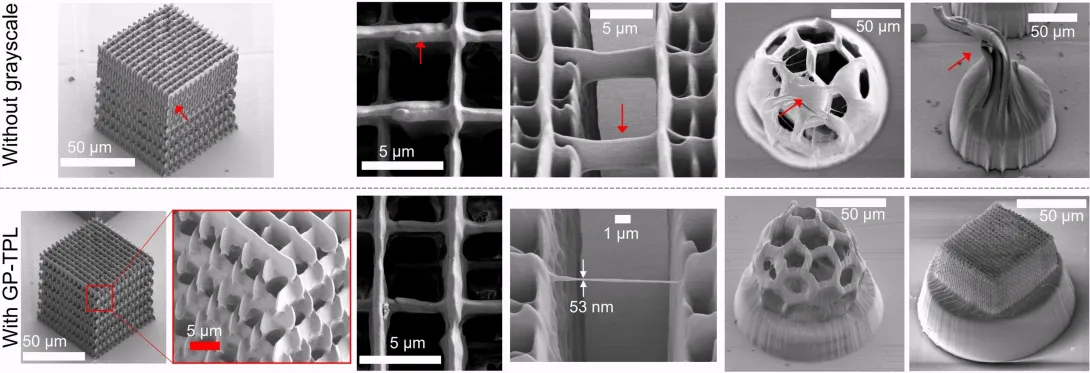
Comparison of nanoscale 3D-printed structures produced without grayscale patterning (top row) and with grayscale projection two-photon lithography (GP-TPL) (bottom row). The top row shows scanning electron microscope images with defects such as bulging struts, uneven surfaces, collapsed internal features, and distorted curved structures, highlighted by red arrows. The bottom row shows the same structures fabricated with GP-TPL, exhibiting smoother surfaces, more uniform lattice geometry, well-defined curved features, and significantly thinner, higher-fidelity bridges as narrow as 53 nanometers. Insets provide magnified views of the improved lattice quality. Scale bars range from 50 micrometers to 53 nanometers.
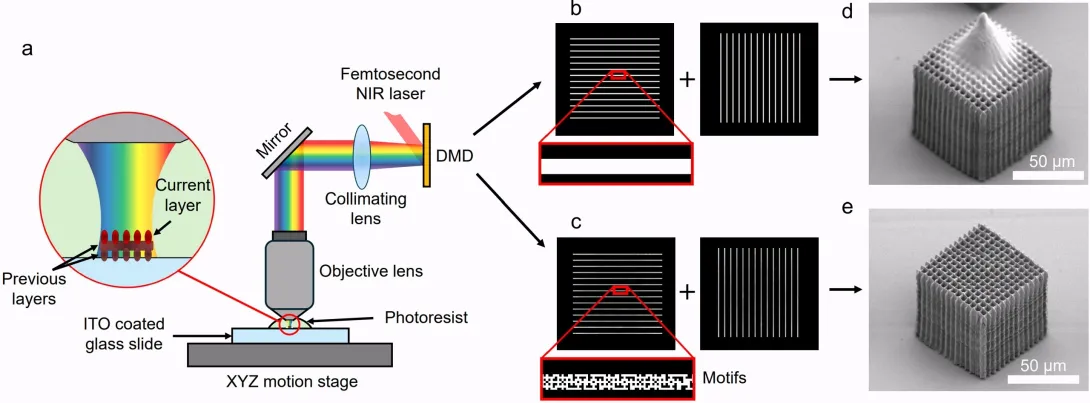
Researchers at the George W. Woodruff School of Mechanical Engineering have developed a new approach to nanoscale 3D printing that improves both speed and fidelity, overcoming a challenge that has limited the technology's broader use in manufacturing.
Their work, led by Sourabh Saha, associate professor and Woodruff Faculty Fellow, and Harnjoo Kim, who conducted the research during his doctoral studies and later as a postdoctoral fellow in Saha's lab, was recently published in the journal Nature Communications.
Nanoscale 3D printing allows researchers to create structures thousands of times smaller than the width of a human hair. These structures have potential applications in fields ranging from advanced computing and optics to biomedical devices and clean energy technologies. However, increasing printing speed often comes at the expense of quality.
Read the full story on the George W. Woodruff School of Mechanical Engineering website
News Contact
Tracie Troha
George W. Woodruff School of Mechanical Engineering