Georgia’s $41 billion forest products industry needs a transformation, and a Georgia Tech research team is reimagining how pulp mills use energy and what they can make from their byproduct streams.
For nearly a decade, Sankar Nair, professor in the School of Chemical and Biomolecular Engineering and a longtime researcher with the Renewable Bioproducts Institute (RBI), has led a collaborative effort to develop technologies that can radically improve the efficiency and profitability of kraft pulp mills.
“What began as a project to save energy in pulp production has grown into a much broader vision,” Nair explains. “We’re not just trying to make mills more efficient. We’re working to turn the kraft pulp mill into a kraft-based biorefinery that produces multiple higher-value products.”
From Energy Savings to High-Value Products
Nair explains that traditional kraft mills use a highly energy-intensive “chemical recovery loop” to handle black liquor — the dark, viscous byproduct left after pulp is separated from wood chips. That loop relies on multistage evaporators and massive recovery boilers to remove water, burn the remaining organics for steam and electricity, and recycle inorganic chemicals back into the process.
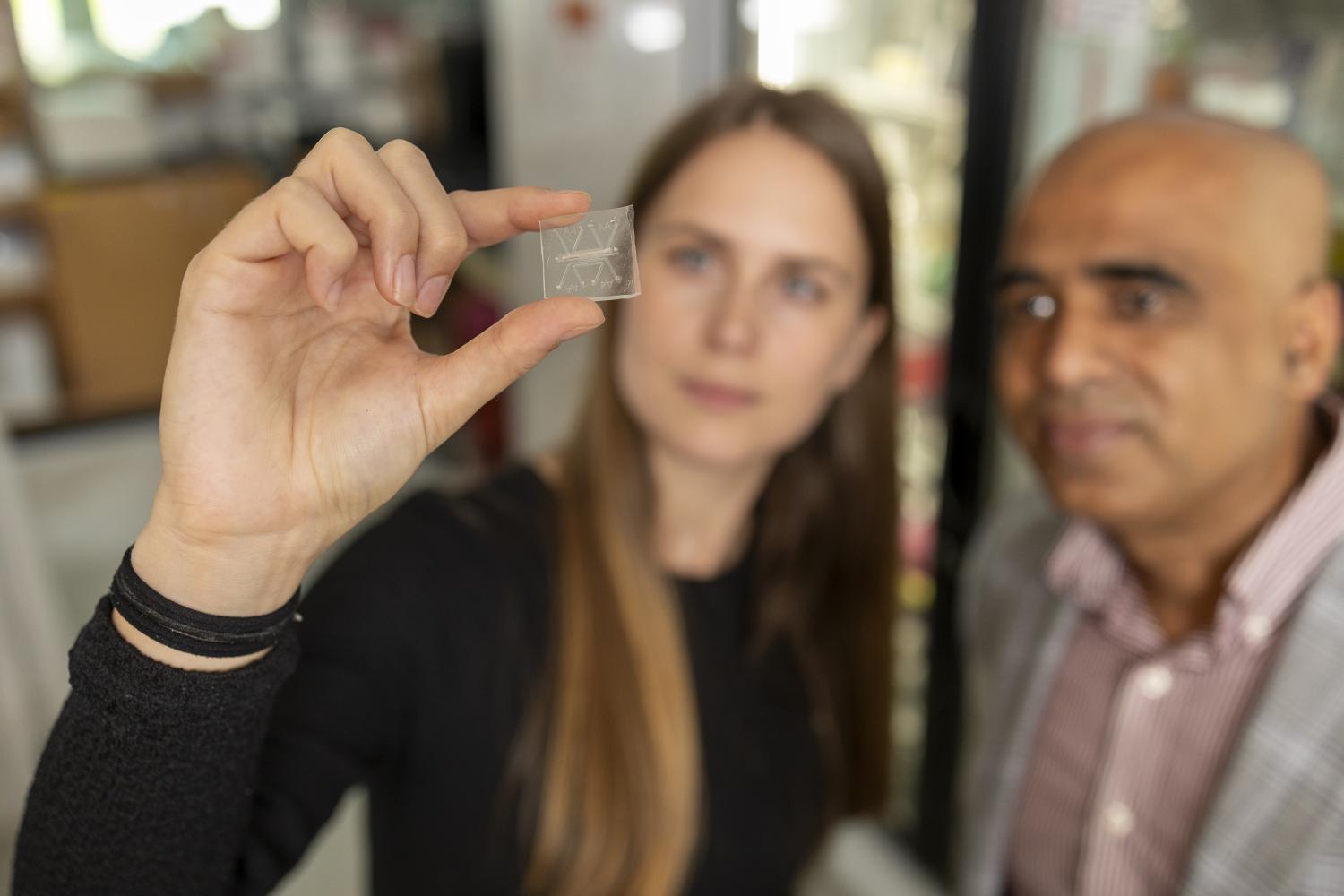
“The original desire from our industry partners was to save energy,” Nair says. “Instead of evaporating the water in black liquor, we asked whether membranes could take on most of the dewatering and potentially cut that energy use in half.”
Over time, the team realized the opportunity went well beyond efficiency. “We use these membranes in such a way that they actually fractionate the black liquor, not just dewater it,” Nair says. “One stream is rich in lignin; another is rich in organic acids. From those, we can recover and purify components and turn them into entirely new products.”
Lignin is a complex organic polymer and one of the most abundant biological materials on Earth. It acts as nature’s “glue,” providing plants with structural rigidity and resistance to decay.
From lignin-rich fractions, the team has already demonstrated carbon materials that can be tailored for battery anodes and porous adsorbents used in environmental remediation and separations — today mostly made from fossil-based carbons. These lignin-derived carbons are of particular interest as a domestic alternative to graphite, a critical battery material that is currently dominated by overseas production.
On the organic acid side, Nair and Christopher Jones, a Georgia Tech catalysis and reaction engineering expert, have gone a step further, converting those acids into mixtures of much heavier molecules that could become high-performance industrial lubricants and additives.
“It’s exciting to do a new cascade of reactions to make products that we haven’t really made before,” says Jones, the John F. Brock III School Chair and professor in the School of Chemical and Biomolecular Engineering.
Jones explains that green lubricants derived from non-fossil sources have “both high demand and high value.” Georgia Tech has not yet compared the performance of these products to conventional lubricants, but the platform is in place to do so in the future.
“The products we are pursuing from lignin and organic acids have bulk demand and also can command significantly higher prices than traditional pulp-based outputs,” Nair notes. “That’s essential if the forest products industry is going to be profitable and competitive over the long term.”
The two researchers have collaborated on three papers, with two already published in ACS Sustainable Chemistry & Engineering (June 2024) and ACS Catalysis (February 2026).
Scaling Up: Continuous Manufacturing and Field Trials
A key hurdle in moving from lab concept to mill reality is scalable manufacturing of the membranes themselves. That’s where collaboration with Georgia Tech’s advanced manufacturing community comes in.
“In recent years, we’ve really focused on how we can manufacture these membranes at low cost and in a continuous, scalable way,” Nair says. “That’s involved close collaboration with colleagues in materials science, mechanical engineering, and Georgia Tech’s manufacturing institutes.”
Another Georgia Tech collaborator, Tequila Harris, a professor in the George W. Woodruff School of Mechanical Engineering, is leading the effort to move the current small-scale batch process into a continuous, industry-ready, roll-to-roll system that can produce long sheets of reduced graphene oxide membranes.
A key enabling step to shift from batch-mode production, says Harris, was integrating vacuum pressure into the manufacturing system to support high-throughput continuous production without the use of any volatile organic solvents that are commonly used in membrane production. Harris envisions “high-quality output at production speeds above 60 meters per minute,” which will “dramatically increase production volume while reducing solvent usage and waste, such as water,” says Harris.
The technology is now mature enough for field testing. The team is preparing to deploy membrane modules at a major pulp and paper mill near Savannah operated by Rayonier Advanced Materials (RYAM).
“We’re assembling full membrane modules and installing them in a test skid that will run on real kraft black liquor from the mill,” Nair says. “We’ll collect long-term performance and reliability data that feeds into detailed models of how best to deploy these membranes in a working kraft mill.”
RYAM leaders, including Larissa Fenn, Director of New Products and Chair of the External Advisory Board for Georgia Tech’s Center for a Renewables-Based Economy From Wood (ReWOOD), help ensure that cutting-edge research remains connected to real-world industry challenges and opportunities.
“Much of our internal research is focused on supporting current operations, customers, and product lines,” Fenn says. “Partnerships with universities allow us to look five to ten years ahead and engage in transformational research that can create entirely new opportunities for our business and the broader forest products industry.”
“The transition to more sustainable materials, chemicals, and fuels represents one of the greatest opportunities our industry has seen in decades,” she adds. “Continued innovation is essential not only for maintaining competitiveness, but also for creating new markets for renewable, wood-based resources and strengthening the long-term sustainability of the forestry sector.”
Fenn emphasized that the impact extends well beyond individual companies.
“The forestry economy is the backbone of many rural communities across Georgia and throughout the Southeast,” she says. “Advancing technologies that create new value from renewable resources helps support landowners, manufacturers, and the communities that depend on this industry.”
Fenn works at RYAM’s Jesup, Georgia facility, which employs more than 800 people and is the largest employer in the local community.
“Facilities like ours are deeply connected to the communities we serve,” Fenn says. “When we invest in innovation, we are investing in the future of manufacturing, forestry, and economic opportunity in rural America.”
Modular Pathways to a Bio-Based Future
Transforming an operating mill into a full biorefinery isn’t something that happens overnight, and Nair’s group is designing with that reality in mind.
“All of these technologies are modular and designed to be fully integrated with the kraft process,” he says. “You don’t have to spend billions of dollars up front to build an entirely new plant. You can gradually integrate membrane-based fractionation and stream upgrading technologies for new product streams into the existing kraft process, and each mill can follow its own transition path.”
That modular design also provides flexibility in how mills manage energy. Diverting black liquor into higher-value products means less organic material available as fuel for the recovery boiler. Still, the energy-efficiency gains from membrane dewatering reduce overall consumption, and mills can draw on grid electricity to make up the difference.
“The goal is not to save energy for its own sake,” Nair emphasizes. “It’s to use that energy more productively to create value-added outputs that support jobs, rural communities, and a more innovative and resilient bio-based economy in Georgia.”
The urgency of this work is underscored by the pressures facing the industry: Georgia’s forestry sector has seen paper mill closures since the 1990s, due to digitization and shifts in demand, with three major mill closures in 2025. The Georgia Forestry Commission estimates that mill closures erased the market for 8.3 million tons of timber, and reduced lumber usage, import tariffs, and labor shortages compounded the crisis, according to the 2026 Georgia AG Forecast. New revenue streams and efficiency gains may be essential for mills’ survival.
Beyond kraft mills, Georgia Tech researchers are already extending the membrane platform to agricultural biomass and municipal waste streams in collaboration with partners like the University of Tennessee, Knoxville, and Texas Tech University. They are also tapping into national initiatives, including the NSF Center for Advancing Sustainable and Distributed Fertilizer Production (CASFER)and the Biobased Rural Innovation for Domestic Growth and Economic Security (BRIDGES).
Lignin-Derived Materials for the Battery Supply Chain
Matthew McDowell, co-director of the Georgia Tech Advanced Battery Center, sees many cross-sector applications for lignin-derived carbon materials, including batteries, which are increasingly foundational to strategic sectors such as mobility, the power grid, and defense.
Lignin-derived carbons can serve as a domestic replacement for graphite in lithium-ion batteries — a critical material not widely produced in the U.S.
“Conventional synthetic graphite is derived from crude oil and requires very high temperatures, making it energy-intensive and polluting,” McDowell said, noting that their goal is to convert lignin and cellulose “to high-value battery materials that could enable the growth of a new battery supply chain here in the United States.” He envisions the work one day transitioning to the Advanced Battery Center, which is planning a new facility scheduled to open at the end of 2027 that will enable companies and academic researchers to “build and test full-scale battery cells for translational R&D.”
Life-cycle analysis carried out by the team has shown benefits in both lower costs and more efficient energy use when making these carbons from biomass sources.
Today, China leads the world in battery production, with Korea and Japan also long-established leaders. The U.S. is building more domestic capability for national security and economic reasons.
Researchers at Georgia Tech on the front lines of this work also include Jones, who also collaborated on the lubricants research; Valerie Thomas, Anderson Interface Chair of Natural Systems and professor in the H. Milton Stewart School of Industrial and Systems Engineering and the Jimmy and Rosalynn Carter School of Public Policy; and Meisha Shofner, professor in the School of Materials Science and Engineering.
Thomas is leading research on life-cycle and economic analyses of converting lignin to produce “carbonized lignin” anodes that can replace petroleum‑based synthetic graphite in batteries. She says that lignin‑based graphite can displace petroleum‑derived synthetic graphite, delivering 84% lower energy use, 92% lower greenhouse gas emissions, and lower emissions of other pollutants.
“This work establishes a supply chain for making batteries, which has really broader impacts throughout Georgia,” says Thomas, who believes lignin-based battery materials will lead to a stronger forest products economy and a more resilient battery supply chain in Georgia.
McDowell agrees. “Marrying the forest products industry and the battery industry makes a lot of sense for Georgia, because both of those industries are really big,” he says, and both are “key employers in the state.” In his view, innovations could benefit both simultaneously.
Scott Sinquefield, senior research engineer in RBI, sees the graphene-oxide membrane work as squarely within its charge to modernize the forest products sector that anchors Georgia’s rural economy.
“Part of our mission is to support this industry and advance it. This falls right under our umbrella,” he said, noting that RBI has been providing scientific support to mills for nearly a century, dating back to its origins as the Institute of Paper Chemistry in 1929.
The Georgia Tech team’s vision is clear, as Nair explains: “If we can do this right, kraft mills don’t just survive. They become hubs of advanced biomanufacturing that anchor a more resilient and sustainable forest-based economy for the state.”
News Contact
Writer: Anne Wainscott-Sargent
Media Contact: Jennifer Martin | jennifer.martin@research.gatech.edu