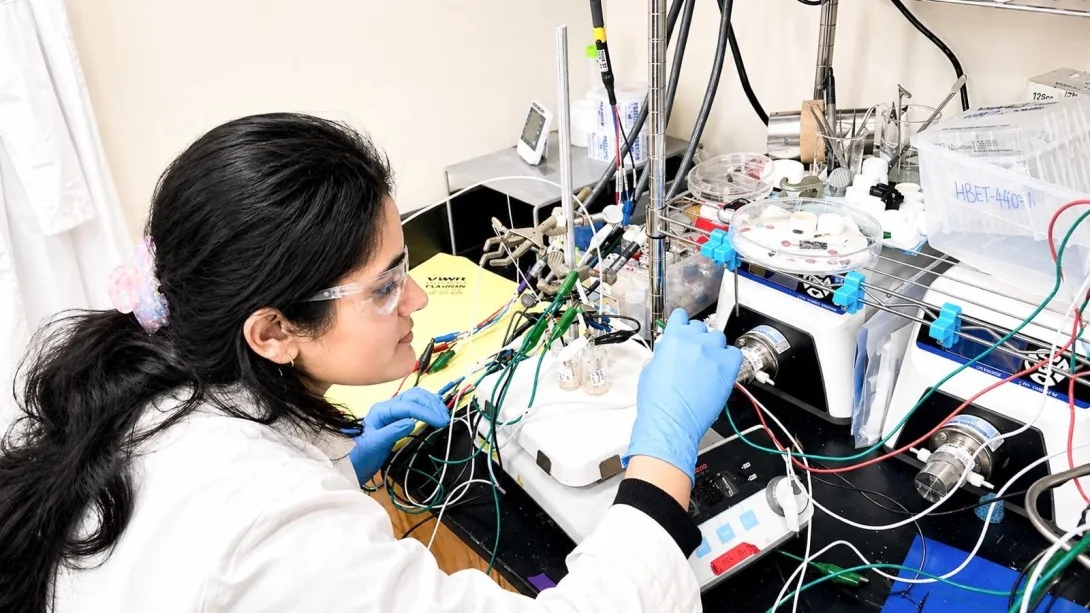
Anuja Tripathi works in a lab developing an energy and environmentally friendly method for extracting rare earth elements from coal fly ash.
Anuja Tripathi grew up in Kanpur, India, where coal fly ash from a nearby power plant coated rooftops, windowsills, and laundry hung outside to dry.
“I used to see ash settling on our terrace from time to time and thought it was just waste,” Tripathi said.
Years later, at Georgia Tech, Tripathi started looking at that ash differently. What once appeared to be ordinary industrial waste became the focal point for her work.
As a postdoctoral researcher in the School of Civil and Environmental Engineering, Tripathi, along with Ching-Hua Huang, Turnipseed Family Chair and Professor, and Xing Xie, Carlton S. Wilder Assistant Professor, both in the School of Civil and Environmental Engineering, developed a method to recover rare earth elements from coal fly ash.
Rare earth elements (REEs) help power electric vehicle motors, wind turbines, MRI machines, smartphones, and defense systems because of their unusually strong magnetic and electrical properties. Despite the name, most REEs are not actually rare in quantity. They’re rare in concentration. REEs are scattered through the Earth’s crust in amounts too small to mine easily, and much of their global supply chain remains concentrated outside of the United States.
That imbalance has turned REEs into both an economic and national security concern. Countries are competing for the materials sustaining advanced manufacturing, energy systems, and military technologies, increasing pressure to find domestic sources. That urgency has pushed researchers like Tripathi, Huang, and Xie to look at coal fly ash differently: not just as industrial waste but as a potential source of materials that modern technology depends on.
Coal naturally contains trace amounts of rare earth elements. Burning the coal concentrates those elements in the ash left behind.
Tripathi developed a method for extracting rare earth elements that avoids the corrosive chemicals used in conventional extraction. The same ash that once coated her rooftop could now become a secondary domestic source of critical materials.
Mining What Was Left Behind
Coal fly ash already exists in enormous quantities across the United States. About 2 billion tons are stored in impoundments, such as storage ponds and landfills, according to the Department of Energy.
Those sites require long-term monitoring because coal fly ash can release contaminants into soil and groundwater. Major storms can also damage storage sites and spread the material into surrounding communities and waterways.
Inside that ash, REEs are dispersed in tiny concentrations. Recovering them is a challenge; recovering them cleanly is an even greater one. Many existing recovery methods rely on concentrated acids, large amounts of water, or extreme heat during extraction. Some techniques require temperatures high enough to rival industrial furnaces. Others create additional waste streams.
Tripathi and her team wanted a different approach.
They built the system around a recyclable ionic liquid, a salt-based substance stable enough to operate under conditions that would break down water-based systems. The liquid pulls rare earth elements away from the ash. An applied electrical current then causes the recovered elements to collect onto a surface where they can be removed. Afterward, the liquid can be cleaned and reused.
“The beauty of this system is that it works beyond the limits of water,” Tripathi said.
“The ionic liquid allows us to recover rare earth elements under conditions that water-based systems just can’t handle.”
The process also changes depending on the voltage applied. At lower voltages, the system selectively recovers neodymium, an REE used in high-strength permanent magnets found in electric vehicles, wind turbines, and defense systems. At higher voltages, it recovers a broader mixture. The system recovered nearly half of the available neodymium during testing.
Beyond Coal Ash
Tripathi has shown that the chemistry works in small batches. The next challenge is scale: whether the system can recover enough rare earth elements efficiently enough to make the process commercially practical.
The same approach could extend beyond coal fly ash. Batteries, discarded electronics, and medical waste all contain valuable metals that often end up buried in landfills or destroyed during disposal.
For Tripathi, the idea began at home, where fly ash would settle on her terrace. What once seemed like an ordinary nuisance could help reshape how critical materials are recovered from waste.
Tripathi’s research is published in Environmental Science and Technology.
It was supported by the U.S. Department of Energy.
News Contact
Michelle Azriel
Senior Research Writer – Editor
Institute Communications
mazriel3@gatech.edu