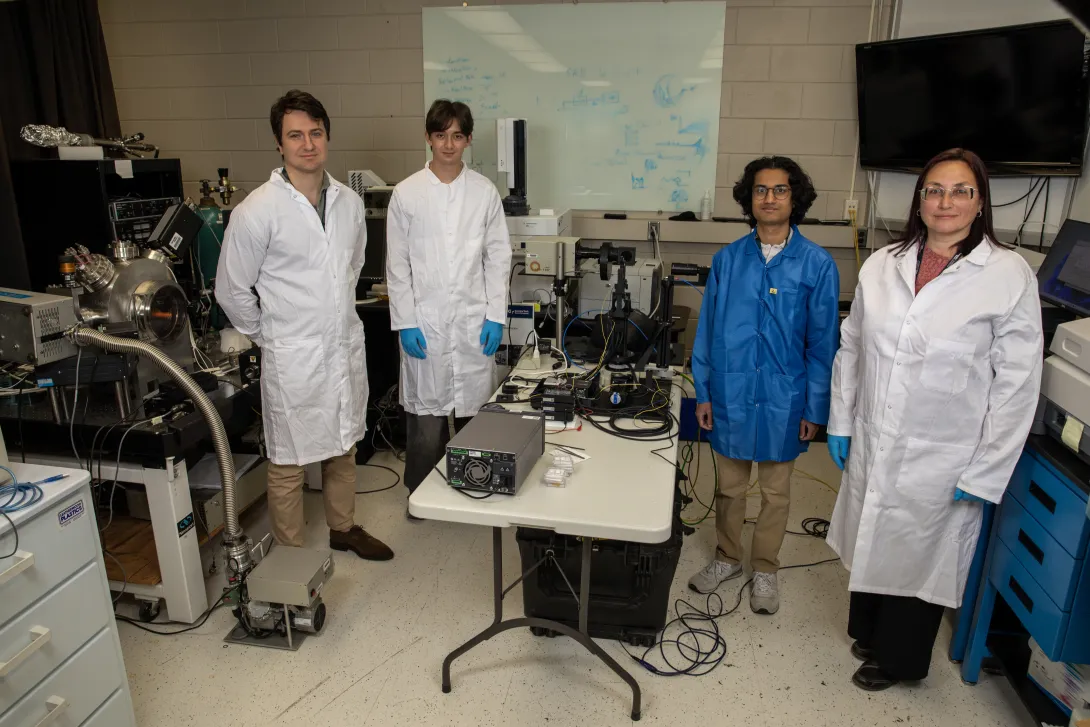
Members of the GTRI research team who helped develop and qualify materials that will be tested on the ISS during the MISSE-22 mission (Photo Credit: Sean McNeil, GTRI).
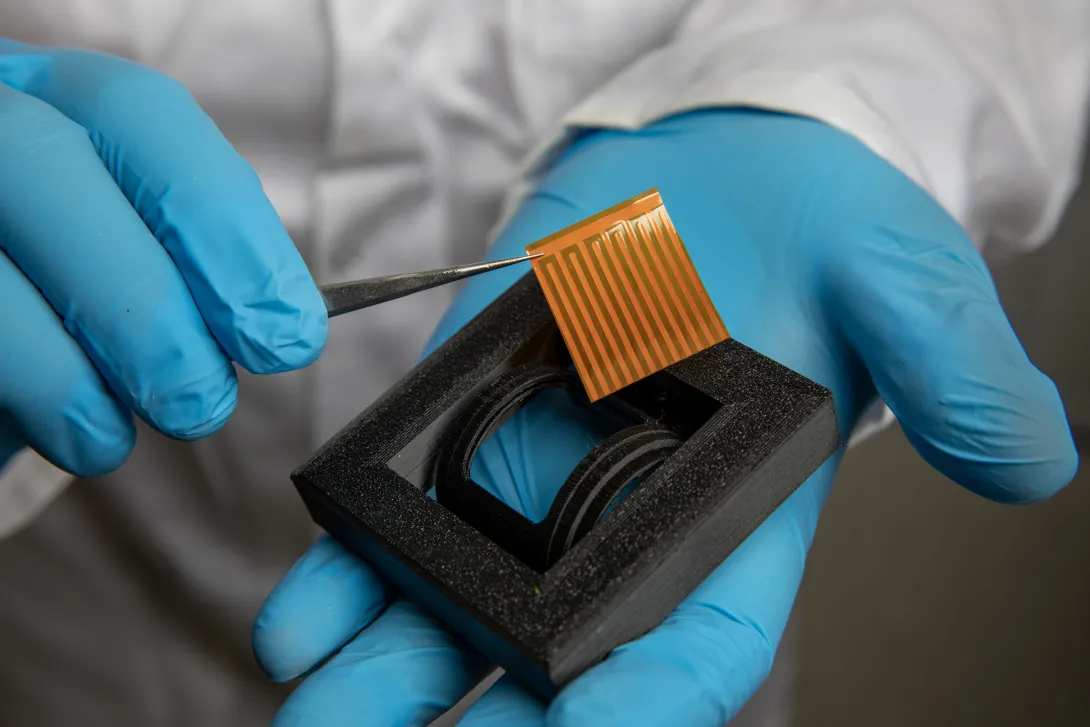
Close-up of a sample similar to those that will be sent to the ISS to study their durability in harsh space conditions (Photo Credit: Sean McNeil, GTRI).
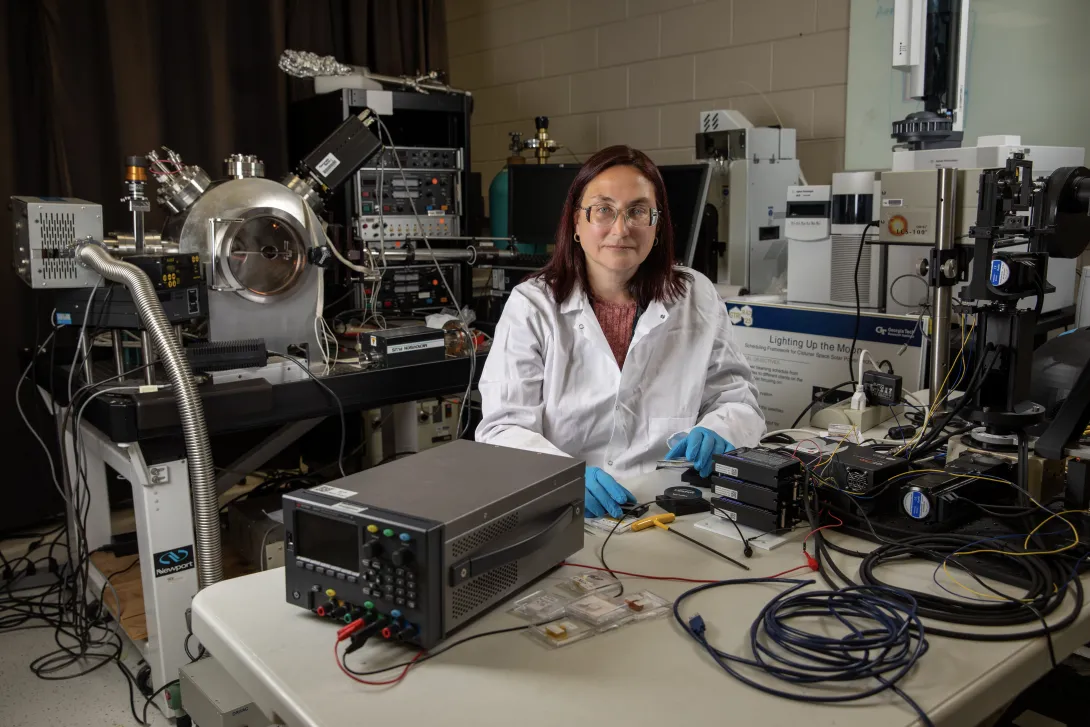
Plis and her team are sending new lightweight, research-grade polymers to the ISS for months of in-orbit exposure and later testing on Earth. Here, she is pictured in a laboratory at a GTRI facility in Atlanta, GA (Photo Credit: Sean McNeil, GTRI).
Researchers have come close to simulating space environments in Earth labs, but the combination of extreme thermal swings, complex cosmic radiation, and sustained microgravity that spacecraft experience make it impossible to capture the real thing perfectly.
Now, in a project led by the Georgia Tech Research Institute (GTRI) in collaboration with the Georgia Institute of Technology (Georgia Tech) researchers are closing the gap between Earth-based simulations and the true space environment by sending experimental materials to the International Space Station (ISS) for several months of in-orbit exposure. In a rare chance for space research, where most hardware is either left in orbit or burns up on reentry, they are getting those samples back for detailed analysis on Earth.
The materials are set to launch to the ISS in the near future as part of the Materials International Space Station Experiment 22 (MISSE-22), a testbed attached to the outside of the station. Mounted on the forward-facing side of the ISS to ensure predominant exposure to highly corrosive atomic oxygen, the test samples will spend several months enduring the extreme temperatures, radiation, and reactive environment of low Earth orbit. The team is testing a selection of lightweight, research-grade polymers designed to survive these harsh conditions. Once the samples return to Earth, engineers will examine how they held up and use that data to enhance the strategic of future satellite constellations.
This project represents a collaboration across government, academia, and industry, bringing together GTRI, Georgia Tech, the Air Force Research Laboratory (AFRL), the University of Texas at El Paso (UTEP), a California-based R&D firm Hedgefog Research Inc., and DuPont de Nemours, Inc. The research is also supported by Aegis Aerospace, which owns and operates the MISSE Flight Facility platform aboard the ISS.
Why Space is So Hard on Satellites
Harsh conditions in low Earth orbit — the region of space extending from approximately 100 miles to over 1,000 miles above Earth, where many satellites and the ISS travel — can darken, roughen, and weaken spacecraft surfaces over time. That damage shortens satellite lifetimes and requires engineers to add extra layers of protection, increasing overall logistical burden and mission costs.
Optimizing material durability is a strategic necessity, explained Elena Plis, a GTRI senior research engineer and principal investigator for the project, because every additional unit of shielding increases the cost of getting to orbit. To design lighter, more resilient materials, researchers need to examine how they degrade in a true space environment. However, most hardware is built for a one-way trip — designed to operate in orbit and then burn up on reentry, taking that valuable material data with it.
“The beauty of this type of experiment is that the materials return to Earth,” said Plis, who is also an affiliate of the Georgia Tech Space Research Institute. “For many missions, stuff is sent up and never seen again. Being able to test returned samples from real space conditions is unique, and I can’t stress enough how exciting that is for us.”
A New Generation of Polymers Head for Space
Instead of relying on familiar spacecraft materials like DuPont’s Kapton — a tough, heat-resistant polyimide plastic film that has coated spacecraft exteriors since the Apollo era — the team is sending up a set of new, lightweight, research-grade polymers. These materials are designed to improve the survivability of assets against space’s unforgiving elements.
Plis and her collaborators started with dozens of candidate materials they developed. To earn a spot on the MISSE-22, a sample has to be transparent or translucent, so light can pass through it, and researchers can examine how its optical properties change in orbit. The materials also have to be tough enough to withstand intense atomic oxygen exposure without fragmenting, which would create debris near the ISS. In the end, only a select number of the team’s materials made the cut.
The MISSE-22 testbed holds multiple experimental polymers. Instead of standard illumination, the team constructed a custom on-orbit polariscope: LEDs beneath each sample shine polarized light up through the material. A small camera system then slides over the top to capture these highly specific optical changes on a set schedule over the course of several months in space.
Using Light to Reveal Space Strain
Using polarized light and machine learning to rapidly analyze color patterns in the images they receive from orbit, the researchers can track how stress inside each sample changes over time. Periodically, the system will cycle through the materials, and the images will be downlinked to Earth.
When the extended mission ends and the samples return, the team will compare those in-orbit measurements with detailed lab tests on the actual pieces that flew. Without returned materials, they would only have images and sensor data to work from. By testing the same samples in the lab, they can check how accurate the remote measurements really are and refine their methods.
If the materials perform as expected, the results could help engineers design satellites that last longer in orbit without carrying so much protective weight —providing a significant technological advantage in space domain awareness and asset longevity.
About the Space Research Institute
The Space Research Institute (SRI) at the Georgia Institute of Technology is an interdisciplinary hub that unites faculty, staff, and students to advance research, education, and collaboration in space science and technology. Bringing together expertise across engineering, science, policy, and the humanities, SRI drives innovative projects in areas such as astrophysics, aerospace systems, astrobiology, and space policy while fostering partnerships with academia, industry, and government. As Georgia Tech’s central nexus for space-related initiatives, SRI is committed to advancing discovery, developing the future workforce, and expanding humanity’s understanding of space and its impact on life on Earth. Learn more at space.gatech.edu.
News Contact
Author:
Communications Officer II
Georgia Tech Research Institute