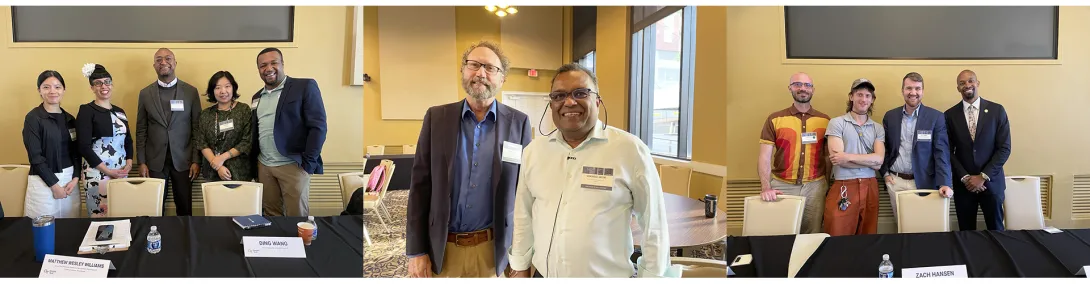
Left: panelists Cindy Lin, Celine Benoit, Matthew Williams, Ding Wang, and Kahil Bostick. Center: Michael Best and Verghese Jacob. Right: panelists Allen Hyde, Michael Czajkowski, Zachary Hansen, and Donnie Beamer. Not pictured: Peter Hubbard who joined virtually.
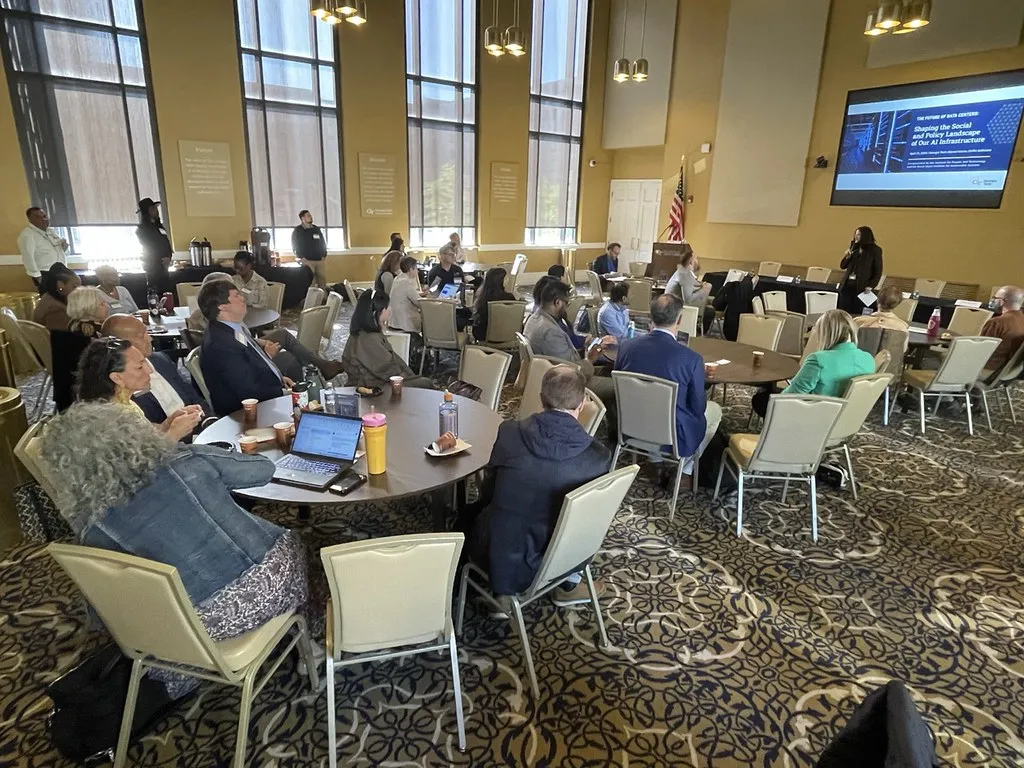
Beril Toktay delivering the welcome and introductory remarks to the attendees.
Georgia Tech hosted an event on April 21 examining the rapid expansion of data centers and the social and policy issues emerging alongside the growth of AI infrastructure. The program, The Future of Data Centers: Shaping the Social and Policy Landscape of Our AI Infrastructure, was held at the Alumni House and co-sponsored by the Institute for People and Technology and the Brook Byers Institute for Sustainable Systems (BBISS).
Georgia has become the world’s second-largest data center market, a shift that has brought economic opportunity as well as concerns about water use, energy demand, land development, and impacts on host communities. One recurring theme throughout the event was the tendency for environmental and resource issues to overshadow other important policy questions about community impact, transparency, and long-term governan
Introductory remarks were made by Beril Toktay, executive director of the Brook Byers Institute for Sustainable Systems, and Michael Best, executive director of the Institute for People and Technology.
Verghese Jacob, senior vice president of technology at the DayOne corporation, delivered the keynote address. Jacob discussed how DayOne works with governments in Asia to plan data centers and said early policy development and consistent communication can help communities better understand the impact and manage growth for long-term, mutually beneficial partnerships between governments and communities.
The event also included a BBISS Connect Workshop, led by Kristin Janacek, a senior extension professional with BBISS. The workshop built on BBISS’s Sustainability for Data Centers Insights Series and asked participants to contribute to a collaborative “blue paper” intended to guide future research partnerships and responses to funding opportunities.
Two panel discussions explored the social and political dimensions of data center development. The first, moderated by Cindy Lin, an assistant professor in the School of Interactive Computing, focused on international perspectives. Panelists included Celine Benoit of the Atlanta Regional Commission, Matthew Wesley Williams of Groundswell, Kahlil Bostick of Ryan Companies, and Ding Wang of Google Research. They discussed global examples of community-centered planning and the need for transparency in negotiations.
A second panel, moderated by Allen Hyde, an associate professor in the School of History and Sociology, examined collaboration between communities and government agencies. Panelists were Georgia Public Service Commissioner Peter Hubbard; Donnie Beamer, senior technology advisor for the City of Atlanta; Atlanta Journal-Constitution reporter Zachary Hansen; and Michael Czajkowski, director of advocacy for Science for Georgia. The group highlighted the importance of proactive regulation and clear communication with residents as data center development accelerates.
Speakers throughout the day emphasized that Atlanta’s continued growth in the data center sector will require coordinated planning and meaningful engagement with affected communities. The event closed with a call for all stakeholders to be proactive about creating policies that balance the technological and economic promise of the data center building boom with environmental and community concerns.
News Contact
Walter Rich