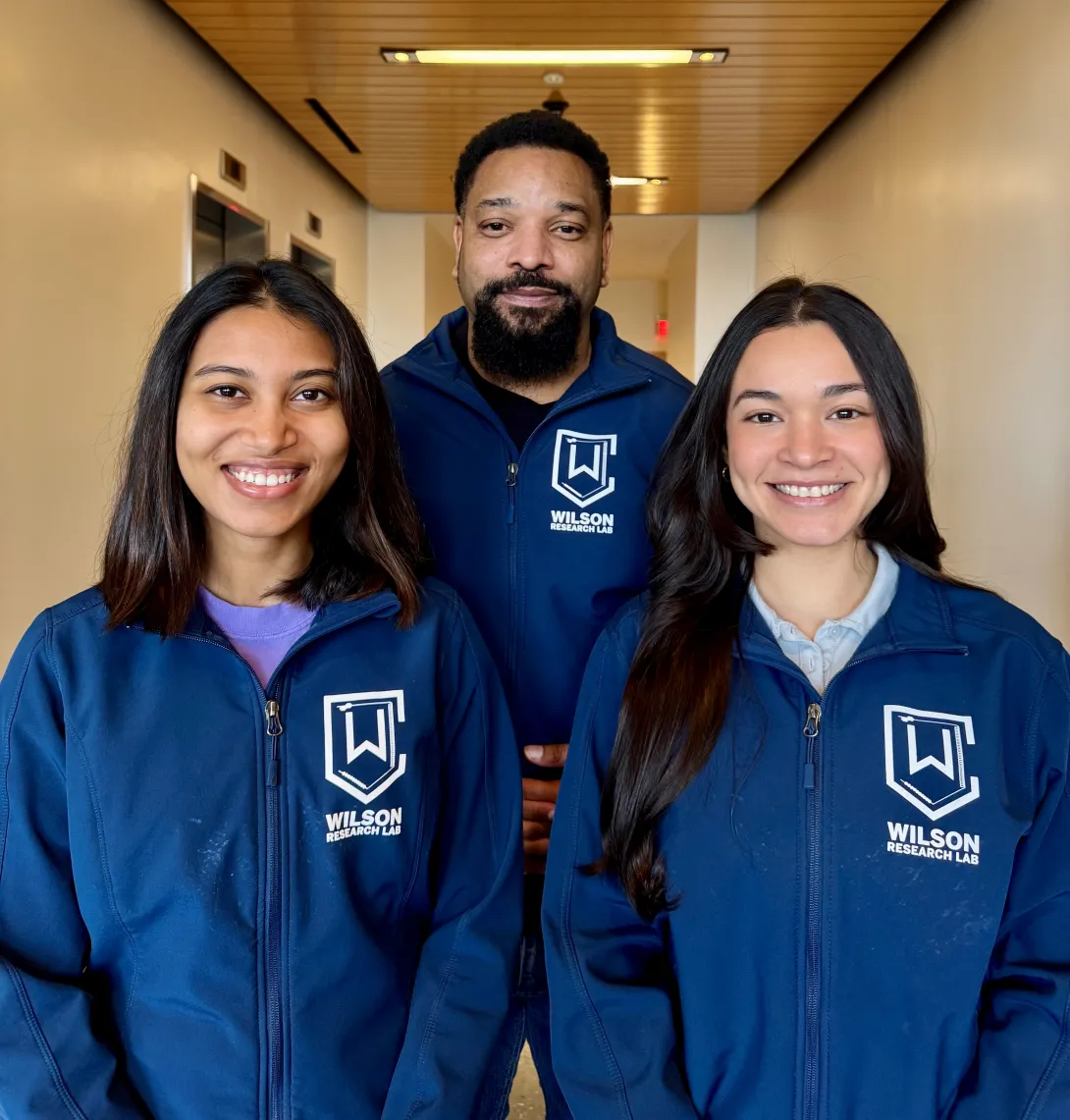
Research team members Ishita Kumar, Corey Wilson, and Luisa F. Barraza-Vergara
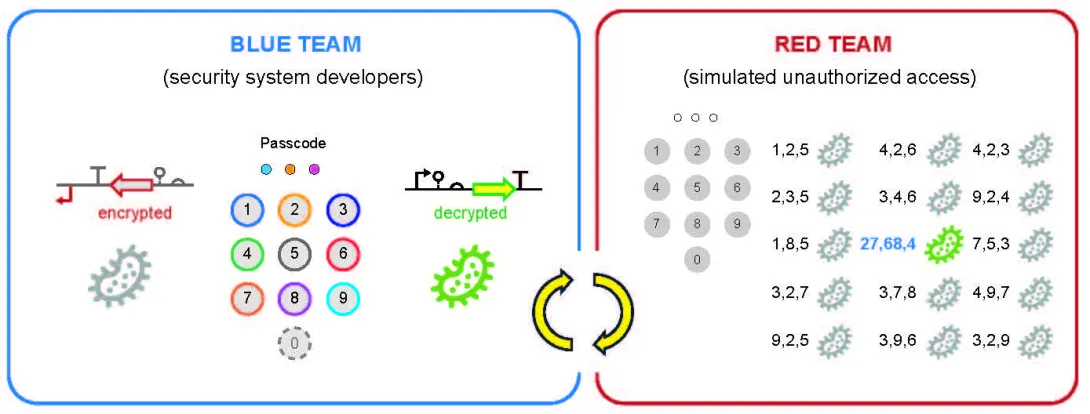
To evaluate the GeneLock technology, the researchers organized a blue team and a red team into a biohackathon.
In recent years, the Centers for Disease Control and Prevention, the Department of Homeland Security, and other authorities have flagged a record number of unauthorized shipments of biological materials. At the same time, global intelligence communities have identified numerous attempts to smuggle sensitive biological samples in efforts of industrial theft or espionage.
“A small vial of genetically engineered cells can contain multiple millions of dollars’ worth of intellectual property and require several years of work to develop,” said Corey Wilson, a professor in Georgia Tech’s School of Chemical and Biomolecular Engineering (ChBE). “Accordingly, the protection of high-value engineered cell lines has become critically important to the biotechnology industry.”
Wilson and his research team have published their findings in Science Advances demonstrating the effectiveness of their new biological security technology, known as GeneLock™, in protecting high-value engineered cell lines.
GeneLock is a cybersecurity-inspired technology that protects valuable genetic material directly at the DNA level. To demonstrate its strength, Wilson’s team conducted what they describe as a first-of-its-kind biohackathon, detailed in the new paper, to simulate unauthorized access.
“GeneLock greatly improves our ability to protect high-value engineered cell lines by expanding security from the lab environment to the genetic level,” Wilson said.
Economic Impact
What are the stakes? Estimates place the global market for high-value genetic materials at more than $1.5 trillion, projected to reach $8 trillion by 2035. The use of these materials ranges from advanced medicines and proprietary research enzymes to specialty chemicals and sustainable materials.
Currently, the protection of high-value cell lines depends on physical safeguards such as restricted lab access and secure facilities, Wilson explained.
“The key weakness of physical security measures is once circumvented, there are typically no measures in place to protect valuable cells from theft, abuse, or unauthorized use,” Wilson said.
“Once a sample leaves the building, the DNA it carries typically remains fully functional. This is like placing an unlocked cellphone in a desk drawer. Anyone who gains access to the drawer can view sensitive content on the phone—or in this case will have full access to the valuable cell line.”
Genetic Passcode Protection
The GeneLock biological security technology developed by Wilson and his team places a passcode on engineered cells, akin to those used on ATM machines and protected cellphones.
Instead of leaving a valuable gene in readable form, the team scrambles the DNA sequence of interest. The scrambled genetic asset remains in a nonfunctional state unless the living cell where it resides receives the correct sequence of chemical inputs. Those inputs act as a molecular passcode.
“Only the right combination, delivered in the right order, rearranges the DNA into a working form,” Wilson said.
Biohackathon Security Test
To evaluate the technology, the researchers organized a blue team and a red team in what they describe as an ethical biohackathon. The blue team designed the encrypted DNA sequence, while the red team was challenged to discover the correct chemical passcode through experimentation in a gray box exercise, meaning the red team had partial knowledge of the system but did not have access to the internal designs.
“This approach for testing security strength is commonly used in cybersecurity,” Wilson explained.
The blue team engineered the system inside Escherichia coli, or E. coli, a bacterium widely used in biotechnology. The protected asset was a fluorescent protein gene selected as a measurable stand-in for commercially valuable targets. When the correct chemical sequence was applied, the fluorescence turned on. Without the correct passcode, the gene remained scrambled and the cells could not fluoresce green.
“In practice, most DNA sequences produce valuable proteins or chemicals that are essentially invisible to the human eye, requiring specialized devices or experiments to observe,” Wilson said. “If the biohackathon were conducted with a standard commercially valuable target, the penetration testing would have taken more than 10 times longer to complete, years instead of months.”
The biohackathon results showed a dramatic reduction in risk. GeneLock reduced the probability of unlocking the genetic asset by random search to about 1 in 85,000 (a 0.001% chance), assuming the unauthorized user had access to the required chemical inputs.
Without access to those inputs, “the likelihood of success by chance becomes effectively negligible,” said Dowan Kim (Georgia Tech PhD 2024), co-lead author of the study.
Commercial Uses and What’s Next
Although the researchers used a non-commercial fluorescent protein as a test case, the implications extend much further. Many biotechnology companies rely on proprietary engineered strains. New England Biolabs, for example, produces more than 265 non-disclosed enzymes in E. coli, each representing a high-value cell line.
Protein-based drugs are also manufactured in living cells, and proprietary metabolic pathways are used to produce specialty chemicals, bioplastics, and high-value ingredients.
“In each case, the genetic blueprint inside the cell represents intellectual property that can be protected by our technology,” said Ishita Kumar, a PhD candidate in ChBE and co-lead author of the study.
While the team’s current focus is on protecting intellectual property in the form of high-value cells, future iterations aim to strengthen biological security more broadly.
“We are currently developing protection measures to mitigate unauthorized use or release of sensitive cell lines that can be potentially hazardous to human health or the environment,” Wilson said.
“As it stands, GeneLock represents an important shift in biological security, enabling, for the first time, protection of valuable cells at the genetic level, even after physical security measures have been bypassed,” he added.
The work is already moving toward commercialization. The team filed a provisional patent application with the U.S. Patent and Trademark Office in February 2026 and is forming a company to deploy the technology.
This research was funded by a grant from the National Science Foundation.
CITATION:
Dowan Kim, Ishita Kumar, Mohamed Hassan, Luisa F. Barraza-Vergara, Christopher A. Voigt, and Corey J. Wilson, “Protecting cells at the genetic level and simulating unauthorized access via a biohackathon,” Science Advances, 2026.
News Contact
Brad Dixon, braddixon@gatech.edu