
As Georgia Tech celebrates the 50th anniversary ofthe matriculation of African-American students, the Institute is proud of theachievements of the FACES program in bringing diversity to science andengineering education.
Since 1998, more than 300 minority students earned theirdoctorate in science, technology, engineering and math, thanks in part to theFACES program.
Georgia Tech ranked no. 1 in the U.S. last year for awardingthe most engineering doctoral degrees to African-American students and allminority students, according to DiverseIssues in Higher Education.
Georgia Tech oversees the FACES program, which stands forFacilitating Academic Careers in Engineering and Science, in partnership withEmory University, Morehouse College and Spelman College. The National ScienceFoundation funds the program.
“Over the last decade, the FACES program has contributedsignificantly to the formation of an environment at Georgia Tech in which thecompletion of a STEM doctorate and consideration of an academic career arevalued by talented minority students and supported by the campus," saidGary May, Georgia Tech’s Steve W. Chaddick School Chair of the School ofElectrical and Computer Engineering. "We are very proud of what has beencreated here and look forward to the contributions of our students as theypursue their careers."
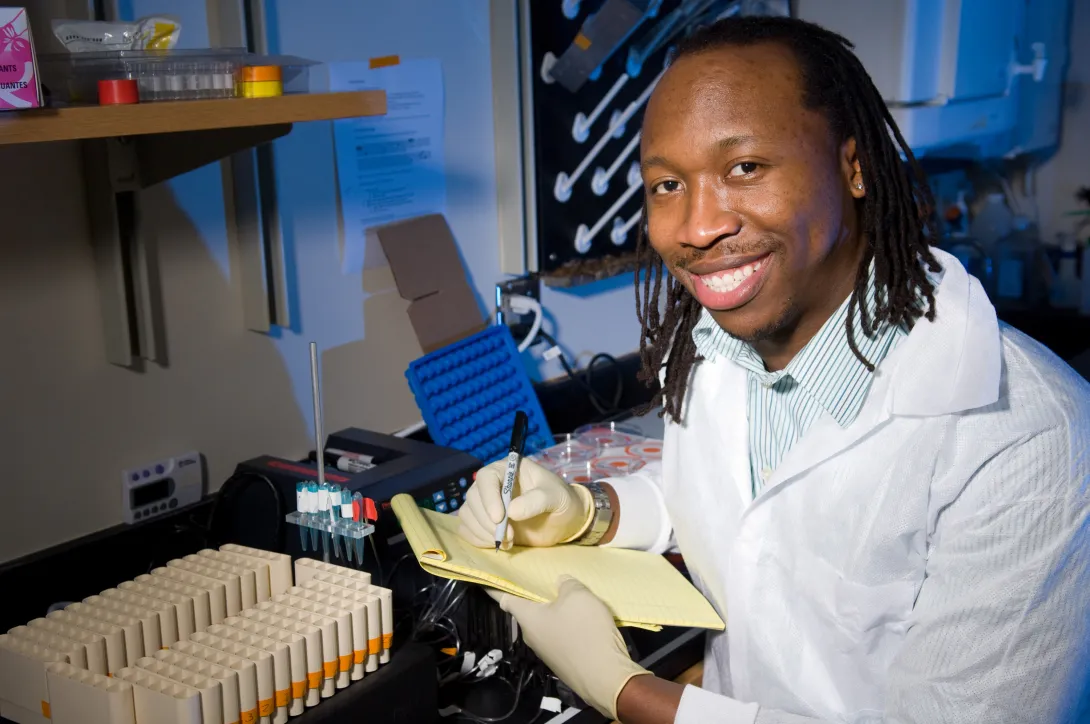
A shining example of the FACES program’s success is ManuPlatt, assistant professor of biomedical engineering in the Wallace H. CoulterDepartment of Biomedical Engineering at Georgia Tech and Emory University.
Platt not only received a FACES grant that allowed him topursue professional development while a postdoctoral fellow at M.I.T., but alsoreceived the FACES Career Initiation Grant when he joined the Georgia Techfaculty in 2009 to kick-start his research.
Platt, who this fall received a $1.5 million NIH Director'sNew Innovator Award to support his research on reducing stroke in children withsickle cell disease, said the prestige of being a FACES recipient has enriched hiscareer.
“Georgia Tech is a special place to be such a top-qualityengineering school and to have a diverse faculty,” Platt said. “I probably wouldn’t be as happy as aprofessor as I am today without the FACES program. Truly, I wouldn’t have theopportunity to be mentored by the African-American professors who helped mebuild a community and have showed me how to avoid the brick walls that youinevitably run into."
Today, Platt sits on the FACES steering committee thatoversees the program and helps mentor African-American undergraduate andgraduate students from Georgia Tech, Emory, Morehouse and Spelman, who willbecome the next generation of STEM professors.
“I enjoy just talking to them and selling them on why beinga professor is so great,” Platt said. “You get to see students develop, learnand grow, and eventually move forward with their career.”
The FACES program includes three components:
- The Summer Undergraduate ResearchEngineering/Science (SURE) program seeks to motivate African-Americans to entergraduate school. Students of at least junior level are recruited on anationwide basis and paired with both a faculty and a graduate mentor toundertake research projects. SURE students are housed on campus and areprovided with a $5,000 stipend, $600 travel allowance and a meal plan.
- For graduate students who are committed topursuing doctorates, the FACES Fellowship provides an add-on stipend of either$3,000 or $5,000 per year, depending on the status of the student's Ph.D.candidacy. In addition to receivingmonetary support, the FACES Fellows participate in workshops designed to helpthem excel in graduate school and prepare them for careers in research andacademia.
- The FACES program also supports future facultydevelopment. Each year, one promisingscientist who accepts a postdoctoral position in engineering or science at anyU.S. college or university is awarded a $35,000 grant, money that he or she cantake with them, as Platt did. FACES also awards two $30,000 Career InitiationGrants to doctoral students who accept a tenure track faculty position in anengineering or science-related field at a U.S. college or university.
All of the pieces of FACES contribute to the program’ssuccess, May said.
“At Georgia Tech, we’ve seen that a key factor for motivatingstudents to pursue advanced degrees and research careers in science andengineering is fruitful research experiences,” he said. “Quality interactionswith engineering faculty can have a significant impact on a student’s decisionto pursue graduate education.”
News Contact
Georgia Tech Media Relations
Laura Diamond
laura.diamond@comm.gatech.edu
404-894-6016
Jason Maderer
maderer@gatech.edu
404-660-2926